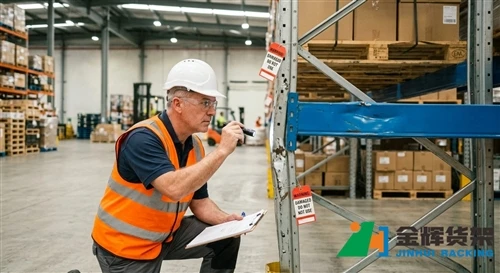
A warehouse can have thousands of pallet positions and still struggle with slow picking, unnecessary forklift travel, and difficult inventory management.
The problem is often not the pallet racking itself. It is how inventory is organized within the available storage space.
When fast-moving products are stored too far from shipping areas, frequently accessed SKUs are placed in difficult-to-reach locations, or large quantities of the same product are spread across multiple rack zones, warehouse operators may spend more time searching, traveling, and repositioning pallets than necessary.
For this reason, pallet racking organization should be based on more than available storage capacity. SKU variety, inventory turnover, pallet quantity, product weight, picking frequency, and shipping patterns should all influence where products are stored.
A practical warehouse storage strategy matches the characteristics of each inventory category with an appropriate rack location and, where necessary, a different pallet racking configuration.
Quick Answer
The most effective way to organize pallet racking is to classify inventory by SKU variety, pallet quantity, turnover rate, weight, and accessibility requirements. Fast-moving products should generally be positioned for easy and quick retrieval, while slower-moving or bulk inventory can be placed in higher-density storage locations.
Why SKU Organization Matters in Pallet Racking
SKU means Stock Keeping Unit, and each SKU can have a different demand pattern.
One product may be shipped dozens of times every day, while another may remain in storage for several months.
If both products are treated exactly the same way, warehouse space may be used inefficiently.
For example, imagine a distribution warehouse with 1,000 SKUs:
- 100 SKUs account for most daily pallet movements.
- 300 SKUs have moderate demand.
- 600 SKUs move only occasionally.
Giving every SKU the same storage priority would ignore the actual movement pattern of the inventory.
A better approach is to organize the warehouse according to demand and operational importance.
Start With Inventory Turnover
Inventory turnover is one of the most useful criteria for organizing pallet storage.
A simple classification can divide inventory into three groups:
| Inventory Category | Typical Movement | Storage Priority |
|---|---|---|
| Fast-moving | Frequent daily or weekly movement | Accessibility and short travel distance |
| Medium-moving | Regular but moderate movement | Balanced accessibility and capacity |
| Slow-moving | Occasional movement | Storage density and space utilization |
This classification does not require every warehouse to use exactly the same percentage or turnover threshold. The appropriate definition depends on the company's order volume and operating model.
The important principle is to recognize that not every pallet needs the same level of accessibility.
Where Should Fast-Moving Pallets Be Stored?
Fast-moving inventory generally deserves the easiest access.
In a conventional pallet racking system, fast-moving SKUs can be positioned closer to the main picking, staging, or shipping areas when the warehouse layout allows it.
This can reduce forklift travel distance and improve the speed of pallet retrieval.
Fast-moving products can also benefit from storage positions that minimize complicated maneuvering.
Depending on the warehouse operation, this may mean:
- Lower rack levels for frequently accessed pallets
- Rack positions near shipping or dispatch areas
- Direct-access selective pallet racking
- Dedicated forward storage locations
- Clearly labeled high-visibility locations
The goal is not simply to put fast-moving inventory on the lowest possible beam. The storage position should be selected based on the entire material flow.
Why Fast-Moving Inventory Should Not Always Be Stored in High-Density Racks
High-density storage systems can provide excellent space utilization, but storage density and accessibility are not the same thing.
For example, push back racking can store multiple pallets deep in a single lane.
This is useful when several pallets of the same product are stored together.
However, if warehouse operators frequently need to retrieve different individual pallets, direct-access storage may be more convenient.
Therefore, the question should not be:
"Which rack stores the most pallets?"
It should be:
"Which rack provides the right balance between storage density and the way this inventory is actually handled?"
How to Organize Slow-Moving Inventory
Slow-moving inventory has different storage priorities.
If a pallet may remain in storage for weeks or months, it may not need to occupy one of the warehouse's most accessible positions.
Depending on SKU characteristics, slow-moving inventory can be allocated to:
- Higher rack levels
- Remote storage zones
- Reserve inventory areas
- Double-deep storage
- Push back storage
- Drive-in storage
- Shuttle-based high-density storage
This allows the warehouse to reserve highly accessible locations for inventory that generates more frequent pallet movements.
However, slow-moving does not mean unimportant. Products with low turnover may still have critical customer or production requirements, so the storage system should maintain accurate location control.
How SKU Quantity per Product Affects Rack Selection
Inventory turnover is only one part of the decision.
The number of pallets stored for each SKU also matters.
Consider two products:
- SKU A: 1 pallet, moved frequently
- SKU B: 20 pallets, moved frequently
Both products are fast-moving, but they do not necessarily require the same storage configuration.
SKU A benefits strongly from direct access because there is only one pallet.
SKU B may justify a higher-density solution because many pallets of the same SKU can share a storage lane.
This is why SKU variety and pallet quantity per SKU should be analyzed together.
High SKU Variety Usually Favors Selective Pallet Racking
Selective pallet racking is particularly useful when a warehouse handles a large number of SKUs.
Each pallet position can be independently accessed, allowing operators to store many different products within the same rack system.
This makes selective racking suitable for:
- Distribution centers
- Manufacturing warehouses
- Retail warehouses
- 3PL facilities
- Spare parts warehouses
- General industrial storage
Its flexibility also makes it easier to adjust storage allocation as SKU demand changes.
For warehouses with hundreds or thousands of different products, direct accessibility can be more valuable than maximizing the number of pallets stored in each individual rack lane.
When High-Density Racking Makes More Sense
High-density pallet storage becomes more attractive when the warehouse stores many pallets of the same or similar SKU.
For example, a manufacturer may produce a particular product in large batches and temporarily store hundreds of pallets before shipment.
In this situation, storing each pallet in a separate selective rack position may use more aisle space than necessary.
Depending on inventory rotation and access requirements, the warehouse could evaluate:
- Drive-in pallet racking
- Push back pallet racking
- Double deep pallet racking
- Radio shuttle pallet racking
- Pallet flow racking
The correct system depends on whether the warehouse prioritizes LIFO, FIFO, direct access, or maximum storage density.
Use ABC Analysis to Prioritize Pallet Locations
Many warehouses use an ABC approach to classify inventory according to its operational importance or movement volume.
A simple pallet storage version can look like this:
A Items: High movement or high operational importance
B Items: Medium movement and regular demand
C Items: Low movement or long storage periods
The warehouse can then assign different storage priorities.
| Class | Storage Strategy | Possible Location |
|---|---|---|
| A | Maximum accessibility | Prime rack positions / near shipping |
| B | Balanced accessibility and capacity | Standard rack locations |
| C | Storage density | Upper levels / reserve zones / deep storage |
ABC classification should be based on the warehouse's actual data rather than a generic percentage.
How to Organize Pallets by Product Family
Grouping related products can make warehouse operations easier to understand.
For example, an industrial parts warehouse might organize rack zones into:
- Automotive components
- Electrical components
- Mechanical components
- Packaging materials
- Finished assemblies
This can reduce product searching and simplify replenishment.
However, product-family grouping should not completely override turnover analysis.
If one SKU within a product family has extremely high demand, it may still be better to position that SKU closer to the main operating area.
The best layout often combines product family + turnover + pallet quantity.
Separate Reserve Storage From Forward Storage
One effective strategy for larger warehouses is to divide inventory into reserve and forward storage.
Reserve storage holds additional inventory that is not immediately required.
Forward storage holds a smaller quantity in a convenient location for frequent picking or replenishment.
The basic flow can be represented as:
High-Density Reserve Storage → Forward Picking Storage → Shipping / Production
This approach can be useful when an SKU has both high demand and large overall inventory volume.
Instead of placing all inventory in premium locations, only the quantity required for short-term operations needs to remain in the forward area.
How Pallet Rack Height Can Be Used for Slow-Moving Stock
Vertical space is valuable in warehouses, but not every pallet needs to occupy a low-level position.
Where rack design, product characteristics, forklift capability, and applicable safety requirements permit, slower-moving inventory can be allocated to higher storage levels.
This leaves more accessible positions available for products that move frequently.
However, operators should never treat upper rack positions as unlimited storage space. Rack load ratings, pallet condition, forklift lift height, building clearance, sprinkler requirements, and safe operating practices must all be considered.
How Weight Should Influence Pallet Location
SKU organization should also consider pallet weight.
Heavy pallets can require different rack configurations and handling procedures from lightweight products.
For example, heavy industrial components may be better positioned at lower levels depending on the rack design and operating requirements.
Before assigning products to rack locations, warehouse managers should know:
- Maximum pallet weight
- Average pallet weight
- Pallet dimensions
- Load stability
- Product packaging
- Forklift capacity
Rack capacity should always be based on the engineered system rating rather than simply assuming that every pallet position can carry the same load.
For more information on rack load considerations, see How to Calculate Pallet Rack Load Capacity.
How Inventory Rotation Changes Storage Organization
Not all warehouses use the same inventory rotation method.
Some products require FIFO, while others can be managed using LIFO.
FIFO - First In, First Out is commonly important when product age, production date, or shelf life matters.
LIFO - Last In, First Out can be suitable for certain bulk storage applications where inventory rotation does not require the oldest pallet to be picked first.
For FIFO operations, pallet flow racking may be considered because loading and retrieval can take place from opposite sides of the rack.
For suitable LIFO inventory, systems such as drive-in or push back racking may provide higher storage density.
Why Product Demand Should Influence Rack Location
Warehouse managers often know which products sell or move the most, but this information is not always reflected in the rack layout.
A product that generates hundreds of pallet movements each month can create a significant amount of forklift traffic.
If that product is stored at the far end of the warehouse, the cumulative travel distance can become substantial.
Moving high-demand products closer to the relevant receiving, picking, production, or shipping area can reduce unnecessary travel.
This is one of the simplest ways to improve warehouse efficiency without necessarily purchasing more racks.

A warehouse can organize pallet rack zones according to inventory turnover, SKU quantity, and accessibility requirements.
How to Reduce Forklift Travel With Better Rack Organization
Forklift travel is one of the hidden costs of poor warehouse organization.
Every pallet movement requires time, and repeated long-distance travel can reduce the number of pallets an operator can handle during a shift.
To reduce unnecessary travel, consider:
- Placing fast-moving products closer to shipping
- Locating production materials near production areas
- Grouping related SKUs
- Creating clear forward-picking zones
- Using high-density storage for suitable reserve inventory
- Reducing unnecessary cross-warehouse movements
However, traffic should not be concentrated into a single narrow area simply to shorten distances. A warehouse layout must still provide appropriate forklift clearance and safe traffic flow.
How to Organize Pallet Racking for Manufacturing Warehouses
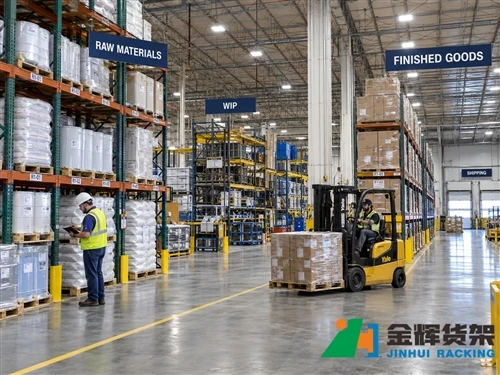
Manufacturing warehouses often have three major inventory stages:
- Raw materials
- Work-in-process materials
- Finished goods
These categories may have very different storage requirements.
Raw materials used frequently by production can be placed closer to manufacturing areas.
Bulk raw materials with lower movement frequency can be placed in higher-density reserve storage.
Finished goods should be organized according to shipping frequency and customer order patterns.
For a more detailed discussion of factory storage requirements, see How to Choose Pallet Racking for a Manufacturing Warehouse.
How to Organize a 3PL Warehouse by Client and SKU
Third-party logistics warehouses have another layer of complexity because the inventory belongs to different customers.
A 3PL facility may need to organize storage by:
- Customer account
- SKU
- Product family
- Turnover
- Order frequency
- Special handling requirements
For some 3PL operations, direct-access selective racking is valuable because different customers can have many low-volume SKUs.
For customers with large quantities of identical pallets, higher-density systems may be more appropriate.
This is why a 3PL warehouse should evaluate inventory profiles separately instead of applying one rack configuration to every customer.
For additional guidance, read How to Choose Pallet Racking for a 3PL Warehouse.
How to Organize Pallet Rack Locations With Labels
Good physical organization should be supported by clear location identification.
Each rack position should have a logical location code that allows operators and warehouse management systems to identify it quickly.
A location code might contain:
- Aisle number
- Rack section
- Bay number
- Level number
- Position number
For example, a warehouse could use a structure such as:
A03 - B12 - L03 - P02
The exact coding system can vary, but consistency is more important than the specific format.
Keep the Physical Layout Consistent With the Warehouse Management System
A well-organized rack layout is only effective if the digital inventory record matches the physical location.
If the warehouse management system says a pallet is in one location while the pallet is physically stored somewhere else, operators may waste time searching for it.
Therefore, changes to rack locations should be reflected in inventory records.
This is especially important when:
- SKUs change frequently
- Temporary storage is used
- Seasonal inventory is added
- Products move between zones
- New rack bays are installed
What to Do When Inventory Demand Changes
Warehouse organization should not be considered permanent.
A product that is classified as slow-moving today may become a high-volume SKU next year.
Likewise, a product that was once a major seller may eventually become obsolete.
Warehouse managers should periodically review:
- Pallet movement frequency
- SKU demand
- Average storage duration
- Order frequency
- Forklift travel distance
- Rack occupancy
- Unused storage positions
When demand changes significantly, rack locations should be reconsidered.
Common Pallet Racking Organization Mistakes
Mistake 1: Storing Every SKU Alphabetically
Alphabetical organization may appear simple, but it does not necessarily reflect product movement. A high-volume SKU may be located far from the shipping area simply because of its name.
Mistake 2: Giving Every Product the Same Storage Priority
High-turnover and low-turnover products have different operational requirements.
Mistake 3: Using High-Density Storage for High-Frequency Picking
Maximum storage density can come at the cost of accessibility. Deep storage should be matched to suitable inventory.
Mistake 4: Ignoring Pallet Quantity per SKU
A SKU stored as one pallet has different storage requirements from a SKU stored as 50 pallets.
Mistake 5: Never Reorganizing the Warehouse
Inventory demand changes. A warehouse layout that was efficient several years ago may no longer match current business conditions.
A Practical Pallet Racking Organization Strategy
For many warehouses, the following process provides a useful starting point:
- List all SKUs. Record pallet dimensions, weight, and quantity.
- Measure movement. Identify which SKUs move most frequently.
- Classify inventory. Divide products into fast, medium, and slow-moving categories.
- Check pallet quantities. Identify products stored in large batches.
- Match rack type. Use direct-access or high-density systems according to inventory characteristics.
- Assign locations. Position high-priority inventory where it can be accessed efficiently.
- Review forklift travel. Check whether the layout creates unnecessary movement.
- Monitor performance. Update storage allocation when demand changes.
This approach turns pallet racking from simple storage equipment into a more structured warehouse organization system.
How Different Pallet Racking Systems Fit Different Inventory Profiles
| Rack Type | Best Suited For | Main Advantage |
|---|---|---|
| Selective | Many SKUs and direct access | High accessibility |
| Double Deep | Multiple pallets per SKU | Higher density than selective |
| Push Back | Batch inventory | High-density LIFO storage |
| Drive-In | Large quantities of similar products | Very high storage density |
| Pallet Flow | FIFO and high-turnover inventory | Product rotation |
| Radio Shuttle | High-volume reserve inventory | High-density semi-automated storage |
No single rack type is ideal for every SKU profile. A warehouse may achieve better overall performance by combining several storage methods.
How Better Pallet Organization Can Improve Warehouse Efficiency
Well-organized pallet racking can produce benefits beyond simply increasing storage capacity.
- Shorter forklift travel distances
- Faster pallet retrieval
- Better inventory visibility
- More logical warehouse traffic
- Improved use of premium rack positions
- Better separation of reserve and forward inventory
- Easier inventory counting
- More predictable replenishment operations
The biggest benefit often comes from matching storage locations to actual demand rather than treating every pallet position as equal.
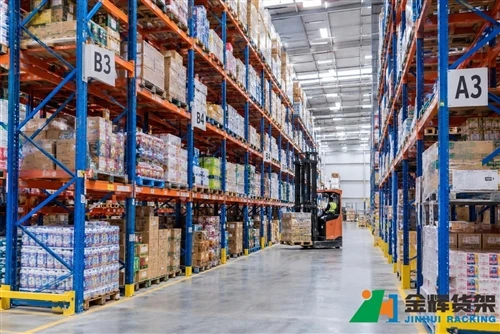
Clear rack labeling and logical SKU zoning help warehouse operators locate and replenish pallet inventory more efficiently.
FAQ About Pallet Racking Organization
How should I organize products in pallet racking?
Start by classifying products according to turnover, SKU quantity, pallet weight, product family, and accessibility requirements. Fast-moving products generally deserve more accessible positions, while slow-moving reserve stock can use higher-density storage.
Should fast-moving inventory be stored on lower rack levels?
It can be beneficial when lower positions improve picking convenience, but the final location should also consider pallet weight, forklift operations, rack capacity, and the warehouse's overall material flow.
Is selective pallet racking suitable for many SKUs?
Yes. Selective pallet racking is commonly used when warehouses need direct access to many different palletized products.
What type of racking is suitable for bulk inventory?
Drive-in, push back, double deep, and radio shuttle systems can be considered for bulk inventory depending on SKU quantity, inventory rotation, access requirements, and storage density objectives.
How often should a warehouse reorganize pallet locations?
There is no universal schedule. Inventory movement and SKU demand should be reviewed regularly, with major storage changes made when product demand, product mix, or warehouse operations change significantly.
Can different pallet racking systems be used in one warehouse?
Yes. Combining selective, push back, drive-in, pallet flow, double deep, or shuttle storage can be an effective strategy when different inventory categories have different storage requirements.
Final Thoughts
Effective pallet racking organization is about putting the right inventory in the right storage location.
Fast-moving products should generally receive greater accessibility, while slow-moving and high-volume inventory can often benefit from higher-density storage. SKU variety, pallet quantity, inventory rotation, product weight, and forklift travel should all be considered when assigning rack locations.
The best warehouse layout is rarely based on one rule. A combination of inventory analysis, rack selection, location management, and regular review can produce a more efficient storage environment.
For warehouses that are growing or changing their product mix, a flexible pallet racking system also makes it easier to adjust storage zones as demand changes.
The objective is not to give every pallet the same storage space. The objective is to give every inventory category the storage configuration and location that best matches how it moves through the warehouse.
Need Help Optimizing Your Pallet Racking Layout?
Jinhui Rack provides customized pallet racking solutions for manufacturing warehouses, distribution centers, 3PL facilities, industrial warehouses, and other pallet storage applications.
Our team can evaluate your warehouse dimensions, pallet specifications, SKU quantity, inventory turnover, forklift requirements, and required pallet positions to develop a storage solution suited to your operation.
For a customized pallet racking proposal, send us your warehouse layout together with pallet size, maximum pallet weight, storage quantity, and forklift information.
WhatsApp: +8618502527163
Email: info@jhrack.com