Introduction: Why Businesses Consider Used Pallet Racking
When setting up or expanding a warehouse, one of the most common questions is whether to invest in new or used pallet racking. At first glance, used racking appears to be a cost-saving option-but is it really the best long-term investment?
In this guide, we break down the real differences between used and new pallet racking systems, helping you make a smarter, more informed decision.
Used vs New Pallet Racking: Quick Comparison
| Factor | Used Racking | New Racking |
|---|---|---|
| Initial Cost | Lower | Higher |
| Safety | Uncertain | Certified & Reliable |
| Customization | Limited | Fully customizable |
| Service Life | Shorter | Long-term |
| Compliance | May not meet standards | Meets international standards |
1. Cost: Is Used Racking Really Cheaper?
Used pallet racking typically costs 30%–50% less than new systems. However, this initial saving often comes with hidden costs, including repairs, replacements, and inefficiencies.
To understand full cost structure, check: warehouse racking cost guide.
In many cases, the total cost of ownership (TCO) of used racking can exceed that of new systems over time.
2. Safety Risks of Used Pallet Racking
Safety is one of the biggest concerns when purchasing second-hand racking. Most used systems have:
- Unknown load history
- Possible structural damage
- Missing or incompatible components

Even minor deformations can significantly reduce load capacity and increase the risk of collapse.
Avoid safety issues by understanding: pallet racking load capacity.
3. Customization and Fit
Used racking systems are typically sold "as-is", meaning:
- Limited sizes and configurations
- Difficult to match existing layouts
- Incompatibility between brands
New pallet racking systems, on the other hand, are designed specifically for your warehouse layout and operational flow.
Learn how layout impacts efficiency: warehouse racking design guide.
4. Compliance and Regulations
Many countries have strict safety standards for warehouse racking systems. Used racking may:
- Lack certification
- Fail to meet current safety codes
- Increase liability risks
New racking systems are manufactured according to updated engineering and safety standards, ensuring compliance and peace of mind.
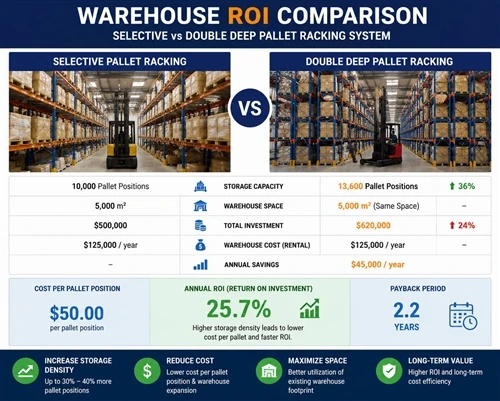
5. ROI Comparison: Short-Term Saving vs Long-Term Value
While used racking may reduce upfront investment, new racking provides:
- Longer lifespan
- Higher operational efficiency
- Lower maintenance costs
To better understand investment returns, read: warehouse racking ROI guide.
In most cases, new pallet racking delivers higher ROI over time.
When Does Used Racking Make Sense?
Used racking may be suitable if:
- You have a very limited budget
- The project is temporary
- You can verify structural integrity and compatibility
However, for long-term operations, new systems are generally the safer and more cost-effective choice.
Expert Recommendation
From an engineering and operational perspective, we typically recommend new pallet racking for:
- Growing businesses
- High-throughput warehouses
- Industries with strict safety requirements
Conclusion
Choosing between used and new pallet racking depends on your budget, operational needs, and long-term goals. While used systems may offer short-term savings, new pallet racking provides superior safety, flexibility, and return on investment.
At JIN HUI Rack, we provide fully customized new pallet racking solutions designed to maximize your warehouse efficiency while ensuring long-term reliability and compliance.
If you're planning a warehouse upgrade or new installation, our team is ready to help you choose the most cost-effective solution.