Pallet Racking Load Capacity Signs: Beam Loads, Bay Limits and Warehouse Load Management
Pallet racking systems are designed to store loads within defined structural limits. However, even a correctly designed and installed rack can become unsafe if warehouse operators do not understand its load capacity or place pallets beyond the approved limits.
Pallet racking load capacity signs provide essential information about the permitted loading configuration. They help warehouse managers, forklift operators and safety personnel understand beam load limits, bay capacity, pallet positions and other important operating restrictions.
Effective load management involves more than displaying a capacity label. The information must match the actual rack configuration, pallet weights and approved structural design. This guide explains how to interpret pallet racking load signs, manage storage loads and maintain accurate capacity information throughout the operating life of a warehouse.
1. Why Pallet Racking Load Capacity Signs Matter
Load capacity signs communicate the loading limits established for a particular pallet racking configuration. They provide operators with a visible reference when placing, removing or rearranging stored goods.
Without clear and accurate load information, warehouse personnel may unintentionally:
- Place pallets that exceed the permitted load for a beam level.
- Exceed the allowable load for an individual rack bay.
- Distribute pallet weights unevenly across a storage level.
- Use a rack configuration that differs from the approved design.
- Continue loading after structural components have been modified.
- Assume that visually similar rack sections have identical capacities.
A properly prepared load sign helps reduce these risks by making the approved loading conditions easier to identify. It should be treated as part of the warehouse's operational safety information, not simply as a decorative label.
2. Understand the Main Types of Pallet Racking Load Limits
One of the most important aspects of load management is understanding that different capacity values describe different structural conditions. Beam capacity, bay capacity and total rack capacity are not interchangeable.
2.1 Beam level load capacity
Beam level capacity generally refers to the permitted load supported by a pair of beams at one storage level, subject to the specified loading arrangement and design conditions.
For example, a storage level may support multiple pallets positioned across the beam pair. The permitted capacity depends on the beam specification, span, connection arrangement, loading assumptions and applicable design requirements.
Operators should not assume that increasing the number of pallets automatically increases the permitted load. The total weight and its distribution must remain within the approved beam level capacity.
2.2 Bay load capacity
A rack bay is the storage section between adjacent upright frames. Bay capacity refers to the permitted loading condition for that section of the rack, as defined by the structural design.
It is important to distinguish bay capacity from beam level capacity. A bay may contain several beam levels, and the combined loading condition must be considered according to the approved design.
2.3 Upright frame capacity
Upright frames transfer the supported loads through the rack structure to the floor. Their capacity depends on the frame configuration, upright sections, bracing arrangement, height, loading pattern and other structural factors.
The permissible frame loading should not be estimated from the appearance or thickness of an upright alone. It must be established using the relevant engineering design information.
2.4 Total rack system loading
The total load stored in a rack installation must be consistent with the structural design of the complete system. This includes the interaction between beam levels, upright frames, bracing, connections, base plates, anchors and supporting floor conditions.
A load value for one beam pair cannot automatically be used as the allowable capacity of the entire rack row.
3. What Information Should a Pallet Racking Load Sign Include?
A useful load capacity sign should present the information needed by warehouse personnel to identify the approved storage arrangement and loading restrictions.
Depending on the rack design and applicable requirements, the sign may include:
- Rack identification or location reference.
- Maximum permitted load per pallet position, where specified.
- Maximum permitted load per beam level.
- Maximum bay load or other applicable structural loading limits.
- Number of storage levels covered by the approved configuration.
- Permitted pallet arrangement and loading pattern.
- Relevant operating restrictions or special instructions.
- Manufacturer, project or inspection identification where required.
The exact information and format should follow the applicable local requirements, engineering documentation and manufacturer's instructions.
Capacity signs should be easy to read from the normal operating area. They should be securely attached in a visible position without interfering with forklift movement, pallet handling or inspection access.

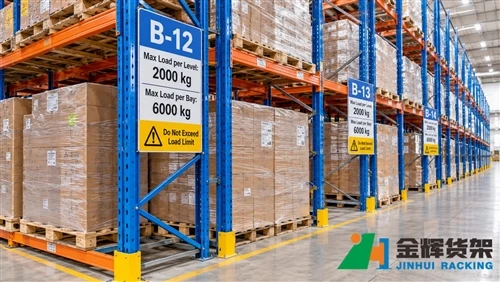
Pallet racking load capacity signage displayed on an organized warehouse storage system.
4. How to Calculate and Verify Pallet Storage Loads
Warehouse operators need reliable weight information to ensure that stored pallets remain within the approved loading limits.
A basic pallet gross weight calculation is:
Pallet gross weight = Product weight + Packaging weight + Pallet weight
For example, if a pallet contains 800 kg of products, 25 kg of packaging materials and a 20 kg pallet, its gross weight is 845 kg.
This value should be compared with the applicable permitted pallet position and beam level loading requirements.
When multiple pallets are stored at one beam level, the combined load must be checked against the approved beam capacity and loading arrangement.
For example, three pallets weighing 700 kg each produce a combined load of 2,100 kg at that storage level. Whether this arrangement is acceptable depends on the rated capacity and the assumptions used in the rack design.
These calculations are useful for operational load tracking, but they do not replace structural capacity verification. The actual permissible loading must be confirmed from the approved rack design and manufacturer documentation.
5. Why Load Distribution Matters as Much as Total Weight
Two pallet arrangements may have the same combined weight but create different structural loading conditions.
Load distribution can be influenced by:
- The number of pallets stored on each beam level.
- The position of each pallet relative to the beam span.
- The dimensions and support arrangement of the pallets.
- Uneven product weight within individual pallets.
- Load overhang beyond the intended storage footprint.
- The presence of concentrated loads or non-standard load carriers.
For this reason, operators should follow the pallet arrangement used in the approved rack design. A pallet should not be positioned in a way that creates an unsupported overhang or concentrated loading condition unless the arrangement has been specifically assessed and approved.
Where unusual pallet dimensions, drums, containers or non-standard load carriers are involved, the storage arrangement should be reviewed before use.
6. Factors That Can Change Pallet Racking Load Capacity
Rack capacity is not determined by a single component. Changes to the structure or operating configuration can affect the permissible loading conditions.
6.1 Beam span and beam specification
Beam capacity depends partly on its length, section properties, connection details and design assumptions. Replacing a beam with a different model or length may change the approved loading capacity.
6.2 Upright frame configuration
Upright height, section type, frame depth and bracing arrangement all contribute to structural performance. Changes to these components should be reviewed against the rack design.
6.3 Beam elevations and storage levels
Changing beam elevations can affect the loading conditions of upright frames. Moving beams to create additional storage space should therefore not be treated as a simple operational adjustment.
6.4 Rack height and bay arrangement
Adding storage levels, increasing rack height or changing bay spacing may alter the structural configuration. Any such modification requires appropriate technical review before implementation.
6.5 Floor and anchorage conditions
Rack loads are transferred to the supporting floor through the frame base plates and anchoring arrangement. The condition and suitability of the concrete floor and anchors must remain consistent with the approved design assumptions.
Warehouse managers should not independently increase the permitted load because the rack appears stable or because the floor seems strong enough.
7. Common Load Management Mistakes in Warehouses
| Common mistake | Potential problem | Recommended control |
|---|---|---|
| Loading pallets without checking gross weight | Actual pallet weight may exceed the permitted value. | Use reliable product and pallet weight records. |
| Confusing beam capacity with bay capacity | Operators may misunderstand the applicable load limit. | Display clearly defined capacity information. |
| Changing beam elevations without approval | The original structural design assumptions may no longer apply. | Obtain technical approval before changing the configuration. |
| Mixing different pallet sizes or arrangements | Unsupported overhang or uneven load distribution may occur. | Use approved pallet dimensions and storage arrangements. |
| Using outdated capacity signs | Displayed limits may no longer match the installed rack. | Update signs after approved configuration changes. |
| Ignoring damaged rack components | Actual structural condition may differ from the original design. | Inspect, report and assess damage before continued use. |
8. How to Manage Rack Configuration Changes
Warehouse operations often change as inventory requirements develop. New products, different pallet sizes, additional storage levels or changes in material handling equipment may create pressure to modify the original rack arrangement.
However, even a small physical modification can affect the structural design assumptions.
Before changing a rack configuration, warehouse management should:
- Identify the existing rack model and configuration.
- Review the original layout drawings and capacity documentation.
- Describe the proposed change, including beam levels, pallet dimensions and expected loads.
- Obtain a technical assessment from the manufacturer or responsible structural engineer.
- Confirm the revised permitted loading conditions.
- Update load capacity signs and warehouse operating records where required.
- Communicate the revised requirements to warehouse operators.
Unauthorized changes should not be used as a way to increase storage density or create additional pallet positions.
9. Establish a Routine Load Management Procedure
Capacity signs are most effective when supported by consistent warehouse procedures. A load management system should connect rack design information with daily inventory and handling activities.
9.1 Maintain accurate pallet weight records
Record the gross weight of standard pallet configurations, including products, packaging and pallet materials. Where product weights vary, use a reliable method to identify the actual load before storage.
9.2 Train forklift operators
Operators should understand the meaning of the displayed capacity values, the approved pallet arrangement and the procedures for reporting unusual loads or damaged components.
9.3 Control non-standard loads
Oversized pallets, concentrated loads, irregular containers and other unusual storage units should be assessed before being placed in the rack.
9.4 Inspect capacity signs regularly
Check that signs remain visible, legible, securely attached and consistent with the installed rack configuration. Replace missing or damaged signs using verified capacity information.
9.5 Review changes and incidents
Any approved structural modification, significant damage event or change in storage requirements should trigger a review of the relevant capacity documentation and operating instructions.
10. Load Capacity Signs and Warehouse Safety Inspections
Load capacity management should be integrated with routine pallet racking inspections. A sign may display the correct original capacity while the actual rack condition has deteriorated due to impact damage, corrosion, loose connections or unauthorized modifications.
Inspection personnel should therefore consider both the displayed loading limits and the physical condition of the structure.
Important inspection points include:
- Whether capacity signs match the current approved rack configuration.
- Whether beams and upright frames show visible damage or deformation.
- Whether beam connectors and locking devices are correctly installed.
- Whether base plates and anchors remain in the required condition.
- Whether pallets are stored in the approved positions and arrangements.
- Whether unauthorized modifications or additional loads have been introduced.
If structural damage or a suspected overload is identified, the affected area should be managed according to the warehouse's safety procedures and assessed by competent personnel. A capacity sign does not override the need to investigate damage or abnormal structural conditions.
11. Prepare a Pallet Racking Load Management Checklist
Warehouse managers can use the following checklist to review their load management practices:
- Approved rack design and capacity documentation are available.
- Capacity signs are installed in visible locations.
- Beam level and bay capacity information is clearly distinguished.
- Displayed capacity values match the installed rack configuration.
- Pallet gross weights are recorded or reliably identified.
- Stored pallet arrangements follow the approved loading assumptions.
- Non-standard pallets and concentrated loads receive technical review.
- Operators understand the meaning of the capacity signs.
- Rack configuration changes are reviewed and authorized.
- Capacity signs are updated when approved changes affect loading limits.
- Routine inspections include both rack condition and load management checks.
Keeping these records helps warehouse operators maintain consistency between the engineered rack configuration and actual storage practices.
Conclusion
Pallet racking load capacity signs play an important role in communicating structural loading limits and supporting safe warehouse operations. Understanding the difference between beam level capacity, bay capacity and overall rack loading helps operators avoid common mistakes when storing palletized goods.
However, effective load management requires more than displaying numbers. Pallet gross weights, load distribution, rack configuration, floor conditions and structural inspection results must all be considered within the approved design requirements.
By maintaining accurate capacity signs, controlling configuration changes and training warehouse personnel, businesses can manage storage loads more consistently and protect the long-term performance of their pallet racking systems.
Contact Us
Planning a new warehouse pallet racking system or reviewing the load requirements of your existing storage installation? Contact Jinhui Rack to discuss your rack configuration, storage capacity requirements and warehouse layout.
Email: info@jhrack.com
WhatsApp: +86 185 0252 7163