How to Reduce Warehouse Congestion Around Pallet Racking
Warehouse congestion can reduce forklift productivity, slow down pallet handling, increase the risk of rack damage, and create unnecessary delays during receiving, storage, picking, and shipping.
In a pallet racking warehouse, congestion is usually not caused by one problem. It often results from a combination of narrow or poorly positioned aisles, temporary pallet staging, inefficient traffic routes, poorly located fast-moving inventory, blocked cross aisles, and conflicts between forklifts and pedestrians.
The good news is that warehouse congestion can often be reduced without completely rebuilding the pallet racking system. By analyzing traffic patterns and improving rack layout, staging zones, pallet locations, and operating procedures, warehouse managers can create a more predictable material flow.
This guide explains practical ways to reduce congestion around pallet racking while maintaining storage capacity, forklift access, and warehouse safety.

What Causes Warehouse Congestion Around Pallet Racking?
Warehouse congestion occurs when the movement of forklifts, pallets, workers, and other equipment exceeds the available operating space or when different warehouse activities compete for the same area.
Common causes include:
- Pallets temporarily stored in forklift aisles
- Insufficient receiving or shipping staging space
- Too many forklifts operating in the same aisle
- Two-way traffic in areas better suited to one-way movement
- Fast-moving inventory located far from operational areas
- Cross aisles that are poorly positioned
- Pedestrian traffic crossing forklift routes
- Long rack rows that limit alternative travel routes
- Inconsistent pallet storage locations
- Peak-period inventory volume exceeding the planned layout
Warehouse congestion should therefore be treated as a layout and operational problem rather than simply an aisle-width problem.
Why Warehouse Congestion Matters
Congestion affects more than forklift travel time.
| Congestion Problem | Potential Operational Impact |
|---|---|
| Blocked aisles | Forklifts must wait, reverse, or take longer routes |
| Forklift traffic conflicts | Higher risk of delays and collisions |
| Staging overflow | Pallets may occupy operating areas that were not intended for storage |
| Pedestrian conflicts | Forklift movement becomes slower and more difficult to manage |
| Poor SKU placement | Frequent pallet movements concentrate traffic in inefficient areas |
| Insufficient cross aisles | Forklifts may need to travel to the end of long rack rows |
Reducing congestion can therefore improve both warehouse productivity and the consistency of daily operations.
Start by Identifying Where Congestion Occurs
Before changing the pallet rack layout, identify where congestion actually occurs.
Warehouse managers should observe operations during normal periods as well as peak receiving, picking, and shipping periods.
Record areas where:
- Forklifts frequently wait for other vehicles
- Pallets accumulate outside rack locations
- Operators frequently stop in aisles
- Forklifts need to reverse repeatedly
- Workers cross active forklift routes
- Multiple forklifts converge at the same rack area
- Receiving and shipping activities interfere with storage traffic
It is important to evaluate peak conditions rather than relying only on average warehouse activity. A layout that works well during a quiet period may become severely congested when several trucks arrive or multiple orders must be prepared simultaneously.
Use a Warehouse Traffic Map
A simple warehouse traffic map can help identify congestion points before making expensive layout changes.
Mark the following areas on the warehouse floor plan:
- Receiving docks
- Shipping docks
- Pallet rack rows
- Main forklift aisles
- Cross aisles
- Receiving staging areas
- Shipping staging areas
- Picking zones
- Pedestrian walkways
- Forklift charging areas
- Packaging or processing stations
Then draw the most common pallet movement routes.
This process can reveal whether several warehouse activities are competing for the same aisle or staging area.
For warehouses undergoing a new rack project, the traffic map should be created before the final rack layout is ordered. Jinhui Rack's warehouse pallet rack solutions can be configured around the actual warehouse dimensions, storage requirements, and material-handling conditions.
Keep Staging Areas Out of Main Forklift Aisles
One of the most common causes of warehouse congestion is using forklift aisles as temporary pallet storage.
Receiving and shipping operations naturally create temporary inventory. However, when staging space is insufficient, pallets may gradually spread into operating aisles.
This creates a cycle:
Insufficient staging space → pallets placed in aisles → restricted forklift movement → longer travel routes → more congestion.
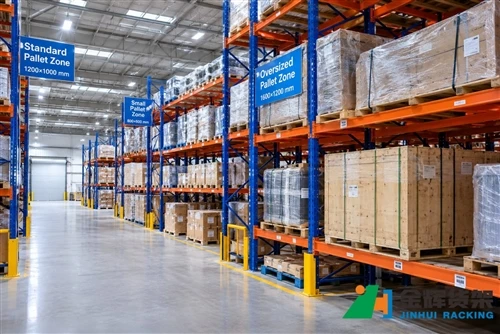
Whenever possible, receiving and shipping staging should have clearly defined locations separate from the main rack aisles.
Floor markings and designated pallet positions can also help operators understand where temporary inventory should be placed.
For more information about connecting rack rows with receiving and shipping operations, see How to Plan Pallet Racking Around Warehouse Receiving and Shipping Areas.
Separate Main Traffic Routes from Storage Aisles
Not every aisle needs to serve the same purpose.
A warehouse may benefit from distinguishing between:
- Main forklift travel routes
- Rack access aisles
- Cross aisles
- Receiving and shipping transfer routes
- Pedestrian walkways
- Staging access routes
Main traffic routes should provide reliable movement between major warehouse zones.
Rack access aisles, on the other hand, primarily provide access to pallet positions.
When all warehouse traffic is forced through the same narrow network of rack aisles, congestion can increase significantly.
Use Cross Aisles to Reduce Traffic Bottlenecks
Cross aisles can provide alternative routes between rack rows and reduce dependence on a single main aisle.
For example, if a forklift must travel to the end of a long rack row every time it needs to reach another storage section, the end of that rack row can become a traffic bottleneck.
A properly positioned cross aisle may allow forklifts to move between rack blocks without traveling through the entire row.
However, adding too many cross aisles can reduce the amount of floor space available for storage.
The goal is therefore not to create as many cross aisles as possible. Instead, cross aisles should be positioned where they provide meaningful traffic benefits.
Rack row length should also be considered when evaluating this issue. Our guide on how to determine the right pallet rack row length explains how rack rows need to be balanced against forklift access, building structures, and warehouse flow.
Review Forklift Traffic Direction
In some warehouse areas, uncontrolled two-way forklift traffic can create unnecessary conflicts.
Where the warehouse layout allows it, one-way traffic can make vehicle movement more predictable.
Potential benefits include:
- Fewer head-on traffic conflicts
- More predictable forklift movement
- Less reversing
- Better visibility at intersections
- More consistent travel patterns
However, one-way traffic should only be introduced when the warehouse has sufficient space and appropriate alternative routes. A one-way system that forces forklifts to make extremely long detours may increase travel distance rather than reduce congestion.
Match Aisle Width to the Actual Forklift
Aisle width should be based on the material-handling equipment actually used in the warehouse.
Different forklifts have different turning characteristics, load dimensions, operating methods, and clearance requirements.
Reducing aisle width simply to create additional rack positions can create operational problems if the forklift cannot maneuver efficiently.
When reviewing congestion, evaluate:
- Forklift type
- Load dimensions
- Turning requirements
- Rack depth
- Operator visibility
- Traffic direction
- Pedestrian movement
See How Warehouse Aisle Width Affects Pallet Racking Capacity and Forklift Access for a more detailed explanation of the relationship between aisle dimensions and forklift operation.
Move High-Frequency Inventory Away from Congested Areas
Fast-moving inventory can create concentrated traffic around specific rack locations.
If a high-frequency SKU is stored in a location that is already difficult to access, repeated pallet movements can make the area even more congested.
Warehouse managers should review:
- Which SKUs are moved most frequently
- Where those SKUs are currently stored
- How many forklifts access the same rack area
- Whether several high-frequency SKUs are concentrated in one aisle
- Whether replenishment and picking traffic compete for the same space
High-frequency inventory does not always need to be stored in the closest possible location. The better approach is to position frequently moved products where they are accessible without creating excessive traffic concentration.
Do Not Concentrate Every Fast-Moving SKU in One Aisle
Placing all high-frequency inventory in one convenient area may appear efficient, but it can create a traffic bottleneck.
For example, if several high-volume SKUs are stored in adjacent rack bays, multiple forklifts may repeatedly enter the same aisle.
In some warehouses, distributing high-frequency inventory across several strategically located rack areas can reduce traffic concentration while maintaining reasonable travel distances.
The best approach depends on order frequency, SKU relationships, replenishment requirements, and warehouse layout.
Separate Replenishment Traffic from Picking Traffic Where Possible
Warehouses often have two different types of pallet movement:
- Replenishment from reserve storage
- Picking or order fulfillment from active storage locations
If both activities repeatedly use the same aisle during peak periods, congestion can increase.
A warehouse may therefore benefit from separating reserve storage and forward-picking locations where the operation justifies it.
This can reduce unnecessary interaction between replenishment forklifts and order-picking activities.
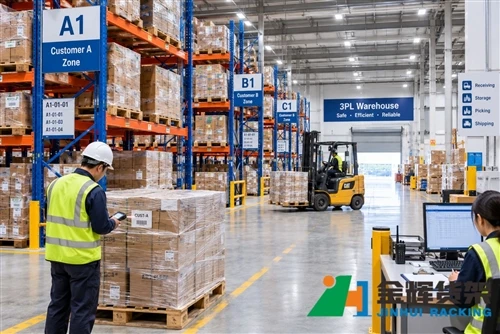
Clear rack location identification is also important. A consistent labeling system can help operators travel directly to the correct storage position instead of searching through multiple aisles. See How Pallet Rack Labeling Improves Warehouse Inventory Accuracy and Picking Efficiency.
Protect Rack Ends and High-Traffic Areas
Rack ends are often exposed to higher forklift traffic because vehicles turn, merge, or change direction near these locations.
Repeated forklift activity around rack ends can increase the risk of accidental impact.
Warehouse managers should therefore review high-traffic rack locations for:
- Rack-end protection
- Clear turning areas
- Visibility
- Pedestrian crossings
- Floor markings
- Obstructions
Rack protection should support traffic management rather than simply being added after repeated impacts occur.
For practical guidance on protecting rack structures from forklift impacts, see How to Protect Pallet Racking from Forklift Impact.
Use Clear Floor Markings
Floor markings can make warehouse traffic patterns easier to understand.
Depending on the warehouse layout, markings may identify:
- Forklift travel lanes
- Pedestrian walkways
- Staging locations
- No-storage zones
- Crossing points
- Emergency access areas
- Loading and unloading zones
Clear markings do not replace proper warehouse design, but they can help operators follow the intended traffic pattern consistently.
Manage Peak Warehouse Traffic Instead of Average Traffic
Warehouse congestion is often most severe during short periods of high activity.
For example, a warehouse may operate smoothly for most of the day but become congested during:
- Morning receiving periods
- Truck loading windows
- Shift changes
- Order-picking peaks
- Seasonal demand periods
- End-of-day shipping operations
Layout decisions should therefore be tested against peak operating conditions.
If five forklifts normally operate in a warehouse but ten forklifts operate during a peak period, the traffic pattern should be evaluated using the higher demand scenario.
How Pallet Rack Layout Influences Warehouse Congestion
Pallet rack layout determines how forklifts move through the warehouse.
Important layout variables include:
| Layout Factor | Potential Congestion Effect |
|---|---|
| Rack row length | Long rows may reduce alternative travel routes |
| Aisle width | Insufficient width can restrict forklift operation |
| Cross aisles | Well-positioned cross aisles can provide alternative routes |
| Rack orientation | Can influence the direction and length of material movement |
| Staging zones | Insufficient staging can push temporary pallets into aisles |
| SKU locations | Poor placement can concentrate traffic around specific rack areas |
| Building columns | Columns can interrupt otherwise efficient rack and aisle layouts |
The objective is to design the warehouse as one operating system rather than treating pallet racks as independent storage structures.
How to Reduce Congestion Without Rebuilding the Warehouse
Not every congestion problem requires a complete rack relocation.
Warehouse managers can often begin with operational changes such as:
- Removing unauthorized pallet storage from forklift aisles.
- Defining dedicated receiving and shipping staging areas.
- Improving rack location labels.
- Reassigning high-frequency inventory.
- Adjusting forklift traffic direction where practical.
- Creating or improving selected cross aisles.
- Separating pedestrian paths from forklift routes.
- Scheduling replenishment during lower-traffic periods.
- Reviewing peak-period forklift deployment.
- Removing unused equipment and obstructions from operating areas.
These relatively simple measures can sometimes improve warehouse flow before larger layout changes are considered.
When Should You Consider Changing the Rack Layout?
A rack layout may need a more significant review when congestion remains persistent after operational improvements.
Typical warning signs include:
- Forklifts regularly queue in the same aisle
- Staging pallets repeatedly block rack access
- Traffic conflicts occur at the same intersections
- Operators frequently take long detours
- Rack locations cannot support the current inventory profile
- Warehouse throughput has increased significantly
- New equipment requires different aisle conditions
- Future inventory growth will exceed the current layout
In these situations, the rack layout should be reviewed together with storage capacity, forklift requirements, inventory turnover, building constraints, and future expansion.
Warehouse Congestion Reduction Checklist
| Check | Question |
|---|---|
| Traffic Routes | Are the main forklift routes clearly defined? |
| Staging | Are receiving and shipping staging areas large enough for peak demand? |
| Aisles | Can the selected forklifts operate efficiently in the available aisles? |
| Cross Aisles | Are alternative routes available where traffic volumes justify them? |
| SKU Placement | Are high-frequency products positioned to avoid unnecessary traffic concentration? |
| Pedestrian Traffic | Are pedestrian and forklift routes clearly separated where practical? |
| Rack Protection | Are high-traffic rack ends adequately protected? |
| Peak Operations | Has the layout been tested during the busiest operating periods? |
| Future Growth | Can the warehouse layout support expected inventory growth? |
Frequently Asked Questions About Warehouse Congestion
What is the main cause of warehouse congestion?
Warehouse congestion is usually caused by a combination of high traffic volume, insufficient staging space, poorly planned forklift routes, blocked aisles, concentrated inventory movements, and conflicts between different warehouse activities.
Can wider aisles solve warehouse congestion?
Wider aisles may improve maneuverability, but they are not a universal solution. Increasing aisle width can reduce storage capacity. The correct approach is to balance forklift requirements, storage density, traffic flow, and warehouse safety.
Do cross aisles reduce warehouse congestion?
They can. Properly positioned cross aisles provide alternative routes between rack sections and can reduce dependence on long rack aisles. However, excessive cross aisles can consume storage space.
Should fast-moving products always be stored near shipping?
Not necessarily. Fast-moving products should be positioned according to their complete movement pattern. Placing too many high-frequency products in one area can create a traffic bottleneck even if the location is close to shipping.
How can I reduce warehouse congestion without replacing my pallet racks?
Start by controlling staging areas, improving location labeling, removing aisle obstructions, adjusting traffic routes, separating pedestrian movement, reviewing SKU locations, and managing replenishment during lower-traffic periods.
Final Thoughts
Warehouse congestion around pallet racking is rarely caused by one rack dimension. It is usually the result of interactions between storage locations, forklift routes, staging areas, inventory movement, pedestrian traffic, and peak operating demand.
The most effective approach is to understand how pallets actually move through the warehouse and then adjust the layout and operating procedures around that movement.
Before moving or replacing pallet racks, review the warehouse traffic map, staging requirements, SKU movement frequency, forklift routes, cross aisles, and peak-period activity.
A well-planned pallet racking layout can help reduce congestion while maintaining storage capacity, forklift access, and efficient warehouse operations.
If you are planning a new warehouse pallet racking project or looking to improve an existing layout, Jinhui Rack can help evaluate rack configuration, storage capacity, forklift requirements, warehouse traffic flow, and future expansion needs.
WhatsApp: +86 185 0252 7163
Email: info@jhrack.com
Website: https://www.jinhui-rack.com/