How to Compare Heavy Duty Selective Pallet Racking and Push Back Racking
Choosing between heavy duty selective pallet racking and push back racking depends on how a warehouse stores, accesses, and moves pallets. The system with the highest storage density is not automatically the best choice for every warehouse.
Selective pallet racking provides direct access to individual pallet positions and is well suited to warehouses with many SKUs and frequent pallet access. Push back racking stores pallets multiple positions deep and can provide higher storage density while allowing loading and unloading from the same operating aisle.
The right decision should therefore consider storage density, SKU variety, inventory turnover, pallet accessibility, forklift movement, available floor space, and the required inventory management method.
This guide compares the two systems and explains when selective pallet racking or push back racking may be more suitable for a warehouse project.
Quick Answer: Selective vs Push Back Racking
| Factor | Selective Pallet Racking | Push Back Racking |
|---|---|---|
| Storage method | Single pallet positions with direct access | Multiple pallets stored deep in each lane |
| Inventory principle | Flexible access to individual pallets | Generally LIFO |
| SKU variety | Excellent for high SKU variety | Better for medium SKU variety and batch storage |
| Storage density | Moderate | Higher |
| Pallet accessibility | Direct access to each pallet | Access from the operating aisle to the front pallet |
| Forklift operation | Forklift accesses individual rack locations | Forklift operates from the aisle without entering the rack structure |
| Inventory rotation | Highly flexible | Best suited to LIFO and batch storage |
| Best application | High SKU variety and frequent individual pallet access | High-density storage with multiple pallets per SKU or batch |
In simple terms, selective racking prioritizes accessibility and flexibility, while push back racking prioritizes storage density and efficient batch storage.
What Is Heavy Duty Selective Pallet Racking?
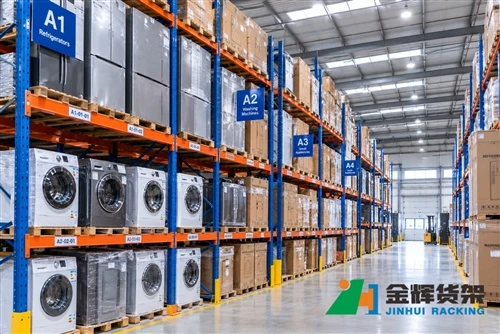
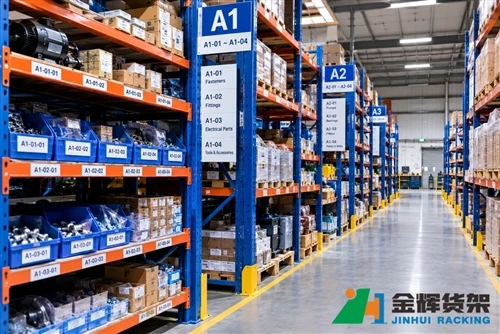
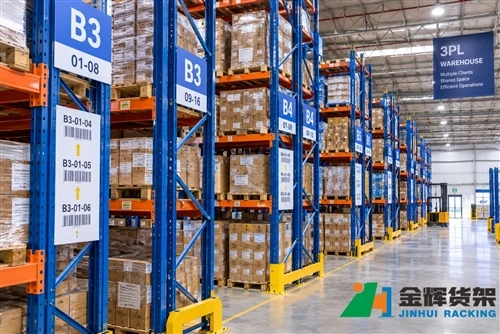
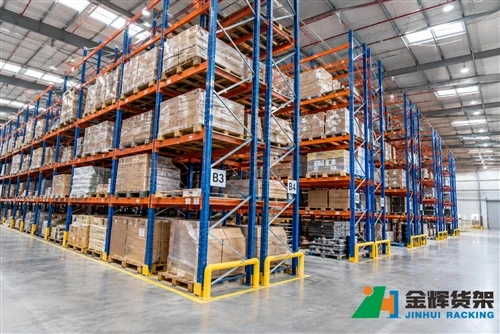
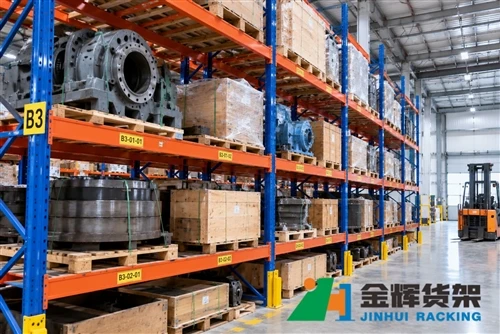
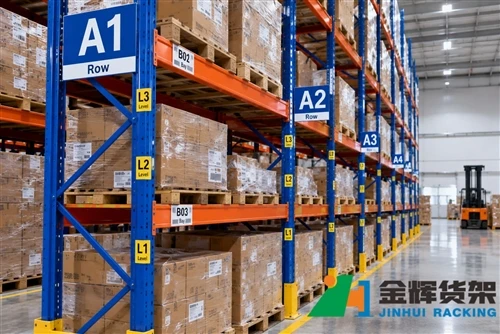
Heavy duty selective pallet racking is a pallet storage system designed to provide direct access to individual pallet positions.
Each pallet is normally stored in its own rack position, allowing a forklift to access a specific pallet without moving other pallets in the same storage lane.
This makes selective racking particularly useful for warehouses with:
- Large numbers of different SKUs
- Frequent individual pallet access
- Variable inventory quantities
- Frequent receiving and shipping activity
- FIFO or flexible inventory management requirements
- Frequent changes in pallet locations
Jinhui's selective pallet racking systems can be configured according to pallet dimensions, load requirements, rack height, bay width, and warehouse layout.
What Is Push Back Pallet Racking?
Push back pallet racking is a high-density pallet storage system that uses inclined rails and nested carts to store multiple pallets deep.
When a new pallet is loaded, it pushes the pallets already stored in the lane toward the back. When the front pallet is removed, the remaining pallets move forward under gravity.
Push back racking normally operates according to the Last-In, First-Out (LIFO) principle.
This configuration allows several pallets to be stored in depth while forklifts perform loading and unloading from the operating aisle.
Jinhui's Push Back Storage System is designed for high-density pallet storage and can be customized according to pallet dimensions, storage depth, load requirements, warehouse height, and operating conditions.
How Selective Pallet Racking Works
Selective racking uses upright frames and horizontal beams to create individual pallet storage positions.
A typical operating process is:
- The forklift approaches the required rack bay.
- The pallet is lifted to the required storage level.
- The pallet is placed directly into its assigned position.
- The forklift can later retrieve that specific pallet without moving other pallets.
This direct-access structure is one of the main reasons selective racking remains widely used in industrial warehouses and distribution centers.
However, because every pallet position normally requires access from an aisle, selective racking generally uses more operating aisle space than deep-lane storage systems.
How Push Back Racking Works
Push back racking uses carts or rails installed inside the rack structure.
The basic process is:
- The first pallet is loaded onto the front storage position.
- The next pallet is placed behind it.
- The incoming pallet pushes the previous pallet deeper into the lane.
- Additional pallets can be stored in depth according to the system design.
- When the front pallet is removed, the remaining pallets move forward.
This allows multiple pallets to share a storage lane while maintaining access from the same operating aisle.
The result is a higher-density configuration than conventional selective racking, particularly when warehouses store multiple pallets of the same product or batch.
Storage Density: Which System Uses Space Better?
If storage density is the primary objective, push back racking can provide an advantage over conventional selective racking.
Selective racking requires access aisles between rack rows and normally stores one pallet position at each accessible location.
Push back racking stores pallets multiple positions deep, allowing more pallets to be stored within the same rack footprint.
However, storage density should not be evaluated only by counting pallet positions.
A warehouse should also consider:
- Required forklift aisles
- Building columns
- Fire protection requirements
- Required pallet accessibility
- SKU distribution
- Inventory turnover
- Staging requirements
- Future expansion
A higher-density rack system may provide more pallet positions but become less efficient if operators frequently need individual pallet access.
Pallet Accessibility: Which System Is More Flexible?
Selective pallet racking has a clear advantage when direct pallet access is important.
With selective racking, a forklift can normally access a specific pallet position without first removing other pallets.
Push back racking provides access from the front of each lane, but pallets are stored behind one another. The storage sequence therefore matters more.
If a warehouse frequently needs to retrieve the middle or rear pallet independently, selective racking may be more suitable.
If several pallets belong to the same SKU or batch and can be managed using LIFO principles, push back racking may provide a better balance between density and accessibility.
For high SKU variety and individual pallet access, selective racking is usually the stronger option.
For batch storage and higher pallet density, push back racking may be more efficient.
SKU Variety Should Influence the Decision
SKU variety is one of the most important factors when comparing these two systems.
Consider a warehouse storing 1,000 different SKUs with only a few pallets of each product. Direct access becomes very important because operators may need to retrieve different pallets throughout the day.
In this situation, selective pallet racking is usually easier to manage.
Now consider a warehouse storing 100 SKUs with dozens of pallets per SKU. Multiple pallets of the same product can be grouped into deeper storage lanes.
Push back racking may then provide better space utilization while maintaining practical access to each product group.
Inventory Turnover and LIFO Requirements
Inventory turnover should also be considered before selecting the rack type.
| Inventory Situation | More Suitable Option | Reason |
|---|---|---|
| Many SKUs with frequent individual access | Selective | Direct access to each pallet |
| Large quantities of the same SKU | Push Back | Multiple pallets can be stored deep |
| Strict FIFO requirement | Selective or pallet flow | Push back normally operates on LIFO |
| Batch storage | Push Back | Deep storage supports grouped inventory |
| Frequently changing SKU quantities | Selective | More flexible individual pallet access |
| High-density storage priority | Push Back | Multiple pallets per lane reduce the need for individual rack aisles |
Warehouse operators should not select push back racking simply because it provides more pallet positions. The inventory rotation method must also be compatible with the system.
Forklift Operation and Travel Distance
Forklift operation is another important difference.
With selective racking, forklifts travel through rack aisles and access individual pallet positions. This provides excellent accessibility but requires sufficient aisle space throughout the warehouse.
Push back racking allows loading and unloading from the operating aisle without driving the forklift into the rack structure.
This can simplify loading operations and reduce the need for forklifts to enter deep storage lanes.
However, forklift travel distance still depends on the overall warehouse layout. A push back system will not automatically reduce travel distance if the rack layout places frequently moved inventory far from receiving, picking, or shipping areas.
This is why rack selection and warehouse layout should be planned together.
Warehouse Floor Space Requirements
When floor space is limited, push back racking may be attractive because multiple pallets can be stored in depth.
Instead of creating an individual aisle for every pallet position, the warehouse can use deeper storage lanes to increase the number of pallets stored within a given floor area.
Selective racking generally requires more aisle access, but its layout flexibility can make it easier to accommodate irregular building shapes, different SKU groups, and changing storage requirements.
The correct comparison is therefore not simply:
More pallets = better warehouse.
The better question is:
Which system provides the required pallet capacity while supporting the actual operating process?
Selective vs Push Back: Warehouse Application Comparison
| Warehouse Requirement | Recommended Direction | Why |
|---|---|---|
| High SKU variety | Selective | Direct access makes individual SKU management easier |
| High pallet volume per SKU | Push Back | Deep lanes can improve storage density |
| Individual pallet retrieval | Selective | Each pallet position can be accessed directly |
| Batch inventory | Push Back | Multiple pallets can be grouped in the same lane |
| LIFO inventory | Push Back | The system naturally supports LIFO storage |
| Flexible inventory rotation | Selective | Operators have direct access to individual pallet positions |
| Limited warehouse floor area | Push Back may be advantageous | Deep storage can increase pallet density |
| Frequently changing product mix | Selective | Greater flexibility for changing storage assignments |
Can Push Back Replace Selective Pallet Racking?
Not in every warehouse.
Push back racking is not simply a higher-density version of selective racking. The two systems solve different operational problems.
Selective racking is designed around accessibility and flexibility.
Push back racking is designed around higher-density storage and efficient batch handling.
For this reason, some warehouses may benefit from using both systems in different zones.
For example, a warehouse could use selective racking for high-SKU inventory that requires frequent individual access and push back racking for bulk inventory with larger quantities per SKU.
Can a Warehouse Use Both Systems?
Yes. A mixed-racking strategy can be practical when the warehouse has different inventory characteristics.
For example:
- Selective racking for high-SKU products
- Push back racking for bulk inventory
- Pallet flow racking for FIFO products
- Drive-in racking for large quantities of similar products
- Radio shuttle systems for high-density or semi-automated storage
Jinhui's warehouse pallet rack solutions include different storage systems that can be evaluated according to warehouse dimensions, SKU quantity, pallet load, inventory turnover, forklift requirements, and storage density objectives.
What Should You Consider Before Choosing?
Before selecting selective or push back racking, collect the following information:
- Warehouse length and width
- Clear warehouse height
- Pallet dimensions
- Maximum pallet weight
- Total number of pallets
- Number of SKUs
- Average pallets per SKU
- Inventory turnover rate
- FIFO or LIFO requirements
- Forklift type
- Required operating aisle
- Receiving and shipping frequency
- Required future storage capacity
These factors provide a much better basis for rack selection than simply comparing the purchase price of two systems.
One Image: Selective vs Push Back Pallet Racking

Common Mistakes When Choosing Between Selective and Push Back Racking
Choosing Only by Storage Density
Higher storage density is attractive, but it does not automatically mean better warehouse performance.
If operators need individual access to many pallets, a dense storage system may increase handling complexity.
Ignoring SKU Variety
A system designed for large quantities of similar products may not be suitable for a warehouse with hundreds or thousands of low-volume SKUs.
Ignoring Inventory Rotation
Push back racking normally operates on LIFO principles. If the warehouse requires strict FIFO rotation, another system may be more appropriate.
Ignoring Forklift Requirements
Rack selection must be compatible with the forklift type, load dimensions, lifting height, turning characteristics, and required aisle configuration.
Comparing Product Price Instead of Total Warehouse Value
The cheapest rack system is not necessarily the lowest-cost solution over the life of the warehouse.
Consider installation, storage capacity, forklift travel, labor efficiency, inventory accessibility, future expansion, and operational requirements when comparing systems.
How to Choose the Right System for Your Warehouse
A simple decision process can help narrow down the options.
- Define the inventory profile. Identify SKU quantity, pallet quantity, turnover, and batch size.
- Define accessibility requirements. Determine whether operators need direct access to individual pallets.
- Define inventory rotation. Confirm whether FIFO, LIFO, or flexible rotation is required.
- Measure the warehouse. Record floor dimensions, clear height, columns, doors, and operational zones.
- Confirm forklift requirements. Check forklift type, load dimensions, lifting height, and aisle requirements.
- Calculate required pallet positions. Include current inventory as well as realistic future growth.
- Compare storage density and operating efficiency. Do not evaluate capacity separately from warehouse operations.
- Request an engineered layout. A professional rack layout can show how the selected system fits the actual building and material flow.
Frequently Asked Questions
Is selective pallet racking better than push back racking?
Neither system is universally better. Selective pallet racking is generally better when direct access, high SKU variety, and flexibility are priorities. Push back racking is generally better when higher storage density and batch storage are more important.
Is push back racking more expensive than selective racking?
The initial system cost can vary according to storage depth, rack dimensions, load capacity, carts, rails, installation, and project requirements. The better comparison should include total warehouse capacity and operating efficiency rather than purchase price alone.
How many pallets deep can push back racking store?
Push back systems can be designed for multiple pallet positions deep. The actual depth depends on the rack design, pallet dimensions, load requirements, forklift operation, and warehouse layout.
Is push back racking FIFO or LIFO?
Push back racking normally operates on a LIFO basis because pallets are loaded and retrieved from the same operating aisle.
Which system is better for many SKUs?
Selective pallet racking is generally more suitable when the warehouse has a large number of SKUs and frequent individual pallet access requirements.
Can selective and push back racking be used in the same warehouse?
Yes. A mixed solution can be useful when different inventory groups have different storage requirements. Selective racking can handle high-SKU inventory while push back racking can handle bulk or batch inventory.
Final Thoughts
The decision between heavy duty selective pallet racking and push back racking should be based on how your warehouse actually operates.
Choose selective pallet racking when direct pallet access, high SKU variety, and flexibility are the main priorities.
Consider push back racking when higher storage density, batch storage, and LIFO inventory management are more important.
For some warehouses, the best solution may be a combination of different pallet racking systems rather than using one system throughout the entire facility.
Jinhui Rack can evaluate your warehouse dimensions, pallet specifications, SKU profile, inventory turnover, forklift requirements, storage capacity, and future expansion plans to recommend a suitable pallet racking configuration.
WhatsApp: +86 185 0252 7163
Email: info@jhrack.com
Website: https://www.jinhui-rack.com/