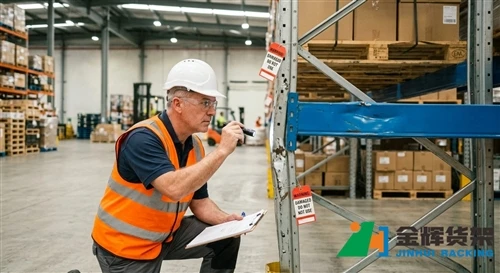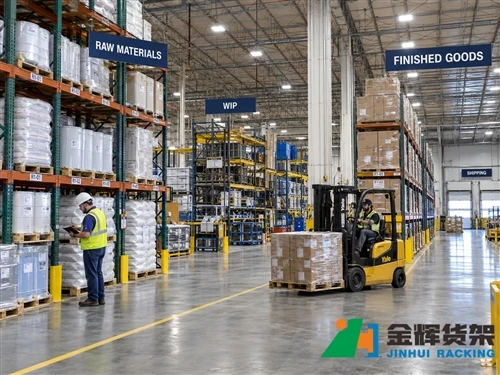
A pallet racking system is often designed around the warehouse's current inventory, but warehouse requirements rarely remain unchanged for long.
New products may be introduced, order volumes may increase, additional customers may be added, or a company may simply need more inventory on hand.
When the original pallet racking layout has no room for expansion, warehouse growth can become expensive and disruptive.
For this reason, planning pallet racking for future warehouse expansion should be considered during the initial design stage rather than after the existing storage capacity has already been exhausted.
Quick Answer
A pallet racking system designed for future expansion should leave practical space for additional rack rows, use consistent rack dimensions where possible, consider future SKU and pallet growth, preserve forklift access, and avoid layouts that make later modifications unnecessarily difficult. The goal is not to leave as much empty space as possible, but to create a storage system that can grow without requiring a complete warehouse redesign.
Why Future Expansion Should Be Considered Before Installing Pallet Racking
One of the most common warehouse planning mistakes is designing a rack layout based entirely on today's storage demand.
For example, a warehouse may currently require 1,500 pallet positions and have enough space for that capacity.
Two years later, inventory may increase to 2,000 or 2,500 pallets.
If every usable area has already been occupied by racks, staging areas, equipment, or other fixed installations, adding storage capacity may require moving existing infrastructure.
That can result in:
- Rack relocation costs
- Operational downtime
- Additional installation work
- Changes to forklift routes
- Changes to inventory locations
- Re-labeling of storage positions
- Temporary loss of storage capacity
A scalable design can reduce these problems by considering likely future requirements before the first rack is installed.
What Does an Expandable Pallet Racking System Mean?
An expandable pallet racking system is not necessarily a special type of rack.
In many cases, it refers to a rack layout and configuration that can be extended or modified as warehouse requirements change.
This may include planning for:
- Additional rack rows
- Additional bays
- Additional beam levels
- Higher future inventory volume
- New SKU groups
- Changing storage requirements
- Future warehouse equipment
The physical rack components should still be engineered for their intended loads and configuration. Future expansion should never be treated as permission to exceed the original rack specifications.
Start With a Warehouse Growth Forecast
Before deciding how much expansion space to leave, warehouse planners should estimate how storage requirements may change.
Useful information includes:
- Current pallet quantity
- Maximum seasonal inventory
- Expected annual inventory growth
- Number of active SKUs
- Expected new product categories
- Customer growth
- Expected order volume
- Potential changes in packaging or pallet dimensions
A simple three-year or five-year storage forecast can provide a better basis for rack planning than using today's pallet count alone.
Current Capacity Is Not the Same as Future Capacity
Warehouse planners should distinguish between current storage capacity and planned storage capacity.
For example:
| Planning Stage | Example Pallet Positions | Purpose |
|---|---|---|
| Current requirement | 1,500 | Meet today's inventory demand |
| Near-term growth | 1,800 | Support expected inventory growth |
| Expansion potential | 2,100+ | Reserve physical or layout capacity |
The exact numbers will vary by warehouse, but the principle is important: future growth should be translated into a physical storage strategy.
Leave Expansion Space in the Right Places
Simply leaving an empty area inside the warehouse does not automatically create a useful expansion plan.
The location of future expansion space matters.
For example, if a warehouse plans to add another rack row later, that space should be compatible with:
- Rack orientation
- Forklift aisles
- Building columns
- Emergency access
- Loading and unloading areas
- Fire protection systems
- Doors and exits
- Existing equipment
A future rack row should not depend on an area that will eventually be blocked by another permanent installation.
This is why future expansion planning should be integrated into the initial warehouse layout rather than handled as an isolated decision.
Use Consistent Rack Bay Dimensions for Easier Expansion
Standardizing rack bay dimensions where practical can make future expansion simpler.
If the original rack system uses consistent upright frames, beam lengths, and bay configurations, additional sections can often be planned around the same basic module.
This creates a more predictable layout.
For example, if a warehouse uses a repeating rack module throughout one storage zone, a future extension can follow the same row and bay logic rather than introducing completely different dimensions.
However, the exact rack components must always be selected according to the required pallet dimensions, load capacity, beam span, rack height, and engineering requirements.
Why Modular Pallet Racking Helps With Warehouse Growth
Industrial pallet racking is generally built from modular components, which provides flexibility when warehouse storage requirements change.
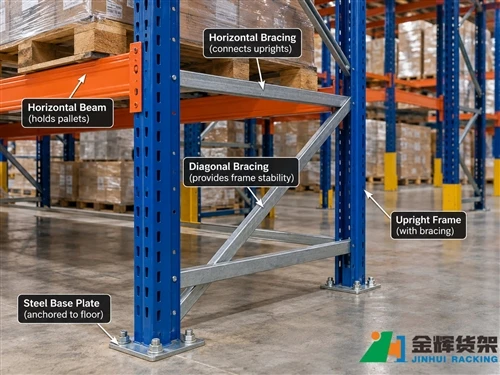
A conventional rack system may include:
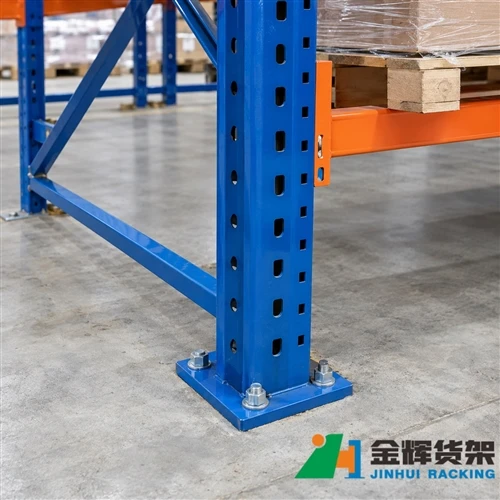
- Upright frames
- Horizontal beams
- Base plates
- Bracing components
- Safety accessories
- Row spacers
- Pallet supports
This modular structure makes it possible to configure rack rows according to the available building space and storage requirements.
Industrial pallet racking systems can therefore be planned around both current storage needs and potential future configuration changes.
Plan Future Expansion Around Existing Rack Rows
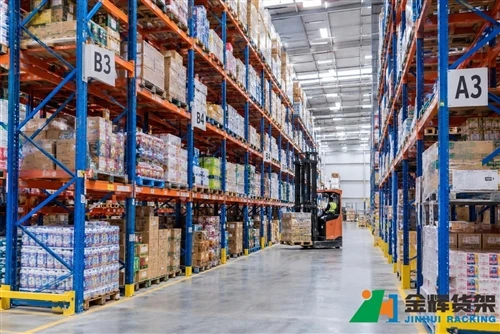
One practical approach is to establish a clear rack-row structure from the beginning.
For example, a warehouse may initially install:
- Row A
- Row B
- Row C
- Row D
while leaving a suitable area for:
- Row E
- Row F
The future rows do not need to be installed immediately, but their potential position can be considered during the initial layout design.
This helps preserve the overall traffic pattern and makes future expansion more predictable.
Do Not Use Every Empty Floor Area for Future Racking
It may seem efficient to plan racks across every available part of the building, but warehouses require more than storage positions.
Space may also be needed for:
- Receiving
- Shipping
- Staging
- Order picking
- Packaging
- Forklift movement
- Maintenance
- Pedestrian movement
Future rack expansion should therefore be balanced against the warehouse's operational requirements.
A warehouse with maximum theoretical rack density may not provide maximum practical efficiency.
Future Expansion and Forklift Aisles
Forklift movement is one of the most important considerations when planning future rack additions.
Adding a rack row changes the surrounding traffic pattern.
If the future rack position creates a narrow or awkward travel route, the expansion may reduce operational efficiency even though it adds pallet positions.
Our previous article on warehouse aisle width and pallet racking explains why material handling equipment should be considered when determining rack spacing and warehouse circulation.
Future expansion should preserve the operating requirements of the forklifts being used in the warehouse.
Consider Future Forklift Changes
Warehouse equipment may change as storage requirements increase.
A facility that currently uses one type of forklift may eventually introduce:
- Reach trucks
- Electric forklifts
- Counterbalance forklifts
- Very narrow aisle equipment
- Automated guided vehicles
Different equipment can have different operating requirements.
If a future expansion depends on changing the material handling equipment, this should be considered during the original layout planning stage.
A rack layout that works well for today's equipment may not necessarily be optimal for tomorrow's equipment.
Plan for SKU Growth, Not Just Pallet Growth
Warehouse expansion is not always caused by storing more pallets of existing products.
Sometimes growth comes from adding more SKUs.
This distinction is important.
A warehouse that grows from 1,000 pallets to 1,500 pallets of the same ten products may have different storage requirements from a warehouse that grows from 1,000 pallets across 100 SKUs to 1,500 pallets across 500 SKUs.
As discussed in our article on SKU variety and pallet racking layout, product diversity can influence accessibility, location planning, and the suitability of different rack configurations.
Future expansion planning should therefore consider both pallet volume and SKU complexity.
Reserve Capacity for Seasonal Inventory
Some warehouses experience significant inventory fluctuations throughout the year.
For these facilities, average inventory may not be the correct number to use when planning pallet racking.
Instead, planners should consider peak storage demand.
For example, a warehouse may normally hold 1,500 pallets but reach 2,000 pallets during a seasonal sales period.
If the rack layout is designed around the 1,500-pallet figure without considering peak inventory, temporary overflow storage may become necessary.
Our previous article about pallet racking for seasonal inventory provides additional considerations for warehouses with significant inventory fluctuations.
Future Rack Expansion and Warehouse Columns
Building columns can become a major limitation when additional rack rows are added later.
A rack layout that looks expandable on a simple floor plan may become difficult to extend if future rack positions conflict with structural columns.
For this reason, future expansion planning should include the building's structural grid.
Our previous article, How Warehouse Columns Affect Pallet Racking Layout, explains how structural columns can influence rack positioning and warehouse aisle planning.
The future expansion area should be reviewed in the same way as the initial rack area.

A scalable pallet racking layout can reserve suitable space for additional rack rows while maintaining forklift aisles and warehouse workflow.
How Much Expansion Space Should a Warehouse Reserve?
There is no universal percentage that applies to every warehouse.
The appropriate amount depends on:
- Expected inventory growth
- Building size
- SKU growth
- Seasonal demand
- Customer growth
- Available floor space
- Forklift requirements
- Future business plans
For some warehouses, expansion may mean adding several rack bays.
For others, the more important requirement may be the ability to add additional rack levels or reconfigure existing storage positions.
The expansion strategy should therefore be based on the warehouse's expected development rather than an arbitrary empty-space percentage.
Vertical Expansion vs. Horizontal Expansion
Warehouse storage capacity can generally be increased in two directions: vertically and horizontally.
Vertical Expansion
Adding additional storage levels can increase pallet capacity without occupying additional floor area.
However, vertical expansion depends on factors such as:
- Building clear height
- Forklift lift height
- Load requirements
- Beam spacing
- Sprinkler and fire protection requirements
- Building and rack engineering requirements
Horizontal Expansion
Adding additional rack bays or rows increases storage capacity by using more floor area.
This approach may be easier in a warehouse with sufficient unused floor space, but it also affects aisles, traffic flow, and other operating areas.
A good long-term plan considers both possibilities.
Do Not Assume Existing Racks Can Simply Be Made Taller
One common misunderstanding is that a warehouse can always add another beam level whenever more storage is needed.
Rack height and load capacity are part of the engineered system.
Before changing beam elevations or adding storage levels, the rack configuration should be reviewed to confirm that the proposed modification is appropriate.
The building itself may also impose limitations.
Future expansion should therefore be planned as an engineered change rather than an improvised modification.
Plan Future Rack Expansion Around Safety Requirements
Warehouse expansion should never sacrifice safe operating conditions to gain additional pallet positions.
Future rack rows should be evaluated in relation to:
- Forklift travel
- Pedestrian routes
- Rack protection
- Emergency access
- Building exits
- Fire protection systems
- Load capacity
- Rack stability
When the warehouse is expanded, the modified configuration should be reviewed as a complete system rather than treating the new rack bays as independent components.
Design a Consistent Location Numbering System
Future expansion can also affect warehouse location codes.
If the original warehouse uses rack locations such as:
A-01-01
A-01-02
A-01-03
future rack rows should follow the same logical structure whenever practical.
This helps avoid major changes to inventory records when additional storage is added.
A consistent location system also makes it easier for warehouse employees to understand newly installed rack sections.
Plan Future Expansion Without Disrupting Existing Inventory
One of the biggest operational challenges during warehouse expansion is that the existing inventory does not disappear while the construction or rack installation takes place.
If the expansion requires removing or relocating existing rack rows, the warehouse may temporarily lose storage capacity.
A better approach is to identify expansion areas that can be developed with minimal disruption where possible.
For example, an unused section of the warehouse may be reserved for future racks rather than filling that area with temporary equipment or unrelated storage.
This can make later expansion more straightforward.
Use a Phased Pallet Racking Expansion Strategy
Not every warehouse needs to install its maximum planned capacity immediately.
A phased strategy can allow the business to add storage as demand increases.
For example:
- Install the initial rack configuration.
- Reserve suitable expansion areas.
- Monitor inventory growth.
- Add rack bays when the existing capacity approaches the operational target.
- Review forklift routes and inventory locations after expansion.
This approach can reduce unnecessary upfront investment while maintaining a clear path for future growth.
How to Know When More Pallet Racking Is Needed
Warehouse managers can monitor several indicators.
- Average rack occupancy is consistently high.
- Peak-season inventory frequently exceeds available positions.
- Temporary floor storage is increasing.
- Fast-moving products are occupying unsuitable locations.
- New SKUs cannot be assigned proper storage positions.
- Forklift operators frequently move pallets to create temporary space.
- Inventory is being stored outside designated rack locations.
These signs may indicate that the warehouse has moved beyond its original storage strategy.
Temporary Floor Storage Is Not Always a Long-Term Solution
When pallet rack capacity becomes insufficient, warehouses sometimes place additional pallets directly on the floor.
Floor storage can be appropriate for certain operating conditions, but it should not automatically become the permanent replacement for properly planned rack storage.
Excessive floor storage can reduce available working space and complicate inventory organization.
If the warehouse consistently needs more pallet positions, expanding the racking system may provide a more structured long-term solution.
Future Expansion and Storage Efficiency
A scalable warehouse layout should not sacrifice today's efficiency unnecessarily.
Leaving excessive unused space simply because the warehouse might grow in the future can reduce current storage efficiency.
The better approach is to identify realistic expansion scenarios.
For example:
- Where would the next rack row go?
- How would forklifts reach it?
- Would the existing aisles remain functional?
- Would the location codes remain logical?
- Would the new rack conflict with columns or building services?
- Would additional storage affect staging areas?
If these questions can be answered during the initial planning process, future expansion becomes much easier to manage.
Common Mistakes in Warehouse Rack Expansion Planning
Using All Available Space Immediately
Filling every possible area with racks can leave no practical path for future expansion.
Ignoring Future SKU Growth
More SKUs can create different storage requirements even when total pallet volume does not increase dramatically.
Planning Expansion Without Checking Columns
Structural columns and building services can make apparently available areas unsuitable for future rack rows.
Changing Rack Dimensions Between Expansion Phases
Introducing completely different rack modules can make the warehouse more difficult to manage.
Ignoring Future Forklift Requirements
A future rack layout should remain compatible with the material handling equipment used in the warehouse.
Adding Capacity Without Reviewing Inventory Flow
More pallet positions do not automatically mean better warehouse performance. The new rack configuration should support receiving, storage, picking, replenishment, and shipping.
Questions to Ask Before Expanding Pallet Racking
Before adding new rack bays or rows, warehouse managers should review:
- How many additional pallet positions are actually required?
- Is the growth temporary or permanent?
- Are new SKUs driving the demand?
- Are current rack locations being used efficiently?
- Can existing rack levels be optimized?
- Is there enough clear height for vertical expansion?
- Where can additional rack rows be installed?
- Will the expansion affect forklift aisles?
- Will building columns interfere with the new layout?
- Will inventory location codes need to change?
- Can the expansion be completed without major operational disruption?
- Does the proposed rack configuration meet the required load and engineering conditions?
FAQ About Future Pallet Racking Expansion
Can pallet racking be expanded after installation?
In many cases, pallet racking can be extended or reconfigured using compatible components, provided that the new configuration is properly engineered and suitable for the intended loads and warehouse conditions.
Should I install all future pallet rack capacity immediately?
Not necessarily. A phased expansion strategy can allow a warehouse to add capacity as inventory grows while avoiding unnecessary initial investment.
How much space should I leave for future pallet racking?
There is no universal percentage. The appropriate amount depends on expected inventory growth, SKU expansion, building dimensions, operational requirements, and business plans.
Is vertical expansion better than adding more rack rows?
It depends on the warehouse. Vertical expansion can increase capacity without using additional floor area, but it depends on building height, equipment capabilities, rack engineering, and other site conditions.
Can future rack expansion use the same components as the existing system?
Compatible components may be used when the specifications match, but existing and new rack components should be verified for compatibility, load capacity, dimensions, and engineering requirements before installation.
Should future expansion be included in the initial warehouse layout?
Yes. Planning future rack positions during the initial design can help preserve forklift routes, building access, structural clearances, and logical storage zones.
Final Thoughts
A pallet racking system should support the warehouse not only as it exists today, but also as the business is expected to develop.
Future expansion planning does not mean leaving large amounts of unused warehouse space. It means making deliberate decisions about rack dimensions, row positions, inventory growth, forklift movement, building structure, and potential storage requirements before the current layout becomes a limitation.
A well-planned expandable rack layout can allow a warehouse to add storage capacity in stages while maintaining a consistent operating structure.
For growing warehouses, the most effective strategy is often to combine current storage efficiency with realistic future flexibility.
The best time to plan your next pallet rack expansion is before you need it.
Need a Scalable Pallet Racking Solution?
Jinhui Rack provides customized pallet racking solutions for warehouses, distribution centers, manufacturing facilities, 3PL operations, and industrial storage applications.
Our team can evaluate your warehouse dimensions, current pallet capacity, SKU profile, forklift requirements, structural conditions, and expected growth to develop a scalable storage layout.
If you are planning a new warehouse or preparing to expand an existing pallet racking system, send us your warehouse dimensions and storage requirements for a customized solution.
WhatsApp: +86 185 0252 7163
Email: info@jhrack.com