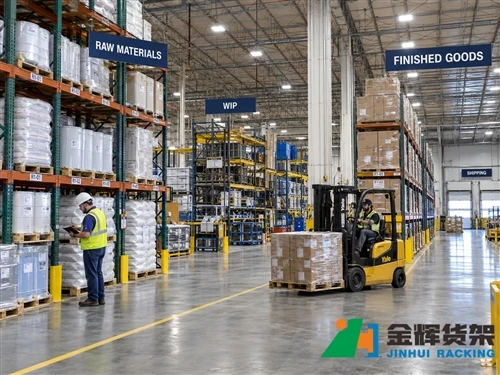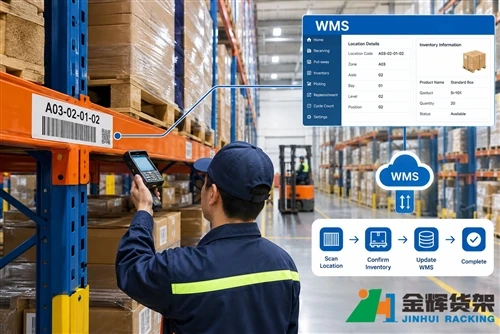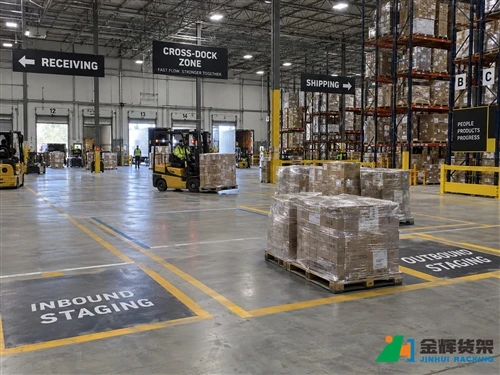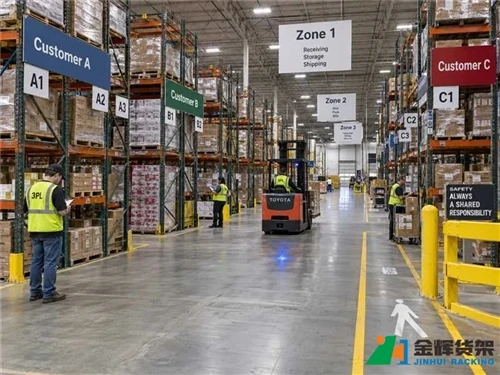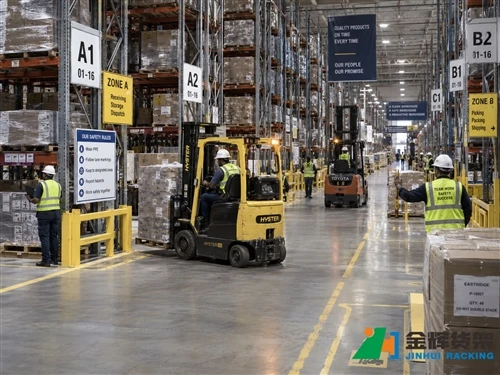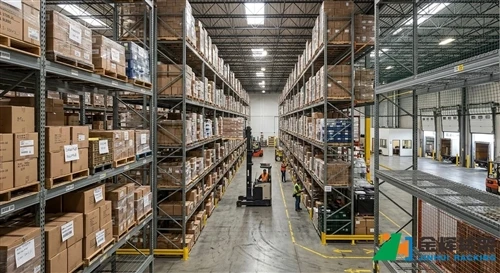
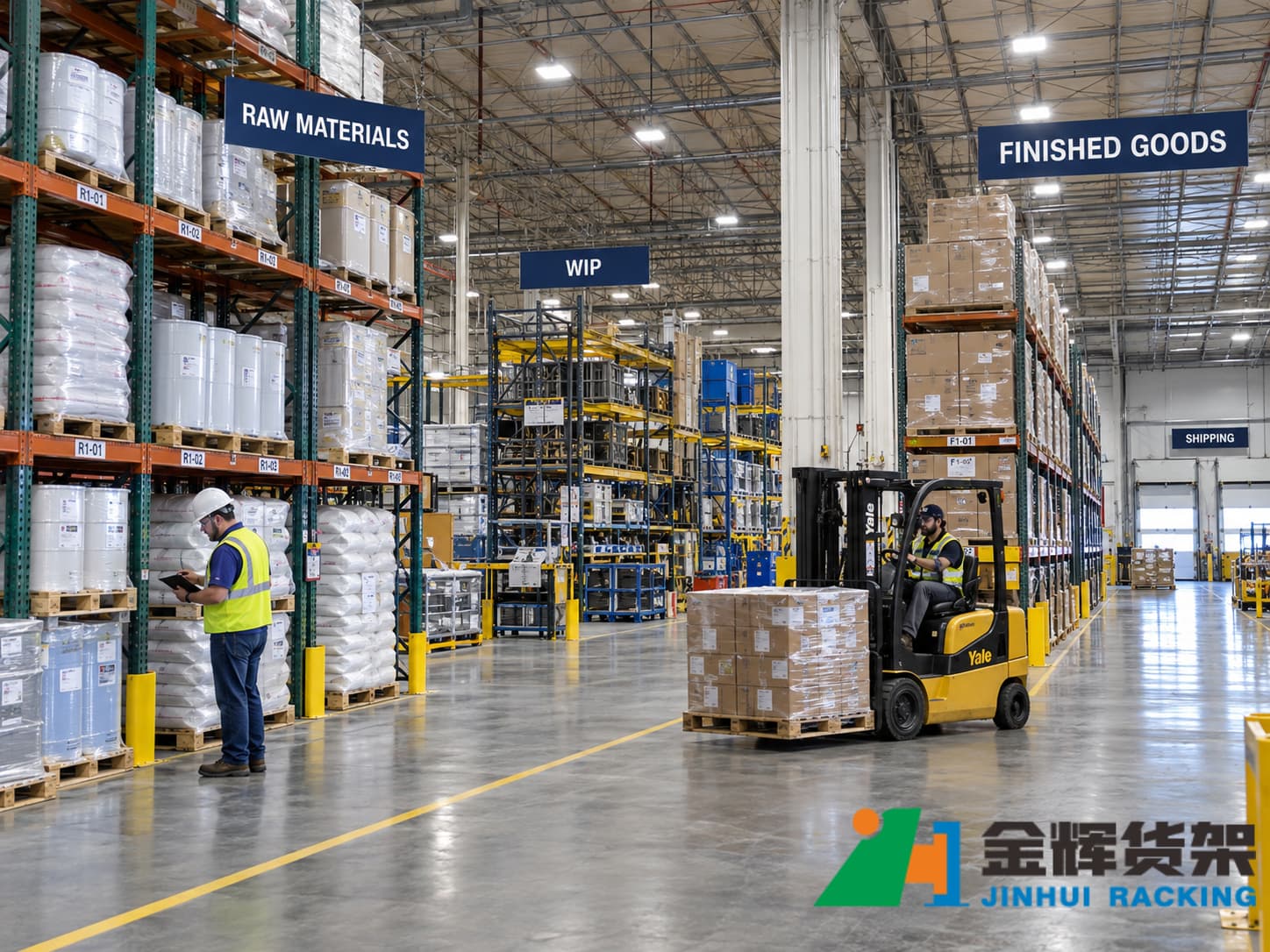
Manufacturing warehouses have different storage requirements from general distribution warehouses. Materials may enter the facility as raw materials, move into production as work-in-process inventory, and later return to storage as finished goods.
This means pallet racking cannot be planned only around the number of pallets that need to be stored. The rack layout also needs to support the relationship between purchasing, receiving, production, intermediate storage, finished goods, and shipping.
A well-organized manufacturing warehouse can use pallet racking to separate these inventory stages while keeping material movement clear and accessible. This article explains how to plan pallet racking for raw materials, work-in-process inventory, finished goods, and production support areas.
Why Manufacturing Warehouses Need a Different Pallet Racking Approach
In a conventional distribution warehouse, inventory may primarily move between receiving, storage, picking, and shipping. A manufacturing facility usually has additional movements between storage and production.
A typical manufacturing material flow may look like this:
Receiving → Raw Material Storage → Production → WIP Storage → Production → Finished Goods Storage → Shipping
Some products may bypass one or more of these stages, but the basic principle remains the same: the rack system needs to support production as well as warehouse storage.
| Inventory Stage | Typical Purpose | Storage Consideration |
|---|---|---|
| Raw materials | Supply production operations | Accessible storage with clear material identification |
| Work-in-process | Hold materials between production stages | Short-term or controlled intermediate storage |
| Finished goods | Hold completed products before shipment | Storage based on order frequency and shipment requirements |
| Production buffer stock | Maintain material availability near production | Convenient access without obstructing production routes |
How to Organize Pallet Racking for Raw Materials
Raw materials are often the first major inventory category entering a manufacturing facility.
Depending on the industry, these materials may include steel components, plastic parts, packaging materials, chemicals, components, fabric, electronic parts, or other production inputs.
The storage strategy should consider how frequently materials are issued to production and whether different materials have different handling requirements.
For manufacturing warehouses with many different material types, individually accessible pallet positions can simplify inventory identification and retrieval.
Selective pallet racking provides direct access to individual pallet positions and adjustable beam levels, making it suitable for warehouses where raw material types and pallet configurations vary.
How to Separate Raw Material Storage From Production Areas
Raw material racks should be close enough to production to support efficient material supply, but they should not automatically occupy every available space around the production line.
If pallet racks extend too far into production working areas, forklifts and production personnel may compete for the same space.
A better approach is to establish a clear boundary between warehouse storage and production operations.
The warehouse can then use designated transfer points or material presentation areas where pallets are moved from storage toward production without turning production space into a permanent storage zone.
How to Manage Work-in-Process Pallet Storage
Work-in-process, or WIP, is one of the main differences between manufacturing warehouses and ordinary distribution warehouses.
WIP may consist of partially completed products, components waiting for the next production stage, assembled units awaiting inspection, or materials temporarily held between processes.
WIP storage should be treated differently from long-term reserve inventory.
The warehouse should define whether WIP requires:
- Short-term floor staging
- Dedicated rack positions
- Production-side buffer locations
- Controlled intermediate storage
- Special identification or quality status areas
The correct arrangement depends on the production process and the physical characteristics of the WIP.
When Should WIP Be Stored in Pallet Racking?
Not every WIP pallet needs to enter a conventional rack.
If the material will move to the next production stage within a short period, a designated staging position may be more practical. However, when production schedules create longer waiting periods, controlled rack storage can prevent WIP from occupying valuable production floor space.
For example, a manufacturing facility may use pallet racks for WIP that must wait several hours or days before the next processing stage, while keeping immediate production buffers on the floor near the relevant work center.
This distinction helps prevent temporary production materials from gradually becoming uncontrolled floor storage.
How to Organize Finished Goods Pallet Racking
Finished goods normally have a different storage purpose from raw materials.
Once production is complete, products may need to remain in storage until they are released for shipment. Some finished goods may ship within hours, while others may remain in inventory for weeks or longer.
The finished goods rack area should therefore be organized around shipment frequency, product variety, pallet quantity, and order requirements.
Fast-moving finished goods may require easier access, while products stored in larger quantities may be candidates for higher-density storage configurations.
Jinhui's warehouse pallet rack solutions include selective, drive-in, push-back, pallet flow, and other configurations that can be matched to different inventory characteristics and operating requirements.
How to Separate Raw Materials and Finished Goods
Raw materials and finished goods should not automatically share the same storage zone simply because both are palletized.
The two inventory categories have different operational roles.
| Factor | Raw Materials | Finished Goods |
|---|---|---|
| Main destination | Production | Customer or shipping operation |
| Typical movement | Receiving → Production | Production → Shipping |
| Storage priority | Reliable production supply | Order fulfillment and shipment readiness |
| Inventory status | Available for production | Completed and available for shipment |
| Location planning | Related to production demand | Related to shipping and order frequency |
Separating the two areas can also make inventory identification easier and reduce the possibility of materials being sent to the wrong operational destination.
How Production Buffer Stock Works With Pallet Racking
Manufacturing facilities often need a small quantity of materials close to production even when the main inventory is stored in a warehouse rack.
This creates a two-stage storage model.
Reserve storage → Production buffer → Production line
The reserve rack stores the main inventory, while the production buffer provides convenient access to materials required for immediate operations.
The buffer should be sized according to actual production consumption rather than becoming an uncontrolled extension of the warehouse.
How to Position Racks Around Manufacturing Columns and Equipment
Manufacturing warehouses often contain more fixed obstacles than standard storage buildings. These may include production machines, columns, conveyors, utilities, doors, inspection areas, and material transfer points.
Rack rows therefore cannot always be arranged in a simple repetitive grid.
The layout should account for fixed building structures and production equipment before the final rack positions are established.
Rack aisles should also provide enough operating space for the forklifts or other material-handling equipment used in the facility.
Jinhui designs pallet racking according to warehouse dimensions, pallet size, load requirements, forklift type, and required storage capacity rather than relying on a single standard configuration. :contentReference[oaicite:2]{index=2}
How Pallet Size Can Change Across Manufacturing Stages
One manufacturing facility may use different pallet configurations for raw materials, WIP, and finished goods.
For example, raw materials may arrive on standardized supplier pallets, while finished products may be placed on a different pallet size for customer shipment.
WIP may also have unusual dimensions because the product is only partially assembled.
This means the rack design should not be based on only one pallet specification if the manufacturing process uses several pallet types.
Before designing the rack system, record the:
- Pallet length and width
- Loaded pallet height
- Maximum loaded weight
- Number of pallets per SKU or product type
- Potential pallet overhang
- Different pallet configurations used during production
How Load Weight Changes From Raw Materials to Finished Goods
The weight of a pallet may also change during the manufacturing process.
A pallet containing raw components can have a different load weight from a pallet containing completed products. The same is true for WIP pallets.
This matters because rack beams, upright frames, storage levels, and the overall rack structure need to be designed around the actual loading conditions.
The warehouse should therefore identify maximum loaded pallet weights for each major storage category rather than assuming that every pallet has the same load.
For heavy industrial applications, Jinhui's industrial heavy duty pallet racks can be configured around pallet dimensions, load requirements, rack height, beam levels, and warehouse operating conditions.
How to Handle Materials Waiting for Quality Inspection
Manufacturing warehouses may also need to store materials that have not yet been released for production or shipment.
These materials should have a clearly defined physical status.
For example, the warehouse may need separate locations for:
- Incoming materials awaiting inspection
- Approved raw materials
- Materials on quality hold
- WIP awaiting inspection
- Finished goods awaiting release
The exact status categories depend on the company's quality-control process.
The important principle is that physically stored materials with different operational statuses should not be indistinguishable.
How to Organize Rack Locations by Production Demand
Rack locations can be organized according to how frequently materials are required by production.
Frequently consumed raw materials may be placed in locations that are easier to access, while less frequently required materials can be assigned to other storage positions.
This does not necessarily mean that the closest rack position is always the best position. The warehouse should also consider pallet weight, forklift access, product characteristics, and replenishment requirements.
The objective is to reduce unnecessary material travel without creating congestion around production areas.
How to Connect Production Storage With Finished Goods Shipping
Finished goods often need to move from production into storage and eventually toward shipping.
If the finished goods rack area is difficult to access from the production area, forklifts may need to travel through unnecessary parts of the warehouse.
At the same time, finished goods should not occupy receiving or raw-material handling areas.
A practical layout therefore establishes a clear route between production output, finished goods storage, and shipping.
This route should accommodate normal forklift movements while avoiding unnecessary interaction with raw material receiving traffic.
Selective vs High-Density Racking in Manufacturing Warehouses
Manufacturing warehouses often contain a mixture of inventory profiles, so different storage systems may be appropriate for different areas.
| Storage Requirement | Potential Rack Configuration |
|---|---|
| Many raw material SKUs requiring individual access | Selective pallet racking |
| Large quantities of similar materials | Drive-in or other high-density storage |
| Multiple pallets per product with moderate access requirements | Push-back racking |
| High-turnover products requiring FIFO movement | Pallet flow racking |
| High-density automated storage requirements | Radio shuttle or ASRS solutions |
These configurations should not be selected only by storage density. The inventory profile, pallet characteristics, access requirements, forklift operation, and production process all need to be considered.
For manufacturing facilities with many different materials and frequent access requirements, Jinhui's selective pallet racking systems provide individually accessible pallet positions and adjustable beam levels. :contentReference[oaicite:3]{index=3}
How to Prevent Production Areas From Becoming Storage Areas
One common manufacturing warehouse problem is the gradual accumulation of pallets around production equipment.
A pallet may be placed beside a machine because the production line needs it temporarily. Another pallet is added later, and eventually the production area begins functioning as an unofficial warehouse.
This can reduce working space and make forklift movement more difficult.
A better approach is to define the maximum quantity of buffer inventory allowed at each production area and return excess material to controlled rack storage.
How to Plan Rack Expansion Around Manufacturing Growth
Manufacturing companies may add production lines, introduce new products, or increase output over time.
These changes can significantly affect warehouse storage requirements.
When planning a new rack system, it is useful to consider not only the current pallet quantity but also possible future changes in:
- Production volume
- Number of SKUs
- Raw material demand
- Finished goods inventory
- Pallet dimensions
- Required storage levels
- Forklift equipment
Modular pallet racking can make future expansion easier when the building layout and operating requirements allow additional bays or storage levels to be added.
Common Manufacturing Warehouse Racking Mistakes
Using One Storage Area for Every Inventory Type
Raw materials, WIP, and finished goods serve different purposes. Combining them without clear location rules can make material identification and movement more difficult.
Placing Too Much Inventory Near Production
Production-side buffer stock can be useful, but excessive pallet accumulation can reduce working space and obstruct material routes.
Ignoring Different Pallet Configurations
Manufacturing processes may use different pallet sizes and load weights at different stages. The rack system needs to accommodate the actual pallet configurations.
Designing Racks Without Considering Production Equipment
Machines, columns, conveyors, doors, and other fixed structures can significantly influence rack placement and forklift access.
Focusing Only on Maximum Storage Capacity
A high-density rack system may store more pallets, but manufacturing warehouses also need reliable access to production materials and finished goods.
Allowing WIP to Become Uncontrolled Storage
WIP should have defined locations and movement rules so that intermediate inventory does not gradually occupy production aisles and working areas.
Manufacturing Warehouse Pallet Racking Checklist
| Item | What to Confirm |
|---|---|
| Raw materials | Identify major raw material categories and storage quantities. |
| WIP | Determine which intermediate products require controlled storage. |
| Finished goods | Determine storage volume and shipment frequency. |
| Pallet dimensions | Record all pallet configurations used in the manufacturing process. |
| Load weight | Confirm the maximum loaded pallet weight for each major inventory type. |
| Production buffer | Define how much material can remain near each production area. |
| Rack locations | Separate raw materials, WIP, finished goods, and special-status inventory where appropriate. |
| Forklift operation | Confirm lifting height, turning requirements, and aisle needs. |
| Building structure | Map columns, doors, machines, conveyors, and other fixed obstacles. |
| Future growth | Consider additional production volume and potential rack expansion. |
How to Plan Pallet Racking for a Manufacturing Warehouse
A practical planning process can be divided into several stages.
- Map the manufacturing building and identify production areas.
- Separate raw material, WIP, and finished goods requirements.
- Record pallet dimensions and maximum loaded weights.
- Analyze production consumption and finished goods shipment patterns.
- Determine which inventory needs direct pallet access.
- Define production buffer areas separately from reserve storage.
- Review forklift routes and material transfer points.
- Compare suitable pallet rack configurations.
- Allow for future production and inventory growth.
- Have the final rack configuration reviewed according to applicable engineering and safety requirements.
This process helps ensure that the rack system supports the manufacturing operation rather than simply filling available floor space with storage positions.
Frequently Asked Questions
What type of pallet racking is suitable for manufacturing warehouses?
There is no single configuration for every manufacturing warehouse. Selective pallet racking is often useful when many raw materials or finished goods require individual pallet access, while high-density systems may be considered for large quantities of similar products.
Should raw materials and finished goods use separate pallet racks?
They do not always require completely separate rack systems, but clearly defined storage zones can make inventory identification and material movement easier. The decision depends on the manufacturing process, product characteristics, and warehouse layout.
Can WIP inventory be stored in pallet racking?
Yes. WIP can be stored in pallet racking when it needs controlled storage between production stages. The appropriate arrangement depends on the size, weight, handling requirements, and expected storage duration of the WIP.
How should production buffer inventory be managed?
Production buffer inventory should have defined limits and designated locations. The objective is to keep enough material available for production without allowing excess pallets to occupy production working areas.
Is selective pallet racking suitable for factory warehouses?
Yes. Selective pallet racking is commonly used in manufacturing warehouses because it provides direct access to individual pallet positions and can accommodate different pallet sizes and storage requirements. :contentReference[oaicite:4]{index=4}
Final Thoughts
Manufacturing warehouse pallet racking needs to support more than simple inventory storage. Raw materials must reach production efficiently, WIP needs controlled intermediate storage, and finished goods need to move from production toward shipment without creating unnecessary congestion.
The most effective approach is to treat the warehouse as part of the manufacturing process. Rack locations, production buffers, forklift routes, pallet specifications, inventory categories, and future expansion should all be considered together.
For manufacturing facilities with varied SKUs and frequent pallet access requirements, selective pallet racking provides direct access to individual pallet positions and flexible beam configurations. For higher-load industrial applications, industrial heavy duty pallet racks can be configured around the actual pallet and load requirements.
Jinhui Rack also provides customized warehouse pallet rack solutions for manufacturing facilities, with rack configurations developed around warehouse dimensions, pallet specifications, load requirements, forklift operation, storage capacity, and operational needs.
Planning pallet racking for a manufacturing warehouse? Send Jinhui Rack your warehouse dimensions, pallet sizes, maximum pallet weights, production volume, required storage positions, forklift information, and the storage requirements for raw materials, WIP, and finished goods.
Website: https://www.jinhui-rack.com/
Email: info@jhrack.com
WhatsApp: +86 185 0252 7163