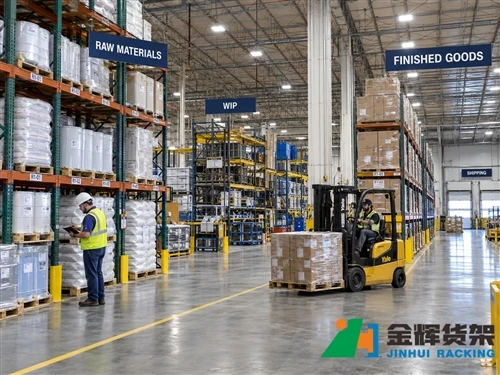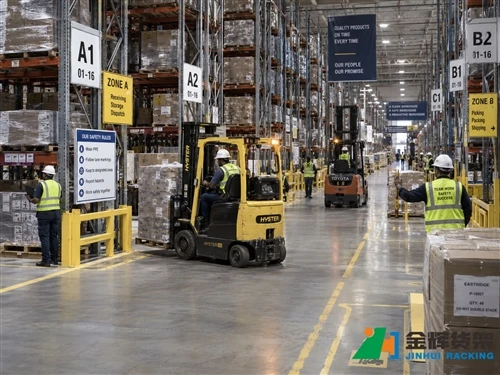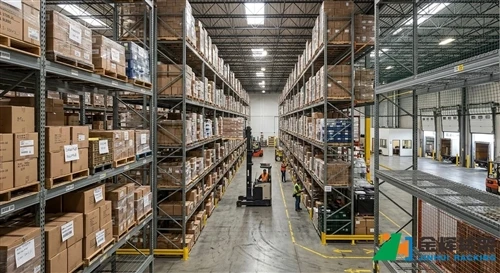
A pallet racking system organizes the physical side of warehouse storage, while a Warehouse Management System (WMS) manages the digital side of inventory and warehouse activities. When these two systems are properly connected, warehouse teams can know not only what inventory they have, but also where each pallet should be located.
This relationship becomes increasingly important as warehouses grow in size, SKU variety, storage levels, and daily pallet movements. Without a clear connection between physical rack locations and digital location records, operators may spend more time searching for inventory, correcting location errors, or manually checking stock.
Integrating pallet racking with WMS does not necessarily mean that a warehouse needs fully automated storage. Even a conventional pallet rack system can benefit from structured rack location codes, barcode scanning, mobile terminals, and disciplined inventory movement procedures.
What Is the Relationship Between Pallet Racking and WMS?
Pallet racking defines where physical inventory can be stored. A WMS records where inventory is supposed to be stored and manages the movement of that inventory through the warehouse.
For example, a selective pallet rack may contain multiple bays, beam levels, and pallet positions. Each physical position can be assigned a unique location code in the WMS.
| Physical Warehouse | WMS Record |
|---|---|
| Rack row | Row or zone identifier |
| Rack bay | Bay location code |
| Beam level | Vertical location code |
| Pallet position | Specific storage location |
| Stored pallet | Inventory record linked to location |
The goal is to create a reliable one-to-one relationship between physical storage locations and digital inventory locations.
Why Physical Rack Locations Need Digital Location Codes
A warehouse may have hundreds or thousands of pallet positions. Relying only on employee memory is not a practical long-term method for controlling inventory at this scale.
A location coding system gives each storage position a recognizable identity.
For example, a location could be represented as:
A03-B07-L04-P02
The exact format can vary, but the code may represent an aisle, rack bay, level, and pallet position.
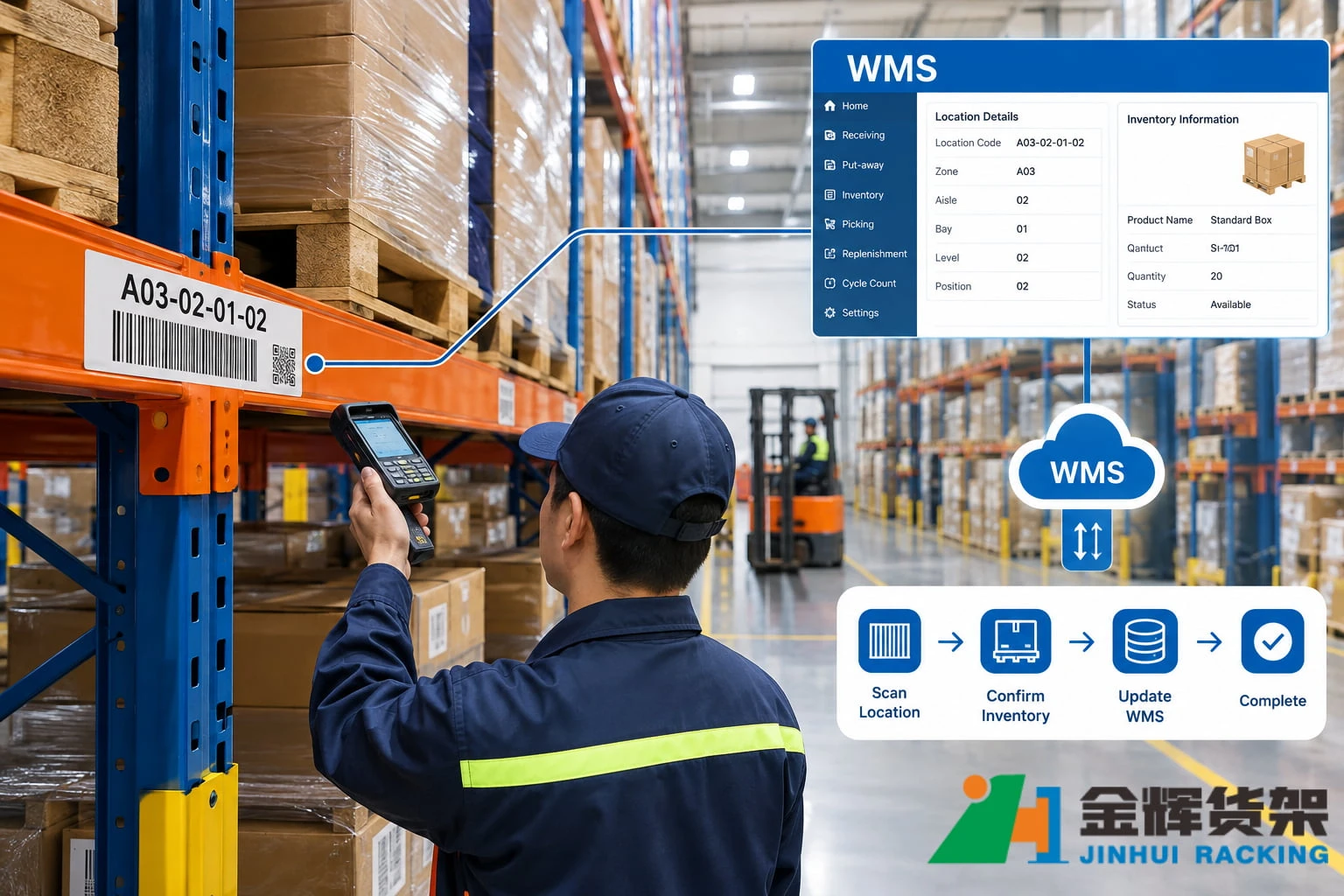
Once these identifiers are connected to WMS records, warehouse operators can use the same location reference during receiving, put-away, picking, replenishment, counting, and shipping.
How to Build a Rack Location Numbering System for WMS
A useful rack location numbering system should be consistent, logical, and easy for warehouse employees to understand.
Before creating the codes, the warehouse should define its physical storage structure.
- Divide the warehouse into logical zones.
- Assign identifiers to rack aisles or rows.
- Number rack bays in a consistent direction.
- Assign beam levels from bottom to top.
- Define pallet positions within each bay where necessary.
- Apply physical labels that match the WMS records.
The numbering direction should also be standardized. For example, bay numbers can increase from one end of an aisle to the other rather than using different numbering directions in different areas.
Consistency makes the system easier to operate and reduces location-entry mistakes.
How WMS Assigns Pallet Put-Away Locations
When a pallet arrives at the warehouse, the WMS can determine an appropriate storage location based on configured rules.
These rules may consider product characteristics, available capacity, storage zones, inventory requirements, or operational priorities.
The physical rack system must support the assumptions used by the WMS. If the software expects a location to accommodate a certain pallet size or load, the actual rack position must be capable of safely storing that pallet.
For conventional selective pallet racking, direct access to individual pallet positions makes it possible to assign different SKUs to separate locations. Jinhui's selective pallet racking systems are designed with adjustable beam levels and layouts based on pallet dimensions, warehouse conditions, load requirements, and forklift operations. :contentReference[oaicite:1]{index=1}
How Rack Location Data Improves Inventory Accuracy
Inventory accuracy depends on more than counting the correct quantity. The warehouse also needs to know where the inventory is physically located.
Consider a warehouse that records 20 pallets of a product but does not accurately track their locations. The total inventory may appear correct in the system while operators still struggle to find the physical stock.
When each pallet movement is linked to a rack location, the WMS can maintain a more useful inventory record:
- What product is stored
- How many pallets are available
- Which rack location contains the pallet
- When the pallet was moved
- Whether the pallet is available, reserved, or allocated
This makes inventory information more actionable for warehouse operators.
How WMS Tracks Pallet Movement Between Rack Locations
Pallets rarely remain in the same physical location throughout their entire warehouse lifecycle.
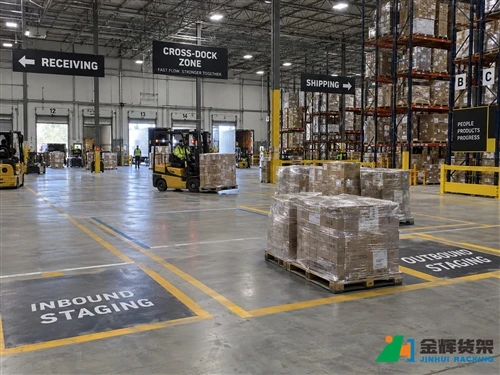
A pallet may move from receiving to temporary staging, then into reserve storage, later to a replenishment location, and eventually to shipping.
Each movement should be reflected in the WMS.
A typical movement process may look like this:
- Scan the pallet identification.
- Confirm the current location.
- Receive the destination location from the WMS or operator workflow.
- Move the pallet physically.
- Scan or confirm the destination rack location.
- Update the inventory record.
The physical movement and digital transaction should occur as closely together as practical. Delayed system updates can create a difference between the physical warehouse and the digital warehouse.
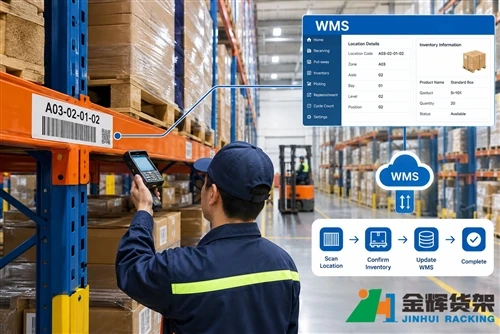
How Barcode Scanning Works With Pallet Rack Locations
Barcode labels are one of the simplest ways to connect physical rack positions with WMS records.
A barcode can be placed on the rack location so that an operator can scan the position before or after placing a pallet.
The pallet itself can also carry a barcode containing information such as a license plate number, pallet ID, SKU, or other warehouse reference.
When both the pallet and rack location are scanned, the WMS can associate the inventory with the specific physical position.
This reduces dependence on manual location entry and can help prevent errors caused by typing long location codes into handheld devices.
How RFID Can Support Automated Rack Location Tracking
RFID can provide another method of identifying pallets and warehouse locations. Instead of requiring a barcode scanner to have a direct visual relationship with a label, RFID systems can identify tagged objects using radio-frequency technology.
The practical configuration depends on the warehouse layout, equipment, required automation level, and inventory process.
RFID is particularly relevant when a warehouse wants to increase automated identification and reduce manual scanning activities.
For more automated environments, Jinhui's ASRS solutions can integrate warehouse racking with WMS, WCS, conveyors, automated handling equipment, and barcode or RFID identification systems.
How Rack Design Affects WMS Location Management
WMS integration starts with software, but the physical rack design still matters.
A rack layout that is difficult to identify physically can also be difficult to manage digitally.
For example, a warehouse should clearly distinguish between:
- Different aisles
- Different rack rows
- Different bays
- Different storage levels
- Different pallet positions
The rack structure should therefore be planned together with the location numbering system rather than adding WMS codes after the warehouse has already been installed.
How to Organize Rack Locations for Multiple SKUs
Warehouses with many SKUs often need a more structured approach to location management.
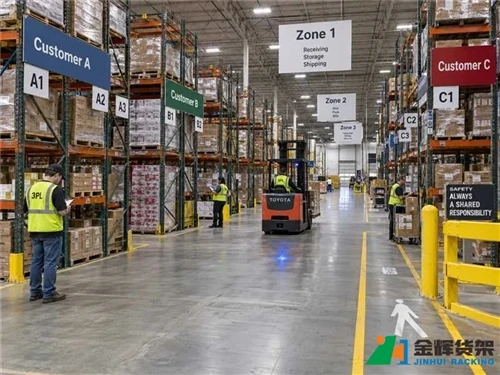
One option is to divide the warehouse into logical storage zones according to product characteristics or operational requirements.
For example, a facility might create separate areas for fast-moving products, reserve inventory, oversized pallets, temperature-sensitive products, or specific product categories.
Within each zone, the rack location codes should follow the same basic logic.
This allows the WMS to distinguish not only between individual rack positions but also between different storage areas.
How WMS Supports Replenishment From Reserve Racking
Reserve pallet racking often holds inventory that will later be moved to a picking or forward-storage area.
A WMS can use inventory information to identify when replenishment is required and determine where reserve stock is located.
The physical rack therefore becomes an important part of the replenishment process.
For example, if a forward location requires another pallet, the system can identify available reserve inventory and provide the operator with the corresponding rack location.
This can reduce unnecessary searching and make replenishment movements more systematic.
How Rack Locations Support Cycle Counting
WMS integration can also improve cycle counting by organizing counting tasks around physical locations.
Instead of manually searching for products throughout the warehouse, employees can be assigned specific rack locations or zones to verify.
The count can then compare the physical pallet or inventory quantity with the WMS record for that location.
If a discrepancy is found, the warehouse can investigate the movement history, previous transactions, and adjacent locations rather than simply changing the inventory quantity without understanding the cause.
How to Prevent WMS and Rack Locations From Getting Out of Sync
One of the biggest risks in a digitally managed warehouse is a difference between the physical rack location and the WMS location record.
Common causes include:
- Moving a pallet without recording the movement.
- Scanning the wrong rack location.
- Using a temporary staging location that does not exist in the WMS.
- Replacing rack labels without updating location records.
- Changing rack layouts without updating the digital warehouse map.
- Using the same location code for multiple physical positions.
The solution is not simply better software. Physical warehouse discipline is equally important.
What Happens When a Rack Location Changes?
Warehouse layouts can change as storage requirements evolve. Additional rack bays may be installed, existing rows may be relocated, or storage zones may be reorganized.
When this happens, the WMS location structure should be reviewed at the same time.
A physical rack change should not be treated as complete until the corresponding digital location information has also been verified.
This is particularly important when rack positions are removed or when new locations are inserted into an existing numbering sequence.
How to Prepare Pallet Racking for WMS Integration
Before implementing WMS-based rack location management, warehouse operators should collect accurate physical information.
| Information | Why It Matters |
|---|---|
| Warehouse dimensions | Defines the physical boundaries of the storage environment. |
| Rack row and bay layout | Provides the basic structure for location codes. |
| Number of storage levels | Determines the vertical component of each location. |
| Pallet dimensions | Helps determine which locations can safely accept specific pallets. |
| Maximum pallet weight | Supports appropriate rack load configuration. |
| Forklift type | Influences aisle and operating requirements. |
| Storage method | Determines how inventory locations should be represented. |
| SKU information | Supports storage rules and inventory organization. |
| Barcode or RFID strategy | Defines how pallets and locations will be identified. |
Jinhui's warehouse pallet rack solutions are designed around factors such as warehouse dimensions, pallet dimensions, load weight, SKU variety, inventory turnover, forklift type, receiving and shipping frequency, and future expansion requirements. :contentReference[oaicite:3]{index=3}
How to Match WMS With Selective Pallet Racking
Selective pallet racking is particularly straightforward to represent in a WMS because each pallet position can be individually accessed.
For example, a warehouse can create a location hierarchy such as:
Zone → Aisle → Bay → Level → Position
Each level of the hierarchy can correspond to a physical feature of the rack.
This structure makes it easier for warehouse personnel to interpret a WMS-directed movement and locate the correct physical position.
Jinhui's Selective Pallet Racking Systems provide direct access to every pallet position and can be configured according to pallet size, load capacity, rack height, beam levels, and forklift operation. :contentReference[oaicite:4]{index=4}
How WMS Works With High-Density Pallet Racking
WMS integration becomes more important when pallet locations are deeper or more complex.
In a high-density system, the WMS may need to understand not only the rack lane but also the sequence and availability of positions within that lane.
The storage logic should therefore match the physical storage method.
Jinhui's warehouse pallet rack portfolio includes selective, drive-in, push-back, pallet flow, radio shuttle, and automated storage solutions, allowing different physical storage methods to be used for different inventory requirements. :contentReference[oaicite:5]{index=5}
The WMS location structure should be designed around the actual operating behavior of the selected rack system rather than treating every rack type as a simple single pallet position.
When Should a Warehouse Consider More Automation?
WMS integration does not automatically require automated storage and retrieval equipment.
A warehouse can start with manual forklifts, rack labels, barcode scanning, and WMS-directed movements.
Higher automation levels may become appropriate when the warehouse has large transaction volumes, high storage density requirements, extended operating hours, labor constraints, or a strong need for automated inventory tracking.
In an ASRS environment, racking becomes part of a larger automated system. Jinhui's ASRS racking solution combines high-rise pallet racking with equipment such as stacker cranes, conveyors, WMS, WCS, and barcode or RFID identification systems. :contentReference[oaicite:6]{index=6}
Common Problems When Rack Locations and WMS Do Not Match
Duplicate Location Codes
Two physical rack positions should not accidentally share the same active WMS location code unless the system is intentionally structured that way.
Missing Location Labels
A WMS may contain a valid location record, but warehouse employees still need a clear physical reference to identify that location.
Unrecorded Pallet Moves
Moving a pallet physically without updating the WMS can make the digital inventory location inaccurate.
Unplanned Temporary Storage
Temporary floor locations should have defined procedures. Otherwise, inventory may disappear from its expected rack location without appearing in a controlled alternative location.
Rack Layout Changes Without WMS Updates
Adding, removing, or relocating rack positions without updating the digital location structure can create long-term inventory control problems.
WMS and Pallet Racking Integration Checklist
| Check | Question |
|---|---|
| Location structure | Does every physical storage position have a clear location identity? |
| Location labels | Are physical rack labels easy to see and consistent with WMS codes? |
| Pallet identification | Can each pallet or inventory unit be identified reliably? |
| Put-away | Can operators confirm the destination rack location? |
| Movement control | Are pallet transfers recorded when they physically occur? |
| Replenishment | Can reserve rack inventory be located quickly? |
| Cycle counting | Can counting tasks be assigned by location or zone? |
| Rack changes | Are physical rack modifications reflected in the WMS? |
| Temporary locations | Are staging and temporary storage positions controlled? |
| Future expansion | Can new rack locations be added without disrupting the existing numbering system? |
Frequently Asked Questions
Can pallet racking work with a WMS without automation?
Yes. A conventional pallet rack system can be managed through a WMS using location codes, barcode labels, handheld scanners, mobile terminals, and controlled pallet movement procedures.
Does every pallet rack location need a barcode?
Not every warehouse uses barcodes, but labeling rack locations with machine-readable identifiers can make scanning and WMS transactions easier and can reduce manual location-entry errors.
What information should be included in a rack location code?
A location code commonly identifies elements such as zone, aisle, bay, level, and pallet position. The exact structure should match the physical rack layout and warehouse operating process.
Can WMS manage selective pallet racking?
Yes. Selective pallet racking is well suited to location-based inventory management because individual pallet positions can be independently accessed and identified.
Is WMS required for ASRS pallet racking?
Automated storage and retrieval systems normally rely on software integration to coordinate inventory and automated equipment. Jinhui's ASRS solution includes WMS and WCS as components of the automated storage system. :contentReference[oaicite:7]{index=7}
Final Thoughts
Pallet racking provides the physical structure of warehouse storage, while WMS provides the digital structure for inventory and location control. When the two are designed to work together, warehouse teams can manage pallet locations more systematically and maintain better visibility of inventory movements.
The most important step is not simply installing WMS software. The physical rack layout, location numbering, rack labels, pallet identification, movement procedures, and digital location records all need to follow the same logic.
For warehouses using conventional storage, selective pallet racking can provide individually accessible pallet positions that are straightforward to map into a WMS. For larger automation projects, Jinhui also provides ASRS racking solutions integrating pallet storage with WMS, WCS, conveyors, automated handling equipment, and identification technologies.
Planning a pallet racking system for a WMS-managed warehouse? Send Jinhui Rack your warehouse dimensions, pallet size, maximum pallet weight, rack height, required pallet positions, forklift information, and current or planned WMS requirements. Our engineering team can help develop a warehouse storage solution that connects the physical rack layout with your operating process.
Website: https://www.jinhui-rack.com/
Email: info@jhrack.com
WhatsApp: +86 185 0252 7163