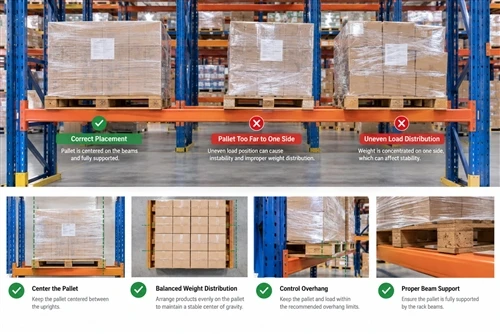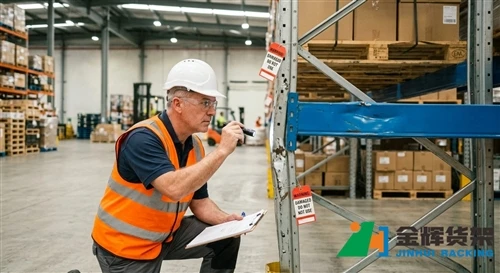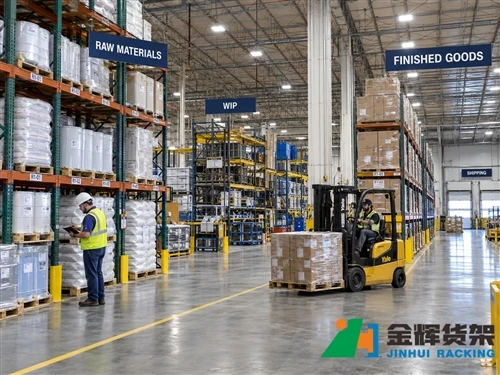
Correct pallet placement is an important part of operating a pallet racking system. Two pallets may have the same total weight but create different loading conditions if their weight is positioned differently on the pallet or if one pallet is placed incorrectly on the rack beams.
For this reason, warehouse operators should consider more than pallet weight alone. The position of the pallet, the distribution of the products on the pallet, pallet overhang, load stability, and the relationship between the pallet and rack beams all affect how a stored load behaves.
This guide explains practical pallet loading and placement principles for warehouse racking systems without replacing the engineered load rating of the rack.
What Is Pallet Rack Load Distribution?
Pallet rack load distribution describes how the weight of a stored pallet is positioned and transferred through the pallet to the rack beams and upright frames.
In a typical pallet rack, the pallet rests across a pair of horizontal beams. The pallet and its contents transfer their weight through the pallet structure and onto the supporting beams.
A properly positioned pallet allows the load to remain stable and distributes the weight in a manner consistent with the rack design. An incorrectly positioned or unstable pallet can create a different loading condition even when its total weight remains unchanged.
Why Pallet Position Matters on Warehouse Racks
A pallet should not simply be placed wherever there appears to be enough space. Its position should be consistent with the intended rack configuration and pallet support arrangement.
Incorrect placement can create several practical problems:
- The pallet may not be adequately supported by the beams.
- The load may become unstable during storage.
- Product weight may become concentrated in an unintended area.
- Pallet overhang may interfere with adjacent storage positions.
- Forklift operators may have difficulty positioning the pallet accurately.
- Repeated incorrect placement can increase the risk of rack or pallet damage.
Good loading practices therefore begin with consistent pallet positioning.
How Weight Should Be Distributed on a Pallet
The products on a pallet should be arranged so that the overall load remains stable and reasonably balanced.
Heavy products should not be placed randomly on one side of a pallet while lighter products are concentrated on the opposite side. Such an arrangement can shift the center of gravity and make the load more difficult to handle.
Whenever possible, the palletized load should have a stable base and a controlled center of gravity. Packaging, stacking pattern, product shape, and securing methods should all be considered when preparing pallets for rack storage.
The objective is not simply to make the pallet look full. The objective is to create a stable unit load that can be safely transported and stored.
Keep Pallets Properly Positioned Between the Rack Uprights
Once a pallet reaches the rack, it should be positioned according to the intended pallet location rather than being left significantly off-center.
Correct positioning helps maintain consistent clearance between adjacent loads and keeps the pallet within the intended storage space.
For warehouses with multiple pallet positions in one bay, operators should also avoid allowing one pallet to encroach into the neighboring position. Consistent positioning makes each storage location easier to identify and reduces interference during loading and unloading.
How Pallet Overhang Affects Load Placement
Pallet overhang occurs when part of the pallet or its load extends beyond the intended supporting area.
A small difference in position may appear insignificant during normal warehouse operations, but repeated overhang can change how the pallet is supported and can reduce the available clearance between adjacent loads.
Warehouse operators should therefore follow the pallet support and positioning requirements established for the specific rack configuration.
Do not assume that a pallet can be moved farther forward or backward simply because there is unused space. The rack should be loaded according to its approved configuration.
Front-to-Back Load Positioning
Correct front-to-back positioning is particularly important when pallets are stored on beams with defined support requirements.
The pallet should be placed so that the supporting structure engages the pallet in the intended manner. Excessive forward or backward movement can change the relationship between the pallet and the beams.
Forklift operators should approach each rack position carefully and place the pallet smoothly instead of using the forks to push or drag a pallet into its final position.
Consistent placement also makes rack inspections easier because abnormal pallet positions become easier to identify.

Left-to-Right Load Distribution Across Rack Beams
A pallet stored on a rack should also be positioned so that its load is supported consistently across the intended beam arrangement.
If a pallet is significantly shifted to one side, the loading condition may differ from the intended configuration. This is especially important when multiple pallets share the same beam level.
Operators should avoid deliberately positioning heavy pallets at the extreme side of a storage position unless the rack design specifically allows that arrangement.
Clear operating procedures can help forklift drivers place pallets consistently from one shift to another.
How Uneven Product Loading Changes Pallet Stability
The total weight of a pallet does not tell the entire story. The location of that weight within the pallet load also matters.
For example, a pallet containing evenly distributed cartons may remain stable during forklift movement, while a pallet with most of its heavy products concentrated near one edge may have a less stable center of gravity.
Uneven loads can also create problems when pallets are lifted, transported, or placed at higher rack levels.
Warehouse teams should therefore check both the total pallet weight and the physical condition of the palletized load before storing it.
Load Distribution When Storing Different Pallet Sizes
Warehouses sometimes store pallets with different dimensions in the same facility. A larger pallet, smaller pallet, or different pallet construction may interact differently with the rack system.
Before mixing pallet types within a rack configuration, warehouse planners should verify:
- Pallet length and width
- Pallet construction
- Loaded pallet height
- Maximum pallet weight
- Load stability
- Required support arrangement
- Clearance between neighboring loads
A pallet that fits physically into a rack position is not automatically suitable for that position. Pallet dimensions and loading characteristics should be considered together with the rack design.
How Forklift Operators Can Improve Pallet Placement
Forklift operation has a direct influence on the consistency of pallet loading.
Operators should approach the rack squarely, position the forks correctly, and place pallets smoothly without striking beams or adjacent pallets.
Useful operating practices include:
- Approach rack locations at a controlled speed.
- Keep the pallet stable during lifting and travel.
- Align the pallet with the intended storage position.
- Avoid pushing pallets against rack components.
- Do not use the forklift to reposition a poorly loaded pallet by force.
- Check the final pallet position before withdrawing the forks.
Consistent forklift practices can help maintain more predictable storage conditions across different shifts and operators.
Heavy Pallets and Load Placement
Heavy pallets require particular attention to both load stability and placement accuracy.
Warehouse operators should follow the approved rack loading configuration rather than deciding where a heavy pallet should be stored based only on available space.
When product weights change significantly, the warehouse should review the rack design information before changing the normal loading pattern.
Heavy products should also be palletized securely so that their center of gravity remains controlled during forklift handling and rack storage.
How to Handle Mixed-Weight Pallets in the Same Rack Bay
Many warehouses do not have identical pallet weights across every storage position. One bay may contain light consumer products while another contains substantially heavier inventory.
The solution is not simply to fill every available position without considering the approved rack configuration.
Warehouse managers should identify the applicable loading requirements for each rack configuration and communicate them clearly to operators.
Where different rack configurations have different approved loading conditions, capacity information should remain clearly associated with the relevant rack areas.
Common Pallet Loading and Placement Mistakes
Placing Pallets Too Far Forward
A pallet should not be pushed forward simply to make room behind it. Its position should follow the intended support arrangement and operating requirements.
Concentrating Heavy Products on One Side
Uneven product placement can shift the center of gravity and make the pallet less stable during handling.
Allowing Pallet Overhang Without Verification
Uncontrolled overhang can reduce clearance and change the intended relationship between the pallet and rack components.
Mixing Pallet Types Without Checking Compatibility
Different pallet dimensions and construction methods may require different storage arrangements.
Using the Forklift to Correct Poor Pallet Placement
Forklifts should place pallets accurately rather than being used to force pallets into position after they have been incorrectly loaded.
Changing Loading Practices Without Reviewing Rack Information
A change in product weight, pallet type, or storage arrangement may affect the intended loading condition. Significant changes should be reviewed with the rack supplier or qualified engineer.
Practical Pallet Rack Load Placement Checklist
- Check that the pallet is in good condition before storage.
- Confirm that the load is stable and properly arranged.
- Distribute products on the pallet to maintain a stable center of gravity.
- Position the pallet according to the rack's intended support arrangement.
- Avoid unnecessary front-to-back or side-to-side offset.
- Control pallet and product overhang.
- Maintain appropriate clearance from adjacent pallets and rack components.
- Use consistent forklift placement procedures.
- Do not exceed the approved rack loading configuration.
- Review changes in pallet size or weight before changing storage practices.
How Pallet Placement Works With a Properly Designed Rack System
Good load placement begins before a pallet enters the warehouse. Rack design should be based on actual pallet dimensions, maximum pallet weight, storage levels, pallet positions, forklift requirements, and the intended loading arrangement.
JINHUI Selective Pallet Racking Systems provide direct access to individual pallet positions and can be configured according to pallet specifications, warehouse dimensions, load requirements, and forklift operations.
Learn more about JINHUI Selective Pallet Racking Systems.
FAQ About Pallet Rack Load Distribution
Should pallets be centered on pallet rack beams?
Pallets should be positioned according to the approved rack and pallet configuration. Operators should avoid arbitrary offsets that change the intended support arrangement.
Does pallet weight distribution matter if the total weight is within the rack capacity?
Yes. Total weight is only one part of the loading condition. The physical distribution of products on the pallet can affect load stability and how the pallet transfers weight to the supporting structure.
Can different pallet sizes be stored in the same pallet rack?
It depends on the rack configuration and the specific pallet characteristics. Pallet dimensions, construction, load weight, support requirements, and clearances should be reviewed before mixing pallet types.
What should operators do if a pallet is loaded unevenly?
An unstable or severely uneven pallet should be corrected before rack storage. Warehouse personnel should not rely on the rack to compensate for an improperly prepared pallet.
Does proper pallet placement replace rack load-capacity requirements?
No. Correct pallet placement supports proper operation, but it does not increase the engineered capacity of a rack. The rack must always be operated within its approved design requirements.
Improve Pallet Storage With Correct Loading Practices
Proper pallet rack load distribution is not simply about knowing how much a pallet weighs. Warehouse operators also need to consider where that weight is positioned, how stable the palletized load is, how the pallet sits on the rack beams, and whether the loading method matches the intended rack configuration.
Consistent pallet preparation and accurate forklift placement can help warehouses maintain organized storage conditions and reduce unnecessary handling problems.
JINHUI Rack can provide pallet racking solutions based on your pallet dimensions, load requirements, warehouse conditions, and storage objectives.
Contact JINHUI Rack:
WhatsApp: +86 185 0252 7163
Email: info@jhrack.com
Website: https://www.jinhui-rack.com/