Cold storage warehouses have different requirements from conventional ambient-temperature warehouses. Low temperatures, condensation, limited floor space, energy costs, specialized forklifts, and high inventory turnover can all influence the choice of a cold storage pallet racking system.
In a refrigerated or frozen warehouse, the rack is not simply a structure for holding pallets. Its layout affects storage density, forklift movement, air circulation, inventory access, and the amount of expensive temperature-controlled space required.
For this reason, pallet racking should be selected according to the complete cold storage operation rather than based only on the pallet dimensions or rack price.
Quick Answer
The right pallet racking for a cold storage warehouse depends on storage temperature, pallet dimensions, maximum pallet weight, required storage density, SKU characteristics, forklift type, inventory rotation, and available cold-room space. Selective pallet racking is suitable when direct pallet access is important, while higher-density systems such as drive-in, push-back, or pallet flow racking may be considered for specific inventory profiles.
Why Cold Storage Requires Different Pallet Racking Considerations
Cold storage facilities are designed to maintain controlled temperatures for products such as frozen food, fresh food, pharmaceuticals, chemicals, and other temperature-sensitive goods.
The storage environment can create several challenges for conventional warehouse racking.
- Low operating temperatures
- Condensation and moisture
- Limited storage volume
- Higher energy costs
- Frequent forklift movement
- Strict hygiene requirements in some industries
- High inventory turnover
- Need for efficient space utilization
Because refrigerated space is expensive to build and operate, maximizing usable storage volume can be especially important.
What Type of Pallet Racking Is Used in Cold Storage?
There is no single racking system suitable for every cold storage warehouse.
The most appropriate system depends on inventory characteristics and operating requirements.
Common options include:
- Selective pallet racking
- Drive-in pallet racking
- Push-back racking
- Pallet flow racking
- Double deep pallet racking
- Radio shuttle racking
Each system provides a different balance between storage density, accessibility, selectivity, and warehouse throughput.
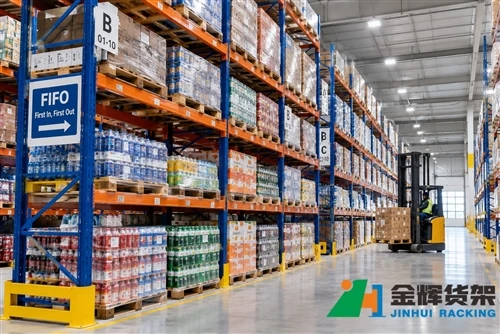
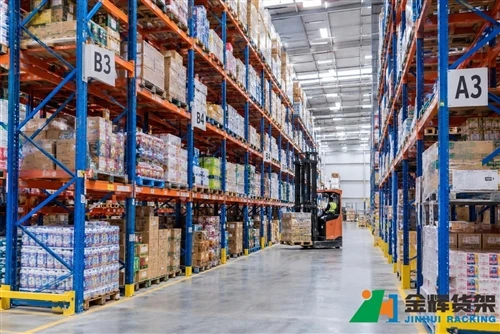
For a general-purpose warehouse where individual pallet access is important, industrial pallet racking with a selective configuration can be a practical starting point.
Selective Pallet Racking for Cold Storage
Selective pallet racking provides direct access to individual pallet positions.
This can be valuable in cold storage facilities with many different SKUs, variable inventory quantities, or frequent pallet retrieval.
The main advantages include:
- Direct access to individual pallets
- Flexible beam levels
- Easy inventory identification
- Suitable for a wide range of pallet sizes
- Simple integration with conventional forklifts
The main limitation is that selective storage does not provide the same storage density as deep-lane systems.
For cold rooms where SKU variety is high, however, accessibility may be more important than achieving maximum pallet density.
When Should You Consider High-Density Cold Storage Racking?
High-density storage can become attractive when the warehouse stores large quantities of the same or similar products.
Instead of creating an individual aisle for every pallet position, high-density systems can reduce the amount of aisle space required.
This can increase the number of pallets stored within the same temperature-controlled building volume.
However, higher density usually involves some compromise in pallet selectivity or inventory flexibility.
The correct choice therefore depends on how the inventory is received, stored, rotated, and retrieved.
Drive-In Racking for Frozen and Refrigerated Storage
Drive-in pallet racking is often considered when a cold storage facility needs high-density pallet storage for products with relatively consistent inventory characteristics.
Forklifts can enter the storage lanes to load and retrieve pallets, reducing the number of conventional operating aisles required.
This can be useful when:
- Large quantities of the same product are stored
- SKU variety is relatively limited
- Storage density is a major priority
- Frequent individual pallet access is not required
Drive-in storage is not automatically the best solution for every cold warehouse. Inventory rotation and forklift operating practices should be reviewed before selecting the system.
Push-Back Racking for Cold Storage
Push-back racking can provide higher storage density while maintaining forklift access from the operating aisle.
Pallets are stored at multiple depths and are moved along inclined rails or carts during loading and retrieval.
This configuration can be useful for warehouses that need more pallet positions than selective racking can provide but still require relatively convenient access to different product groups.
Push-back systems are particularly worth evaluating when the warehouse stores products in batches rather than requiring every pallet to be individually accessible at all times.
Pallet Flow Racking for Temperature-Controlled Warehouses
Pallet flow racking uses gravity-assisted movement to move pallets through storage lanes.
This configuration can be valuable when inventory rotation is important.
For example, a food distribution warehouse may need to follow a first-in, first-out inventory strategy.
With the appropriate configuration, pallets can be loaded from one side and retrieved from another, supporting organized product rotation.
Cold storage operators should evaluate the roller system, pallet type, product weight, temperature conditions, and maintenance requirements before selecting pallet flow equipment.
How Temperature Affects Pallet Rack Selection
Temperature is one of the first environmental conditions that should be communicated to the racking manufacturer.
A refrigerated warehouse may operate above freezing, while a freezer warehouse can operate at significantly lower temperatures.
The exact operating temperature should therefore be specified during the design stage.
Other environmental conditions may also need to be considered:
- Humidity
- Condensation
- Cleaning procedures
- Water exposure
- Corrosive environments
- Food hygiene requirements
The rack finish and material selection should be appropriate for the actual environment and application.
Why Condensation Matters in Cold Storage Racking
Temperature changes can create condensation on metal surfaces.
Repeated exposure to moisture can contribute to corrosion if the rack finish is not appropriate for the environment.
This is particularly important in facilities where doors are frequently opened and closed or where warm and cold areas are located close together.
The racking manufacturer should be informed about the expected humidity and cleaning conditions so that an appropriate surface treatment can be considered.
How Pallet Size Affects Cold Storage Rack Design
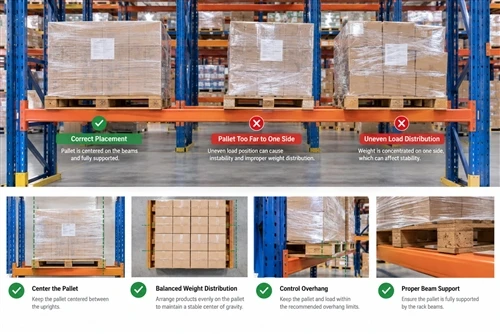
Pallet dimensions remain important even when the rack is installed inside a freezer or refrigerated room.
The rack needs to accommodate the actual pallet dimensions, load distribution, required clearances, and storage configuration.
Common pallet sizes may include:
- 1200 × 800 mm
- 1200 × 1000 mm
- 1100 × 1100 mm
- 48 × 40 inches
- Other application-specific pallet sizes
Cold storage facilities should measure the actual pallets being used instead of assuming that all pallets follow one standard.
Our previous article on how pallet size affects pallet racking design provides additional information about this relationship.
How Maximum Pallet Weight Affects Cold Storage Racking
The maximum loaded pallet weight should be provided when designing the rack system.
A warehouse storing lightweight packaged food products may have very different loading requirements from a facility storing frozen meat, beverages, or other dense products.
The design should consider:
- Maximum pallet weight
- Number of pallets per beam level
- Number of storage levels
- Beam span
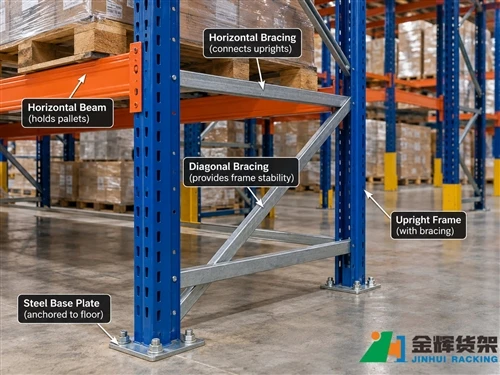
- Upright frame configuration
- Load distribution
It is better to design around the maximum expected load rather than the average pallet weight.
For more information, see How to Determine Pallet Rack Load Capacity for Warehouse Storage.
Cold Storage Space Is Expensive: Why Density Matters
Constructing and operating temperature-controlled space can be significantly more expensive than maintaining an ordinary warehouse.
Every square meter of unused floor space inside a refrigerated facility represents capacity that may be difficult to recover later.
For this reason, cold storage rack planning should consider the relationship between:
- Pallet positions
- Aisle space
- Rack height
- Rack depth
- Building height
- Equipment access
A higher-density racking system may allow more pallets to be stored within the same building footprint, but the system must remain compatible with the warehouse's inventory and handling requirements.
Forklift Selection for Cold Storage Warehouses
Forklift operation is another important part of cold storage rack planning.
The equipment must be suitable for the temperature and operating environment while providing enough lift height and maneuverability for the selected rack configuration.
Rack planning should therefore consider:
- Forklift type
- Maximum lifting height
- Turning radius
- Aisle requirements
- Load capacity
- Cold-room operating conditions
For example, selecting a high-density rack system that requires specialized forklift operation may not be appropriate if the facility does not have the necessary equipment.
How Aisle Width Affects Cold Storage Capacity
Aisle width has a direct relationship with the amount of floor area available for pallet storage.
Wider aisles can make forklift operation easier, but they also consume valuable cold-room floor space.
Narrower aisles may increase storage density, but the forklift must be capable of operating safely within the selected aisle configuration.
The correct aisle dimension should therefore be determined from the actual material handling equipment and rack layout rather than choosing the narrowest possible aisle.
Our article How Warehouse Aisle Width Affects Pallet Racking provides additional background on this topic.
Cold Storage Racking and FIFO Inventory Rotation
Inventory rotation can be particularly important for temperature-sensitive products.
Food, pharmaceutical, and other perishable products may need to be stored and retrieved according to defined inventory rotation procedures.
Depending on the operation, FIFO-oriented pallet flow systems may provide advantages over conventional selective storage.
However, FIFO is not required for every cold storage application. The inventory strategy should be determined first, followed by the selection of the rack configuration.
Cold Storage Racking for High-SKU Warehouses
Facilities storing a large number of SKUs need to balance storage density with product accessibility.
Selective pallet racking can provide direct access to individual pallet positions, which can simplify inventory management when many different products are stored.
For warehouses with fewer SKUs and larger quantities per SKU, deeper storage systems may provide better space utilization.
The key question is not simply how many pallets can fit? but rather how often does each pallet need to be accessed?
How Rack Height Can Improve Cold Storage Utilization
When building height allows it, vertical storage can help increase the number of pallet positions without expanding the cold-room footprint.
However, increasing rack height affects the entire warehouse design.
The following factors need to be reviewed:
- Clear ceiling height
- Forklift lifting capability
- Beam elevations
- Pallet height
- Load requirements
- Fire protection arrangements
- Building structure
Higher racks should therefore be treated as part of an engineered storage solution rather than simply adding additional levels to an existing rack.
Cold Storage Rack Layout Planning
A good cold storage layout should consider more than the rack itself.
The complete plan may include:
- Receiving areas
- Shipping areas
- Temperature transition zones
- Rack aisles
- Forklift travel paths
- Picking areas
- Staging areas
- Emergency access
- Building columns
- Refrigeration equipment
Rack rows should be positioned to support the actual material flow through the facility.
This can reduce unnecessary forklift travel and make better use of expensive temperature-controlled space.

Pallet racking in a temperature-controlled warehouse should be planned around pallet access, storage density, forklift movement, and environmental conditions.
Which Pallet Rack System Is Best for a Cold Storage Warehouse?
The answer depends on the warehouse's inventory profile.
| Storage Requirement | Potential Rack Solution |
|---|---|
| High SKU variety and direct pallet access | Selective pallet racking |
| Large quantities of similar products | Drive-in racking |
| Multiple pallets per SKU with moderate selectivity | Push-back racking |
| FIFO inventory rotation | Pallet flow racking |
| Very high-density automated storage | Radio shuttle or automated storage solutions |
This table should be used as a starting point rather than a final design recommendation. Actual rack selection should be based on the warehouse's pallet dimensions, inventory turnover, temperature, equipment, and layout.
How to Choose Pallet Racking for Cold Storage
Before requesting a quotation, prepare the following information:
- Specify the storage temperature range.
- Confirm whether the room is refrigerated or frozen.
- Provide pallet dimensions.
- Provide maximum loaded pallet weight.
- Specify the number of pallets required.
- Provide the required number of storage levels.
- Identify the forklift type.
- Provide warehouse length, width, and clear height.
- Identify building columns and refrigeration equipment.
- Explain FIFO, LIFO, or other inventory requirements.
- Identify the number of SKUs.
- Describe pallet turnover and retrieval frequency.
The more complete this information is, the easier it is for the racking manufacturer to develop a suitable configuration.
Common Mistakes When Choosing Cold Storage Pallet Racking
Choosing the Rack Before Defining the Inventory Strategy
A rack system should support the way products are actually stored and retrieved.
Ignoring Temperature and Condensation
Environmental conditions can influence material selection and surface treatment.
Focusing Only on Maximum Storage Density
High density can reduce accessibility. The correct system needs to balance density and operational efficiency.
Using the Same Aisle Configuration as an Ambient Warehouse
Cold storage facilities may use different handling equipment and space constraints.
Ignoring Future Capacity Requirements
If the business expects inventory growth, future storage requirements should be considered during the initial layout planning stage.
Not Considering Pallet Quality
Damaged or inconsistent pallets can create problems in some high-density storage systems. The pallet type should be compatible with the selected rack configuration.
FAQ About Cold Storage Pallet Racking
What type of pallet racking is best for cold storage?
There is no single best system for every cold storage warehouse. Selective racking is suitable when direct pallet access is important, while drive-in, push-back, pallet flow, or shuttle systems may be more appropriate when storage density or inventory rotation is the priority.
Can standard pallet racking be used in a freezer warehouse?
A rack system can be designed for cold or frozen environments, but the operating temperature, moisture, condensation, surface treatment, pallet type, and other environmental conditions should be reviewed before selecting the final configuration.
Is selective pallet racking suitable for cold storage?
Yes. Selective pallet racking can be suitable for cold storage facilities that handle many SKUs and require direct access to individual pallets.
How can I increase cold storage pallet capacity?
Potential approaches include increasing rack height where practical, optimizing aisle dimensions, using deeper storage configurations, improving pallet layout, or selecting high-density systems such as drive-in, push-back, pallet flow, or shuttle racking.
Does cold temperature affect pallet rack design?
Yes. Temperature, condensation, humidity, cleaning conditions, and potential corrosion should be considered when designing the rack system and selecting its finish.
Can pallet racking be customized for a freezer warehouse?
Yes. Rack height, depth, beam levels, bay configuration, storage density, and system type can be customized according to the cold storage facility's requirements.
Final Thoughts
Choosing pallet racking for cold storage is primarily a warehouse planning decision rather than simply a product selection decision.
The right system needs to balance temperature conditions, pallet loads, storage density, forklift access, SKU variety, inventory rotation, and the limited volume of temperature-controlled space.
Selective pallet racking can be an effective option for high-SKU operations that require direct pallet access, while deeper storage systems can provide advantages when storage density is the primary objective.
The best approach is to evaluate the complete warehouse operation before selecting the rack configuration.
Planning a pallet racking system for a refrigerated or frozen warehouse? Jinhui Rack can help develop a storage configuration based on your pallet dimensions, load requirements, storage temperature, warehouse layout, forklift equipment, and inventory strategy.
Talk to Jinhui Rack About Your Cold Storage Project
Whether you need selective pallet racking, drive-in racking, push-back storage, pallet flow racking, or another high-density pallet storage solution, our team can help evaluate the appropriate configuration for your cold storage facility.
Send us your warehouse dimensions, pallet size, maximum pallet weight, storage temperature, required pallet positions, and forklift information for a customized solution.
WhatsApp: +86 185 0252 7163
Email: info@jhrack.com