When planning a pallet racking system, warehouse managers often start with the rack itself. In reality, one of the most important design inputs is the pallet.
The length, width, height, and loaded weight of a pallet influence almost every major dimension of a warehouse rack layout. They affect rack depth, beam length, storage levels, aisle requirements, pallet positions, forklift operation, and ultimately the amount of inventory a warehouse can store.
This is why a pallet racking system should not be designed around a generic "standard rack size" before the actual pallet specifications are confirmed.
Quick Answer
Pallet size affects pallet racking design by determining the required rack depth, beam length, vertical clearance, aisle width, pallet position configuration, and storage density. Larger or irregular pallets generally require more operating space, while standardized pallet dimensions make rack layout planning easier. The rack should be designed around the actual loaded pallet dimensions and handling equipment rather than relying only on nominal pallet size.
Why Pallet Size Matters in Pallet Racking Design
A pallet is not simply a platform for moving products.
Once a pallet is loaded and placed into a rack, its physical dimensions become part of the storage system.
For example, changing from a 1,000 mm × 1,200 mm pallet to a larger pallet can affect:
- Rack frame depth
- Beam length
- Pallet positions per bay
- Aisle width
- Forklift maneuvering space
- Vertical storage clearance
- Back-to-back rack spacing
- Total warehouse storage capacity
Even when the warehouse building remains exactly the same, changing pallet dimensions can require a different rack configuration.
What Pallet Dimensions Should Be Measured?
Before designing or modifying a pallet racking system, collect the actual dimensions of the pallets that will be stored.
At minimum, measure:
- Pallet length
- Pallet width
- Overall loaded height
- Maximum loaded weight
It is important to measure the pallet together with the product rather than considering the empty pallet only.
A pallet may be 150 mm high, but the finished load could be 1,400 mm high. The rack level must accommodate the complete stored unit.
Pallet Size vs Loaded Pallet Size
One of the most common planning mistakes is using the nominal pallet dimensions while ignoring the actual load.
Consider a pallet measuring:
- 1,200 mm long
- 1,000 mm wide
- 150 mm high
If the product extends beyond the pallet footprint, the actual storage envelope is larger than the pallet itself.
For rack design purposes, the warehouse should consider the complete load profile.
This includes:
- Product overhang
- Stretch film
- Packaging materials
- Irregular cartons
- Load instability
- Actual maximum height
This information is particularly important when designing rack clearances and aisle layouts.
How Pallet Width Affects Rack Bay Design
Pallet width influences how many pallets can be stored within a single rack bay.
For example, a rack bay designed for two pallets per level will have different beam requirements from a bay designed for three pallets per level.
The design must consider:
- Pallet width
- Number of pallets per beam level
- Required clearance between pallets
- Beam length
- Load weight
- Required pallet overhang
Simply making a beam longer does not automatically create a better storage solution.
A longer beam changes the structural loading conditions and may require a different beam profile or rack configuration.
How Pallet Depth Affects Rack Depth
Pallet depth is one of the most direct factors affecting rack frame depth.
If the pallet is too large for the rack, excessive overhang or insufficient support can create operational and storage problems.
If the rack is significantly deeper than necessary, valuable warehouse floor space may be consumed without providing useful additional capacity.
Our existing guide How Deep Is Pallet Racking? explains the relationship between pallet dimensions and rack depth in greater detail.
For conventional selective pallet racking, the rack depth is commonly selected to provide appropriate pallet support while allowing practical forklift access.
The exact dimension should be determined from the pallet, rack configuration, support method, and applicable design requirements.
Does a Bigger Pallet Always Require a Deeper Rack?
Not necessarily.
Rack depth should not simply equal pallet depth.
The final design depends on how the pallet is supported, the direction in which it enters the rack, beam arrangement, required clearances, and the specific rack system.
For example, a pallet stored in a selective rack may have a different support arrangement from a pallet stored in a drive-in system.
This is why pallet dimensions should be treated as a starting point for rack engineering rather than as a simple one-to-one dimension.
How Pallet Height Affects Rack Level Spacing
Pallet height determines how much vertical space is needed between rack beams.
A warehouse should consider the maximum loaded pallet height, not only the average pallet height.
For example, if most pallets are 1,200 mm high but some products reach 1,500 mm, designing every rack level around the smaller pallets may create operational problems.
Rack level spacing should account for:
- Maximum pallet height
- Load variation
- Forklift handling requirements
- Beam dimensions
- Required vertical clearance
- Building clear height
- Fire protection and building services
Using the actual inventory profile can help avoid excessive unused vertical space while maintaining appropriate clearance.
How Pallet Weight Affects Rack Design
Pallet dimensions are only one part of the design.
The maximum loaded weight is equally important.
Two pallets may have identical dimensions but completely different weights.
For example:
| Pallet | Dimensions | Loaded Weight | Design Consideration |
|---|---|---|---|
| A | 1200 × 1000 mm | 600 kg | Standard-duty storage |
| B | 1200 × 1000 mm | 1,500 kg | Higher load requirement |
| C | 1400 × 1200 mm | 1,500 kg | Larger footprint and higher load |
The rack system needs to accommodate both the physical dimensions and the structural load requirements of the stored pallet.
Pallet Size Also Affects Aisle Width
Aisle width is often discussed as a forklift issue, but pallet dimensions are also part of the equation.
A larger pallet requires the forklift to handle a larger load envelope.
This can affect:
- Turning space
- Fork insertion
- Load positioning
- Clearance from rack uprights
- Cross-aisle movement
Our article How Warehouse Aisle Width Affects Pallet Racking explains why aisle design needs to be matched to the actual handling equipment.
The correct aisle dimension should be determined from the forklift manufacturer's requirements, load dimensions, operating method, and warehouse layout.
Standard Pallets Make Warehouse Planning Easier
Standardized pallet dimensions can simplify rack design because the storage system can be built around a consistent load footprint.
When most pallets have similar dimensions, the warehouse can more easily standardize:
- Rack depth
- Beam length
- Storage levels
- Pallet positions
- Forklift procedures
- Inventory locations
This consistency can improve both warehouse planning and day-to-day operation.
However, "standard pallet" does not mean that every warehouse should use the same rack dimensions.
Different pallet standards are common in different regions and industries.
Common Pallet Sizes Used in Warehouses
Industrial warehouses may encounter several pallet formats depending on the region, industry, and supply chain.
Common dimensions include:
| Pallet Format | Typical Dimensions | Common Use |
|---|---|---|
| EUR / Euro pallet | 1200 × 800 mm | European logistics |
| North American pallet | Approx. 1200 × 1000 mm | General industrial storage |
| Large industrial pallet | Varies by application | Heavy or oversized products |
These dimensions are examples rather than universal rack specifications. Actual pallet and rack dimensions should always be confirmed for the specific project.
What Happens When a Warehouse Uses Multiple Pallet Sizes?
This is common in manufacturing, distribution, and 3PL warehouses.
A facility may receive pallets from different suppliers or store products with different packaging requirements.
In this situation, using one rack configuration for every pallet may not provide the best result.
Possible strategies include:
- Grouping similar pallet sizes into dedicated rack zones
- Using adjustable beam levels
- Separating oversized pallets from standard pallets
- Using different rack depths where appropriate
- Assigning high-density storage to compatible pallet groups
This can reduce wasted space and make pallet handling more predictable.
Why 3PL Warehouses Need Special Pallet Planning
Third-party logistics warehouses often handle products from multiple customers.
As a result, pallet dimensions can vary significantly between accounts.
A 3PL warehouse may need to accommodate:
- Different pallet footprints
- Different load heights
- Different pallet weights
- Different packaging types
- Different inventory turnover rates
This makes flexible pallet racking for 3PL warehouses particularly important.
Selective pallet racking is often useful where direct access and flexibility are more important than maximum density, while high-density systems can be considered for compatible bulk inventory.
Pallet Orientation Matters Too
The same pallet can occupy a rack differently depending on its orientation.
Warehouse designers need to determine how the pallet enters and sits within the rack.
Possible considerations include:
- Long side facing the aisle
- Short side facing the aisle
- Fork entry direction
- Pallet support position
- Product overhang
- Forklift reach requirements
Changing pallet orientation can affect beam length, rack depth, aisle requirements, and storage capacity.
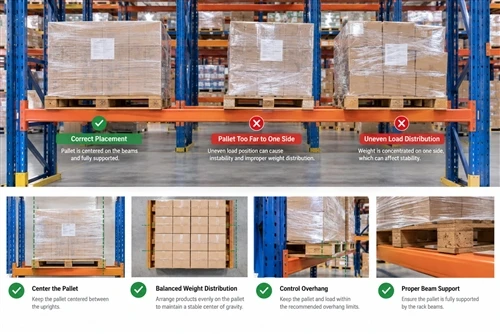
Pallet Overhang Must Be Considered
Pallet overhang is another reason why rack dimensions cannot be selected solely from nominal pallet measurements.
Depending on the rack design, the pallet may extend beyond the beam or support members by a controlled amount.
The acceptable arrangement depends on the rack configuration and engineering requirements.
Excessive or uncontrolled overhang can affect:
- Load stability
- Clearance
- Forklift operation
- Adjacent pallet positions
- Rack loading behavior
For this reason, pallet support should be evaluated during the design stage rather than adjusted after installation.
Pallet Size and Back-to-Back Rack Spacing
When rack rows are installed back-to-back, pallet dimensions also influence the required space between the rear sides of the racks.
If pallets extend beyond the rear of the rack, insufficient back-to-back clearance can cause interference between loads on opposite rack rows.
This can create problems when:
- Pallets are deeper than expected
- Loads overhang the pallet
- Pallets are not positioned consistently
- Different pallet sizes share the same rack zone
Back-to-back spacing should therefore be considered as part of the complete warehouse layout.
How Pallet Size Influences Storage Density
Storage density is not determined by rack height alone.
The pallet footprint determines how efficiently the warehouse floor can be divided into pallet positions.
For example, a rack bay designed around smaller standardized pallets may accommodate more pallet positions within a given floor area than a layout designed around large irregular loads.
However, simply choosing smaller pallets is not necessarily practical.
The pallet must be compatible with the products, packaging, forklifts, transport network, and supply chain.
Pallet Size and Selective Pallet Racking
Selective pallet racking is particularly adaptable when a warehouse handles multiple pallet sizes.
Beam levels can generally be configured to accommodate different load heights, while the rack layout can be designed around the dominant pallet footprint.
For warehouses with high SKU diversity, this flexibility can be more valuable than pursuing the highest possible storage density.
Pallet Size and Drive-In Racking
Drive-in pallet racking requires more consistent planning because pallets are stored in deep lanes.
The pallet dimensions affect the width, depth, and usable configuration of each lane.
Drive-in systems are generally more suitable when pallet dimensions and inventory characteristics are relatively consistent.
If a warehouse stores many different pallet sizes, a fully high-density drive-in layout may be less flexible than a selective configuration.
Pallet Size and Push Back Racking
Push back pallet racking stores pallets multiple positions deep and uses inclined storage lanes.
Pallet dimensions affect the usable lane depth and the arrangement of the carts or rails.
For this reason, the pallet footprint should be confirmed before the system is designed.
Using inconsistent pallet sizes within the same lane can reduce the predictability of storage and retrieval operations.
Pallet Size and Pallet Flow Racking
Pallet flow racking uses gravity-assisted movement and therefore requires careful matching between pallet characteristics and the flow lane.
The pallet must interact correctly with the rollers, guides, and braking components used in the system.
Important factors include:
- Pallet dimensions
- Pallet bottom construction
- Load weight
- Load stability
- Surface condition
- Product distribution on the pallet
Not every pallet type is automatically suitable for every pallet flow configuration.
Why Pallet Dimensions Should Be Confirmed Before Ordering Racks
One of the easiest ways to avoid costly changes is to confirm pallet specifications before the rack quotation is finalized.
For a new warehouse project, collect:
- Maximum pallet length
- Maximum pallet width
- Maximum loaded height
- Maximum loaded weight
- Fork entry direction
- Number of pallets per SKU
- Expected number of pallet positions
Providing these details to the rack manufacturer makes it easier to develop an appropriate rack layout.
Jinhui Rack's warehouse pallet rack solutions are designed around warehouse dimensions, pallet specifications, forklift requirements, and storage objectives.
Example: How a Pallet Change Can Affect a Warehouse
Imagine a warehouse originally designed around 1,200 × 1,000 mm pallets.
The warehouse later begins receiving products on larger pallets measuring 1,400 × 1,200 mm.
The change may affect:
- Rack depth
- Rack bay configuration
- Pallet positions per bay
- Aisle requirements
- Back-to-back rack spacing
- Forklift maneuvering
- Total storage capacity
If the new pallets are simply placed into the original rack without evaluating the new dimensions, the warehouse may experience poor utilization or clearance problems.
This example demonstrates why pallet dimensions should be treated as a core warehouse design parameter.
How to Design Pallet Racking Around Multiple Pallet Sizes
When a warehouse must store different pallet dimensions, a practical design process can be:
- List all pallet sizes.
- Identify the most common pallet footprint.
- Record maximum loaded height and weight.
- Group compatible pallet types.
- Assign rack zones according to pallet characteristics.
- Select suitable rack depths and beam configurations.
- Check forklift requirements.
- Calculate the resulting pallet capacity.
This approach is usually more effective than forcing every pallet into one standardized storage position.
Common Pallet Size Mistakes in Warehouse Rack Planning
Designing Around the Empty Pallet
The stored load is usually much larger and heavier than the empty pallet. Rack dimensions should account for the complete loaded unit.
Assuming All Pallets Are the Same
Warehouses serving multiple suppliers or customers may have significant pallet variation.
Ignoring Product Overhang
A product that extends beyond the pallet changes the actual storage envelope.
Using the Same Rack Depth for Every Application
Different pallet sizes and storage systems may require different rack configurations.
Changing Pallet Size Without Reviewing the Rack
A change in pallet footprint or load weight can affect the suitability of the existing storage system.
Pallet Size Should Be Considered Together With Rack Height and Aisle Width
Pallet dimensions do not work independently.
A complete rack layout needs to balance:
Pallet Dimensions
+
Rack Height & Depth
+
Beam Configuration
+
Forklift Requirements
+
Warehouse Workflow
Optimizing only one of these elements can create problems elsewhere in the warehouse.
What Information Should You Give a Pallet Rack Manufacturer?
If you are requesting a rack layout or quotation, providing complete pallet information can significantly improve the design process.
A useful project specification should include:
| Information | Why It Matters |
|---|---|
| Pallet length | Determines storage orientation and layout |
| Pallet width | Influences bay configuration |
| Loaded height | Determines vertical level spacing |
| Maximum weight | Influences structural capacity |
| Forklift type | Influences aisle and handling requirements |
| Warehouse dimensions | Determines the overall rack layout |

Pallet dimensions influence rack depth, bay configuration, storage levels, and the overall warehouse layout.
How to Optimize a Rack Layout When Pallets Are Different Sizes
If pallet sizes cannot be standardized, the warehouse can still achieve good storage efficiency by organizing inventory intelligently.
For example:
- Standard pallets can use the main rack zone.
- Oversized pallets can be assigned to dedicated bays.
- High pallets can use higher-clearance levels where appropriate.
- Heavy pallets can be placed in rack levels designed for their loads.
- Slow-moving oversized products can be assigned to suitable reserve areas.
This reduces the need to design the entire warehouse around the largest pallet when only a small percentage of inventory requires that space.
When Should You Redesign Existing Pallet Racking?
Existing racking should be reviewed when pallet specifications change significantly.
Common triggers include:
- New pallet dimensions
- Higher maximum pallet weights
- Increased product height
- Changed forklift equipment
- New storage system requirements
- Warehouse expansion
- Major inventory changes
The rack should not simply be modified based on appearance or available space. Structural and operational implications need to be evaluated before changes are made.
FAQ About Pallet Size and Pallet Racking
What pallet size is best for pallet racking?
There is no single pallet size that is best for every warehouse. The appropriate pallet depends on the products, supply chain, handling equipment, storage system, and regional pallet standards.
Does pallet size determine pallet rack depth?
Pallet dimensions are an important input when selecting rack depth, but rack depth is not necessarily identical to pallet depth. The final dimension depends on the rack system, pallet support method, orientation, and required clearances.
Can different pallet sizes be stored in the same pallet rack?
Yes, but the rack configuration and storage locations should be designed to accommodate the different pallet dimensions safely. In some warehouses, dedicated zones for different pallet sizes provide better control and space utilization.
How does pallet height affect rack design?
The loaded pallet height affects vertical beam spacing and the number of storage levels that can fit within the available building height.
Does pallet weight affect rack dimensions?
Yes. Pallet weight affects the structural load requirements of beams, upright frames, connections, and the overall rack configuration. Rack capacity should be based on the actual maximum load rather than an average pallet weight.
Should I tell the rack manufacturer my forklift model?
Yes. Forklift type, load dimensions, lifting height, and operating characteristics can affect aisle width, rack height, storage configuration, and the overall warehouse layout.
Can I change pallet sizes after installing pallet racks?
A pallet size change should be reviewed before the new pallets are introduced into the existing rack system. Changes in dimensions, weight, or load height can affect rack capacity, clearances, and handling requirements.
Final Thoughts
Pallet size is one of the fundamental inputs in pallet racking design.
It affects far more than rack depth. The pallet footprint, loaded height, weight, and orientation can influence beam length, storage levels, aisle width, pallet positions, forklift operation, and overall warehouse capacity.
The best rack layout is therefore not simply the one with the most pallet positions.
It is the layout that fits the actual pallets, supports the required loads, works with the available handling equipment, and allows inventory to move efficiently through the warehouse.
Before ordering pallet racking, confirm the maximum pallet length, width, loaded height, loaded weight, and forklift requirements. These five pieces of information can significantly affect the final rack design.
Need a Pallet Racking Layout Based on Your Pallet Size?
Jinhui Rack provides customized industrial pallet racking systems designed around actual warehouse dimensions, pallet specifications, load requirements, forklift type, and storage objectives.
Whether you need selective pallet racking, drive-in racking, push back racking, pallet flow racking, or another warehouse storage configuration, the rack should be designed around the way your pallets are actually stored and handled.
For a customized warehouse rack proposal, provide your warehouse length, width and clear height, pallet dimensions, maximum loaded pallet weight, forklift type, required storage levels, and target pallet capacity.
WhatsApp: +8618502527163
Email: info@jhrack.com