Pallet racking is designed to support heavy loads, but even a properly designed rack system can be affected by forklift impacts, overloaded pallets, damaged components, poor installation, or changes in warehouse operations over time.
For this reason, pallet rack inspection should be part of normal warehouse management rather than something performed only after an accident or visible failure.
A regular inspection does not need to be complicated. Warehouse managers can establish a practical process that checks the condition of rack frames, beams, connectors, anchors, pallets, load labels, aisles, and operating areas.
Quick Answer
A practical pallet rack inspection should check rack uprights, beams, braces, connectors, anchors, protection equipment, load signs, pallets, aisles, and visible damage. Any component that appears significantly damaged or unsafe should be assessed by a qualified person and managed according to the rack manufacturer's requirements and applicable local regulations.
Why Regular Pallet Rack Inspection Matters
Warehouse racking operates in an environment where forklifts, pallet loads, people, and storage equipment interact continuously.
Even a small forklift impact can deform a rack upright or damage a beam connection.
Other problems may develop gradually, such as:
- Damaged upright frames
- Bent beams
- Loose or damaged connections
- Missing safety components
- Damaged anchors
- Incorrectly positioned beams
- Overloaded rack levels
- Damaged pallets
- Unstable loads
- Obstructed aisles
Some problems are immediately visible, while others require closer examination or professional assessment.
The purpose of an inspection is therefore not simply to decide whether a rack "looks good." It is to identify conditions that could affect the rack's intended performance and determine what action should be taken.
How Often Should Pallet Racking Be Inspected?
The inspection frequency should be based on the warehouse environment, rack usage, forklift traffic, local requirements, manufacturer's recommendations, and the organization's safety procedures.
A practical warehouse management system can include several levels of checking:
| Inspection Type | Typical Purpose |
|---|---|
| Routine visual checks | Identify obvious damage or abnormal conditions during normal operations |
| Scheduled internal inspections | Review rack components and warehouse conditions systematically |
| Professional assessment | Evaluate significant damage, modifications, or technical concerns |
There is no universal inspection schedule that applies identically to every warehouse. The appropriate procedure should follow the applicable rack standard, local regulations, manufacturer instructions, and site-specific risk assessment.
What Should Be Included in a Pallet Rack Inspection?
A complete visual inspection should consider more than the rack beams alone.
Warehouse managers should establish a checklist covering the entire storage system and its operating environment.
The main inspection categories include:
- Rack uprights
- Horizontal beams
- Braces
- Beam-to-frame connections
- Base plates and anchors
- Rack protection
- Load signs and identification
- Pallet condition
- Stored load stability
- Aisle and operating clearances
- Visible modifications
- Housekeeping around the rack system
1. Inspect Pallet Rack Uprights
Upright frames are among the most important structural components in a pallet rack system.
They carry vertical loads from beams and stored pallets down toward the floor.
During inspection, look for visible signs such as:
- Bent upright columns
- Dents
- Twisting or deformation
- Cracked or damaged components
- Corrosion
- Damaged frame bracing
- Missing structural components
Forklift impact is a common source of rack damage because the lower portions of upright frames are located close to operating aisles.
If an upright appears significantly deformed, the warehouse should not simply straighten it and continue using the rack without appropriate technical evaluation.
2. Check Pallet Rack Beams
Beams support the pallet loads placed on each storage level.
Inspect beams for visible signs of:
- Bending
- Deformation
- Impact damage
- Damaged beam connectors
- Displaced beams
- Unexpected changes in beam position
A beam that has been impacted by a forklift may require assessment even when the damage initially appears minor.
Warehouse personnel should also verify that the beam configuration matches the intended rack design.
3. Check Beam-to-Upright Connections
The connection between beams and upright frames is critical to the rack assembly.
During an inspection, check for obvious signs that a connection has been damaged, displaced, or modified.
Depending on the rack design, connections may include locking pins, clips, hooks, or other components specified by the manufacturer.
Missing or improperly installed locking components should be addressed according to the rack manufacturer's instructions.
4. Inspect Bracing Components
Rack frames normally include horizontal and diagonal bracing that helps maintain the geometry and structural behavior of the frame.
Inspect these components for:
- Bending
- Impact damage
- Loose connections
- Missing components
- Visible corrosion
A damaged brace should not be ignored simply because it does not directly support a pallet.
5. Check Base Plates and Floor Anchors
Rack uprights transfer loads through base plates and anchors to the warehouse floor.
Visible inspection should look for:
- Damaged base plates
- Loose or missing anchors
- Cracked concrete around anchors
- Unexpected movement
- Visible corrosion
If the warehouse floor has changed, been repaired, or developed cracking around rack anchors, the condition should be evaluated before assuming that the rack remains suitable for its original loading.
6. Inspect Rack Protection Equipment
Rack protection can reduce the potential consequences of forklift contact with vulnerable rack components.
Common protection equipment includes:
- Column guards
- End-of-aisle guards
- Frame protectors
- Barrier systems
Protection equipment should itself be inspected for damage.
A severely damaged guard may no longer provide the protection expected from its original design.
7. Verify Rack Load Information
Warehouse employees need to understand the intended loading limits of the rack system.
Load information should be clearly communicated through appropriate rack labels, signs, documentation, or warehouse procedures.
Important information may include:
- Maximum beam or level capacity
- Maximum bay capacity where applicable
- Permitted pallet configuration
- Number of pallets per level
- Rack configuration requirements
The exact capacity depends on the rack design, component dimensions, loading configuration, and engineering assumptions.
Never assume that two visually similar rack systems have identical load capacities.
8. Check for Overloaded Rack Levels
A rack may appear structurally normal while being loaded beyond its intended capacity.
This can happen when:
- Pallet weights increase
- New products are introduced
- Beam levels are changed
- Additional pallets are added
- Inventory procedures change
Warehouse managers should compare actual stored loads with the rack's approved capacity information.
If the warehouse operation has changed substantially since the rack was installed, the storage system should be reviewed rather than assuming that the original design still covers the new application.
9. Inspect the Condition of Pallets
Pallet condition is closely connected to rack storage performance.
A damaged pallet can create problems even when the rack itself is in good condition.
Look for:
- Broken boards
- Cracked components
- Missing support elements
- Severe deformation
- Unstable loads
- Contamination that affects load stability
Pallets should be suitable for the intended storage system and loading method.
10. Check Pallet Placement
Pallets should be positioned consistently within the rack system according to the rack design.
During inspection, look for pallets that are:
- Improperly positioned
- Visibly unstable
- Excessively overhanging
- Damaged
- Placed outside designated storage locations
Operators should follow the warehouse's established pallet placement procedures rather than creating their own storage methods.
11. Check Rack Aisles
A rack inspection should also consider the space immediately surrounding the storage system.
Aisles should remain suitable for the intended forklift and warehouse traffic.
Look for:
- Obstructions
- Stored pallets outside designated areas
- Damaged floor surfaces
- Blocked emergency routes
- Accumulated packaging materials
- Unsafe pedestrian conditions
A warehouse can have structurally sound racks but still operate inefficiently or unsafely if the surrounding aisles are poorly managed.
For more information about the relationship between aisle dimensions and rack layout, see How Warehouse Aisle Width Affects Pallet Racking.

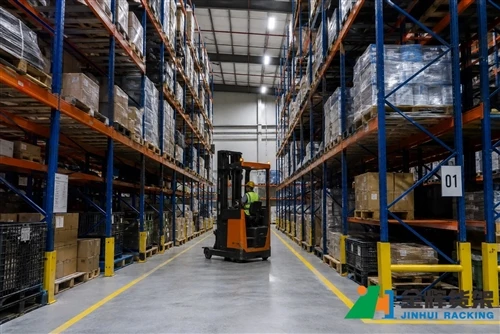
Routine visual checks can help warehouse teams identify visible rack damage, displaced components, and abnormal storage conditions.
12. Look for Forklift Impact Damage
Forklift traffic is one of the main reasons warehouse racking needs ongoing inspection.
Impact can occur during:
- Pallet put-away
- Pallet retrieval
- Turning at aisle intersections
- Reverse travel
- Loading and unloading operations
Damage is particularly important around lower rack components because these areas are closest to forklift operating paths.
After a significant impact, the affected rack should be assessed according to the warehouse's damage-response procedure.
What Should You Do When Rack Damage Is Found?
Finding damage is only the first step.
The warehouse should have a clear response procedure.
A practical process can include:
- Identify the affected rack location.
- Record the visible condition.
- Prevent further use if the condition presents an immediate concern.
- Notify the responsible warehouse or safety personnel.
- Obtain appropriate technical assessment where required.
- Repair or replace components according to approved procedures.
- Document the corrective action.
The exact response depends on the type and severity of damage and the requirements applicable to the warehouse.
Do Not Repair Damaged Racking Without Technical Guidance
One common mistake is trying to repair rack components using improvised methods.
Examples may include:
- Heating and straightening structural members
- Welding damaged components without engineering approval
- Drilling new holes into structural members
- Replacing components with visually similar parts
- Removing braces to make room for equipment
These changes can affect the original structural design.
Rack repairs and modifications should therefore follow the manufacturer's approved procedures or be evaluated by an appropriately qualified professional.
Why Rack Modifications Need to Be Controlled
Warehouse operations often change after a rack system has been installed.
A company may:
- Change pallet sizes
- Increase pallet weight
- Change forklift equipment
- Add storage levels
- Move beams
- Change aisle layouts
- Install conveyors
- Add protective barriers
Any modification that changes the rack's structural configuration or loading assumptions should be reviewed appropriately.
A rack designed for one configuration should not automatically be treated as suitable for a different configuration.
Check Rack Configuration After Warehouse Reorganization
Warehouse rearrangement is another situation where inspections become particularly important.
For example, a warehouse may originally use selective pallet racking for many different SKUs and later introduce higher-density storage for bulk products.
Changing the storage strategy may require different rack configurations or loading conditions.
Our article on pallet rack storage efficiency explains how layout and storage configuration influence warehouse capacity.
Inspection Considerations for Selective Pallet Racking
Selective pallet racking is widely used because it provides direct access to individual pallet positions.
Inspection should focus on the condition of upright frames, beams, connectors, anchors, and pallet positions.
Because forklifts frequently travel directly in front of the rack, lower-level components may be exposed to repeated impact risk.
Regular visual checking can help warehouse teams identify damage before it becomes overlooked during normal operations.
Inspection Considerations for Drive-In Racking
Drive-in pallet racking creates a different operating environment because forklifts enter storage lanes.
Inspection should therefore pay particular attention to components located inside the drive-in lanes, including visible guide rails, supports, uprights, and other structural elements.
Forklift alignment and operating discipline are particularly important because the equipment moves closer to the rack structure than in many conventional aisle layouts.
Inspection Considerations for Push Back Racking
Push back racking includes additional components associated with pallet movement within each lane.
In addition to inspecting the main rack structure, warehouse teams should monitor the condition of the storage lanes and visible operating components according to the system manufacturer's instructions.
Any unusual pallet movement, damaged components, or abnormal operating behavior should be investigated.
Inspection Considerations for Double Deep Racking
Double deep pallet storage places pallets behind one another, creating additional requirements for forklift operation and pallet positioning.
Warehouse teams should pay attention to:
- Pallet positioning
- Rear pallet access
- Forklift handling
- Rack frame condition
- Beam condition
- Load stability
Our previous guide, Double Deep Pallet Racking, provides more information about this storage configuration.
Inspection Considerations for Pallet Flow Racking
Pallet flow racking uses gravity-assisted movement to support pallet rotation.
Inspection should consider both the rack structure and the condition of the flow lanes and related components.
Warehouse operators should report unusual pallet movement, damaged components, or problems with loading and retrieval.
This is particularly important in operations where FIFO inventory rotation is part of the storage process.
Keep Rack Load Labels Visible
Rack load information is useful only when warehouse personnel can actually see and understand it.
During inspections, check whether labels and signs are:
- Visible
- Legible
- Correct for the current configuration
- Located where operators can easily reference them
If the warehouse layout or rack configuration has changed, existing load information should be reviewed rather than assumed to remain correct.
Train Warehouse Employees to Recognize Visible Damage
Warehouse employees interact with pallet racking every day.
They can therefore play an important role in identifying obvious changes between formal inspections.
Training can help employees recognize:
- New dents
- Bent beams
- Damaged uprights
- Missing locking components
- Unstable pallets
- Unusual rack movement
- Blocked aisles
Employees should also know who to report problems to and what to do when a potentially serious condition is identified.
Create a Simple Rack Inspection Record
Documentation makes inspection programs easier to manage.
A basic inspection record can include:
| Inspection Item | Condition | Action |
|---|---|---|
| Upright frame | Normal / Damage observed | Monitor / Assess |
| Beam | Normal / Damage observed | Monitor / Assess |
| Connections | Normal / Concern | Correct / Assess |
| Anchors | Normal / Concern | Review |
| Pallets | Acceptable / Damaged | Remove / Replace |
| Aisles | Clear / Obstructed | Clear area |
For larger warehouses, inspections can be organized by rack row, aisle, zone, or rack identification number.
Use Photos to Track Rack Conditions
Photographs can make inspection records easier to understand, particularly when damage needs to be compared over time.
A useful record can include:
- Rack location
- Date
- Photograph
- Description of condition
- Person reporting the issue
- Corrective action
- Follow-up status
This creates a clearer history of recurring forklift impact or other warehouse problems.
A structured inspection checklist helps warehouse teams review rack components and surrounding operating conditions consistently.
What Rack Damage Should Be Treated Seriously?
Any visible structural damage deserves attention, but certain conditions should receive particular priority.
Examples include:
- Significant deformation of an upright
- Severe beam damage
- Missing structural components
- Damaged or missing connections
- Loose or damaged anchors
- Unstable pallet loads
- Rack movement that was not expected
- Damage following a significant forklift impact
The appropriate response depends on the actual condition and applicable requirements. Where structural integrity is in question, the rack should be assessed by a suitably qualified person before continued use.
How Rack Inspections Support Warehouse Efficiency
Inspection is not only about safety.
A well-managed inspection process can also improve warehouse efficiency.
For example, damaged racks may create:
- Blocked storage positions
- Unexpected repairs
- Inventory relocation
- Forklift delays
- Temporary storage requirements
- Operational downtime
Identifying problems early can help warehouse managers plan corrective actions rather than reacting to unexpected disruptions.
Rack Inspection Should Be Part of Warehouse Layout Management
Warehouse layouts change over time.
New products arrive, inventory volumes increase, forklifts change, and storage requirements evolve.
These changes can affect how pallet racking is used.
For example, if the warehouse has recently increased seasonal inventory, rack occupancy and forklift traffic may rise significantly.
Our article on optimizing pallet racking for seasonal inventory explains how changing inventory levels can influence rack utilization and warehouse flow.
What Should Be Checked After a Warehouse Reorganization?
After changing the warehouse layout, review:
- Rack positions
- Beam elevations
- Aisle dimensions
- Forklift routes
- Rack protection
- Load information
- Emergency access
- Inventory loading patterns
Changes should be made according to the rack manufacturer's requirements and applicable engineering or regulatory requirements.
Simple Pallet Rack Inspection Checklist
For quick reference, warehouse managers can use the following checklist:
- Check upright frames for visible deformation.
- Check beams for bending or impact damage.
- Check beam connections and locking components.
- Check bracing members.
- Check base plates and visible anchors.
- Check rack protection equipment.
- Verify load information is visible and appropriate.
- Check pallet condition.
- Check pallet placement and load stability.
- Check aisles and operating areas.
- Record visible damage.
- Escalate significant damage for appropriate assessment.
- Document corrective actions.
FAQ About Pallet Rack Inspection
What is included in a pallet rack inspection?
A typical inspection reviews upright frames, beams, braces, connections, anchors, rack protection, load information, pallets, stored loads, aisles, and visible operating conditions.
How often should pallet racking be inspected?
Inspection frequency depends on the warehouse environment, rack usage, applicable regulations, manufacturer recommendations, and the site's safety procedures. Routine visual checks can be supplemented by scheduled internal and professional assessments where appropriate.
What is the most common cause of pallet rack damage?
Forklift impact is a common source of visible rack damage, particularly around lower upright frames and areas adjacent to operating aisles. Other causes include overloading, improper pallet placement, unauthorized modifications, and environmental conditions.
Can damaged pallet racking be repaired?
Some rack components can be repaired or replaced, but the appropriate method depends on the rack design and the type and severity of damage. Structural repairs should follow the manufacturer's approved procedure or appropriate technical assessment.
What should I do if a pallet rack upright is bent?
A bent upright should not simply be straightened and returned to service without appropriate evaluation. The condition should be reported and assessed according to the warehouse's rack damage procedure and applicable requirements.
Should pallet condition be included in rack inspections?
Yes. Pallets are part of the storage system's operating environment. Damaged or unstable pallets can affect how loads are supported and handled within the rack.
Do different pallet rack systems require different inspections?
Yes. Selective, drive-in, push back, double deep, pallet flow, and other systems have different components and operating characteristics. Inspection procedures should consider the specific rack design and manufacturer's instructions.
Final Thoughts
A pallet rack inspection is not simply a search for visibly damaged steel.
A useful inspection process considers the complete storage environment, including rack components, connections, anchors, pallets, loads, aisles, protection equipment, and changes to warehouse operations.
Regular visual checks can help warehouse teams identify problems early, while significant structural concerns should be escalated for appropriate technical evaluation.
As warehouse inventory and layouts change, inspection procedures should evolve with them. A rack system that was correctly configured when installed may require review when pallet dimensions, loads, forklifts, aisle layouts, or storage methods change.
The goal of pallet rack inspection is simple: identify abnormal conditions early, control potential risks, and keep the storage system operating according to its intended design.
Need a Pallet Racking System Designed for Your Warehouse?
Jinhui Rack provides customized industrial pallet racking solutions for warehouses, manufacturing facilities, logistics centers, and distribution operations.
We can help evaluate pallet dimensions, load requirements, warehouse height, aisle configuration, forklift type, SKU characteristics, and required pallet positions when developing a rack solution.
If you are planning a new pallet rack system or replacing an existing configuration, provide your warehouse layout, pallet size, maximum pallet weight, required pallet positions, and forklift information for a more accurate proposal.
WhatsApp: +8618502527163
Email: info@jhrack.com