Introduction: Why Pallet Quality Matters in ASRS Warehouses
An Automated Storage and Retrieval System (ASRS) is designed to move, store, and retrieve goods with a high degree of automation. Unlike conventional warehouses, where operators can often adjust to minor differences in pallet condition or load arrangement, an ASRS depends on predefined equipment dimensions, handling clearances, and standardized operating procedures.
This makes pallet quality inspection before ASRS storage an important part of warehouse planning and daily inbound operations. A pallet that is damaged, oversized, unstable, excessively heavy, or incorrectly identified may cause problems at the conveyor interface, transfer station, storage location, or retrieval process.
The consequences are not limited to a single rejected pallet. An unsuitable load can interrupt conveyor movement, trigger equipment alarms, create inventory discrepancies, require manual intervention, and reduce the overall throughput of an automated warehouse.
For this reason, pallet inspection should be treated as an operational control process rather than a simple visual check. Warehouse operators need to verify pallet dimensions, structural condition, total load weight, load stability, identification labels, and compatibility with the specific ASRS equipment.

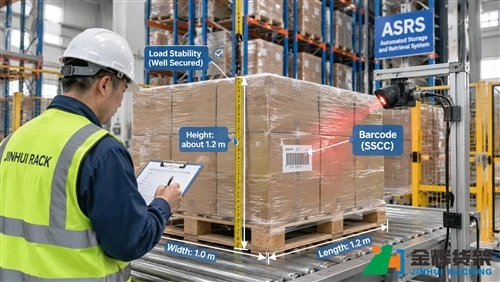
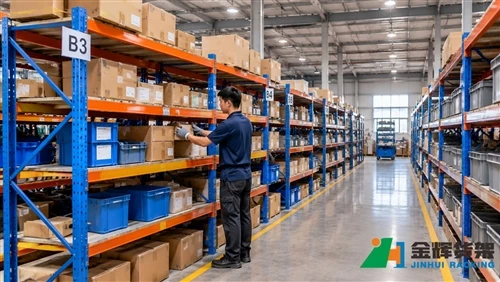
Key pallet inspection points before goods enter an automated storage and retrieval system.
1. Check Pallet Dimensions Against ASRS Technical Requirements
Pallet dimensions are one of the first factors to verify before a pallet enters an automated storage system. The length, width, and overall height of the loaded pallet must be compatible with the dimensions and operating clearances of the storage and handling equipment.
A pallet may be suitable for a conventional selective pallet racking system but still be unsuitable for a particular ASRS installation. Automated conveyors, transfer devices, stacker cranes, and shuttle equipment are designed around specific load-unit requirements. Even relatively small dimensional deviations may affect positioning, detection, or smooth transfer.
1.1 Pallet Length and Width
Measure the actual pallet footprint rather than relying only on the nominal dimensions stated by the pallet supplier. Repeated use, impact damage, loose components, and manufacturing variations can cause differences between the nominal and actual measurements.
The inspection should include:
- Overall pallet length and width.
- Consistency between different pallets in the same operation.
- Protruding boards, blocks, nails, or other components.
- Warping or deformation that changes the pallet footprint.
- Compatibility with conveyor width, transfer points, and storage clearances.
For mixed pallet fleets, it is useful to establish approved pallet dimension categories. Pallets outside the approved categories should be identified before they reach the automated inbound line.
1.2 Overall Loaded Height
The relevant measurement is not just the height of the empty pallet. The total height must include the pallet base, products, packaging, protective materials, and any components extending above the load.
An oversized load may interfere with conveyor structures, safety sensors, lifting equipment, or the available storage clearance. Irregular packaging can also create a load profile that differs from the dimensions recorded in the warehouse management system.
When setting height limits, warehouse operators should use the maximum permitted loaded height defined in the approved ASRS project specifications. The limit should account for the actual handling path and storage configuration, not just the nominal rack opening.
1.3 Bottom Clearance and Fork Entry Openings
The pallet underside is also important. Depending on the handling method, the ASRS may use roller conveyors, chain conveyors, lifting transfer devices, or other pallet transport equipment.
Check that the pallet bottom structure provides the required support and clearance for the selected handling equipment. Damaged bottom boards, missing support blocks, and inconsistent openings may affect pallet transfer or support.
2. Inspect Pallet Structure and Physical Condition
A pallet must remain sufficiently rigid and stable during conveying, lifting, transferring, and storage. Structural defects can become more serious when the pallet is moved automatically because the equipment follows a predefined movement path and cannot compensate for every physical irregularity.
The inspection should cover both the pallet itself and the way it interacts with the load.
2.1 Common Pallet Defects
Inspect the following areas before releasing a pallet for ASRS inbound operations:
- Broken deck boards: Damaged boards may reduce load support and create unstable contact surfaces.
- Cracked runners or blocks: Structural damage can affect the pallet's ability to support the intended load.
- Loose nails and fasteners: Protruding metal components may interfere with handling equipment or damage surrounding materials.
- Warped pallet surfaces: Deformation can affect positioning and load stability.
- Missing components: Missing boards or support blocks may create an uneven load-bearing structure.
- Contamination: Excessive dirt, debris, moisture, or other foreign materials may affect equipment operation and product handling.
2.2 Wooden, Plastic, and Metal Pallets
Different pallet materials have different inspection considerations. The material alone does not determine whether a pallet is suitable for automated storage. Its dimensions, stiffness, structural design, load behavior, and compatibility with the handling equipment are equally important.
Wooden pallets should be checked for broken boards, loose fasteners, moisture-related deformation, and inconsistent construction. Plastic pallets should be checked for cracks, damaged support feet, deformation, and signs of excessive wear. Metal pallets should be inspected for bent sections, damaged welds, corrosion, and distorted support surfaces.
If a warehouse uses multiple pallet types, each type should be evaluated and approved against the same project-specific handling requirements before being introduced into the ASRS operation.
3. Verify Load Capacity and Weight Distribution
A pallet's rated load capacity should not be treated as the only weight limit relevant to an automated warehouse. The permissible load depends on the complete handling and storage system, including the pallet, conveyor equipment, transfer mechanisms, stacker crane, rack structure, and storage configuration.
The total gross weight of the loaded pallet must remain within the approved limits for the relevant equipment and storage position.
3.1 Confirm the Actual Gross Weight
The inspection process should consider the combined weight of:
- The empty pallet.
- Products or materials placed on the pallet.
- Cartons, containers, and protective packaging.
- Stretch film, straps, and other securing materials.
- Any additional components included in the handling unit.
Where weight variation is significant, an inbound weighing station can be used to verify the actual gross weight before the pallet enters the automated storage area. Weight data should be associated with the correct pallet identification record.
3.2 Check Load Distribution
A pallet can be within the permitted gross weight and still be unsuitable because its load is poorly distributed. An off-center or uneven load may affect stability during acceleration, deceleration, lifting, and transfer.
Inspect whether:
- The load is distributed evenly across the pallet support area.
- The center of gravity is reasonably aligned with the approved handling position.
- Heavy products are not concentrated on unsupported areas.
- Stacked cartons or containers do not lean excessively.
- The load remains stable when moved through the expected handling process.
For products with unusual dimensions, concentrated weight, or a high center of gravity, additional engineering review may be necessary. The acceptable load arrangement should be confirmed during the ASRS design and commissioning process.
4. Evaluate Load Stability and Packaging Security
Load stability is essential because the pallet and its contents move together through automated handling equipment. A load that shifts, leans, or becomes loose during transport may create an obstruction or cause a handling interruption.
The inspection should consider the complete unit load, not just the pallet base.
4.1 Product Overhang and Irregular Loads
Products extending beyond the approved pallet footprint can interfere with rack clearances, conveyor guides, adjacent loads, and automated detection systems.
Check for:
- Cartons or products extending beyond the permitted pallet edges.
- Unbalanced stacks or uneven product layers.
- Loose packaging materials.
- Damaged cartons that may collapse during handling.
- Irregular shapes that exceed the approved load envelope.
4.2 Stretch Film and Strapping
Stretch film and strapping help keep products together during movement. However, packaging materials must be applied in a way that does not create loose tails, hanging straps, or other obstructions.
The load should be secured sufficiently to prevent shifting during normal automated movement. At the same time, packaging should not obstruct barcode labels, required detection areas, or pallet handling interfaces.
For high-value, fragile, or unusually shaped products, the load securing method should be reviewed as part of the project's unit-load design.
5. Verify Barcode Readability and Pallet Identification
An ASRS warehouse relies on accurate identification data to connect physical pallets with digital inventory records. A pallet that cannot be identified correctly may be rejected at the inbound station or create an inventory discrepancy.
Barcode and RFID verification should therefore be included in the pallet inspection process.
5.1 Check Barcode Label Quality
Inspect the barcode label for damage, fading, poor print quality, wrinkles, and other conditions that may affect scanning. The label should be securely attached and positioned so that the installed scanning equipment can read it.
Where GS1 logistics labels are used, the Serial Shipping Container Code (SSCC) provides a unique identifier for an individual logistics unit. The SSCC is commonly encoded in a GS1-128 barcode and can be linked to shipment and warehouse information.
5.2 Confirm Label Position and Scanner Compatibility
The correct label position depends on the scanning arrangement and the warehouse's identification requirements. Labels should be visible to the relevant scanners and should not be hidden by stretch film, packaging, or adjacent products.
If the system uses fixed barcode scanners, confirm the required scanning faces and label positions during the system design stage. If RFID is used, verify tag placement, reading performance, and compatibility with the installed readers.
5.3 Match Identification Data with WMS Records
Successful barcode reading is only one part of identification verification. The scanned value must also match the correct inventory record.
The inbound process should confirm:
- The pallet identifier is valid and unique within the applicable system.
- The scanned code corresponds to the expected shipment or handling unit.
- The product information and quantities match the receiving data.
- Batch, lot, or expiry information is recorded when required.
- Duplicate, missing, or incorrect identifiers are resolved before storage.
This helps prevent a situation in which a pallet is physically stored in the correct location but recorded incorrectly in the warehouse management system.
6. Check ASRS Compatibility at the Inbound Interface
Pallet inspection should reflect the actual equipment configuration of the automated warehouse. A pallet that passes a basic visual inspection may still fail when it reaches a conveyor, transfer station, or automated storage interface.
The inbound interface is where physical pallet characteristics meet the mechanical and control requirements of the ASRS.
6.1 Conveyor Compatibility
Different conveyor types have different support and transfer requirements. Roller conveyors, chain conveyors, and other handling devices may require specific pallet bottom configurations and contact surfaces.
The project team should confirm that the pallet can be transferred smoothly through the selected conveyor arrangement without unstable support, interference, or unexpected movement.
6.2 Stacker Crane and Storage Position Compatibility
The pallet must also be suitable for the storage and retrieval equipment. Its dimensions, weight, load center, and structural condition should comply with the approved handling envelope.
The rack opening, support arrangement, and equipment clearances should be considered together. Pallet acceptance criteria should be based on the actual engineering design rather than assumptions about general pallet standards.
Learn more about the equipment configuration and automated handling process in our ASRS Warehouse Storage System .
7. Establish a Standard ASRS Pallet Inspection Checklist
A documented inspection checklist helps warehouse teams apply consistent acceptance criteria across different shifts, suppliers, and pallet types. It also makes it easier to identify recurring defects and improve inbound quality control.
The following checklist can be adapted to the technical requirements of an individual ASRS project.
| Inspection Item | What to Verify | Acceptance Reference |
|---|---|---|
| Pallet dimensions | Length, width, and overall loaded height | Approved project dimensions |
| Bottom structure | Support blocks, runners, openings, and clearances | Handling equipment requirements |
| Structural condition | Cracks, broken boards, loose fasteners, and deformation | Approved pallet condition criteria |
| Gross weight | Combined weight of pallet, products, and packaging | System load limits |
| Load distribution | Load balance and center of gravity | Approved unit-load design |
| Load stability | Overhang, leaning products, and packaging security | Permitted load envelope |
| Identification | Barcode or RFID readability and data accuracy | WMS and identification requirements |
| Equipment compatibility | Conveyor transfer and storage interface | ASRS engineering specifications |
The checklist should be converted into a documented inspection record. Depending on the operation, records may include pallet ID, supplier, inspection date, measured dimensions, actual weight, inspection result, and the reason for rejection.
8. What Should Happen When a Pallet Fails Inspection?
A clear exception-handling process is just as important as the inspection itself. Non-compliant pallets should not be sent into the automated storage area simply because the inbound line is busy or the warehouse needs to meet a throughput target.
A practical rejection process can include the following steps:
- Identify the issue: Record whether the problem relates to dimensions, pallet damage, load stability, weight, or identification.
- Separate the pallet: Direct the non-compliant load to a designated inspection or exception-handling area.
- Determine corrective action: Repack the goods, replace the pallet, correct the label, or adjust the load when permitted.
- Repeat the inspection: Recheck the affected items against the approved acceptance criteria.
- Release or reject: Only release the pallet into the ASRS process after it meets the required conditions.
- Record the result: Maintain inspection and rejection records for traceability and continuous improvement.
Repeated failures from the same supplier or product category should be investigated. Reviewing defect trends can help warehouse operators improve pallet specifications, packaging procedures, supplier quality requirements, and inbound controls.
9. Integrate Pallet Inspection into ASRS Project Planning
Pallet quality requirements should be defined before an ASRS warehouse begins full operation. If pallet specifications are considered only after installation, changes to packaging, pallet sourcing, conveyor interfaces, or inbound procedures may become more complicated and costly.
During project planning, the warehouse owner, system integrator, and equipment supplier should agree on a common unit-load specification.
9.1 Define the Standard Unit Load
The unit-load specification should describe the approved pallet types, maximum dimensions, permitted gross weight, load arrangement, packaging method, and identification requirements.
Where several product categories are handled, separate specifications may be necessary for different load types. Special loads should be reviewed individually rather than automatically treated as standard pallets.
9.2 Confirm Inspection and Automation Equipment
Depending on the project's requirements, an inbound inspection station may include:
- Dimensioning sensors for checking pallet and load size.
- Weighing equipment for verifying gross pallet weight.
- Barcode scanners for reading pallet identification labels.
- Photoelectric sensors for detecting pallet presence and position.
- Vision systems for identifying irregular load profiles.
The selected equipment should match the expected pallet types, inbound throughput, inspection accuracy, and system integration requirements. Not every project requires every inspection technology.
9.3 Test Pallets During Commissioning
Before normal operation begins, representative pallets should be tested through the complete inbound process. Testing should cover different approved pallet types, load weights, dimensions, packaging conditions, and identification formats.
The commissioning team should verify that pallets can pass through the inbound interface, be identified correctly, transfer to the storage equipment, and be stored and retrieved according to the approved operating procedures.
This is also the right time to document non-compliant conditions and confirm how the system responds to rejected pallets, unreadable labels, dimensional deviations, and other exceptions.
For projects requiring customized storage structures and automated material handling, explore our ASRS Racking Solution .
10. Common Mistakes to Avoid in ASRS Pallet Inspection
Even warehouses with established quality procedures can overlook issues that affect automated handling. The following mistakes should be avoided:
- Using nominal dimensions only: Actual pallet and load dimensions should be checked, especially when pallets are reused or supplied by different manufacturers.
- Checking the empty pallet but not the loaded unit: Product overhang, packaging, and total height can change the handling envelope.
- Relying only on rated pallet capacity: The complete system's approved load limits must be considered.
- Ignoring load distribution: A pallet can meet the gross weight limit but still be unstable because of an off-center load.
- Assuming a readable barcode means correct data: The scanned identifier must match the relevant WMS record.
- Mixing unapproved pallet types: Different pallet designs should be evaluated before they are introduced into automated handling.
- Skipping commissioning tests: Representative pallets should be tested through the actual inbound and storage process.
Frequently Asked Questions About Pallet Requirements for ASRS
1. What pallet dimensions are suitable for an ASRS warehouse?
There is no single pallet dimension that is suitable for every ASRS installation. The permitted length, width, height, and bottom structure depend on the rack design, conveyor configuration, stacker crane, transfer equipment, and project-specific handling requirements. Always confirm the approved pallet specification with the ASRS supplier.
2. Can standard wooden pallets be used in an ASRS system?
Some wooden pallets can be used in ASRS warehouses if their dimensions, structural condition, load capacity, bottom configuration, and handling performance meet the system requirements. Damaged, warped, or inconsistent pallets should be rejected or corrected before automated handling.
3. Why is load stability important in automated storage?
A stable load is less likely to shift, lean, or lose packaging during automated conveying, lifting, and storage. Unstable loads may cause handling interruptions, equipment alarms, product damage, or safety concerns.
4. Does every ASRS pallet need a barcode?
The identification method depends on the warehouse control design. Many systems use barcode labels, while some use RFID or other identification technologies. The essential requirement is that each handling unit can be identified accurately and matched with the correct inventory information.
5. How can a warehouse check pallet quality automatically?
An automated inbound inspection station can combine dimensioning sensors, weighing equipment, barcode scanners, photoelectric sensors, and vision systems. The actual configuration should be selected according to the project's inspection requirements and throughput.
6. What happens if a pallet does not meet ASRS requirements?
A non-compliant pallet should be diverted to an exception-handling area. The warehouse team can then replace the pallet, correct the load, repair identification information, or take another approved corrective action. The pallet should only enter the automated storage process after it passes inspection.
7. Should pallet specifications be confirmed before ASRS installation?
Yes. Pallet dimensions, weight, load arrangement, bottom structure, and identification requirements should be confirmed during the engineering and planning stage. Representative pallets should also be tested during commissioning to verify compatibility with the actual equipment.
Conclusion: Make Pallet Quality a Part of ASRS Planning
Reliable automated storage starts with a suitable and consistent unit load. Pallet dimensions, structural integrity, gross weight, load distribution, packaging stability, and identification accuracy all influence how effectively goods move through an ASRS warehouse.
A well-defined pallet inspection process helps reduce inbound errors, prevent avoidable equipment interruptions, improve inventory accuracy, and maintain stable warehouse operations. More importantly, establishing pallet acceptance criteria during the engineering stage can help prevent compatibility problems after the system is installed.
For warehouse owners planning a new automated facility or upgrading an existing operation, pallet specifications should be discussed together with the rack structure, conveyor system, stacker crane, and warehouse control requirements.
Discuss Your ASRS Warehouse Project with JINHUI RACK
Are you planning an automated warehouse and need a storage solution based on your pallet dimensions, load requirements, and available building space?
JINHUI RACK provides customized ASRS storage and racking solutions for logistics centers, manufacturing facilities, distribution warehouses, and other industrial applications.
To help our engineering team understand your project, you can share:
- Warehouse length, width, and clear building height.
- Pallet length, width, and overall loaded height.
- Maximum gross weight per pallet.
- Required storage capacity and number of pallet positions.
- Inbound and outbound throughput requirements.
- Warehouse layout, CAD drawings, or project specifications, if available.
Our team can review your requirements and discuss a suitable automated storage and retrieval solution.
Contact JINHUI RACK:
WhatsApp: +86 185 0252 7163
Email: info@jhrack.com