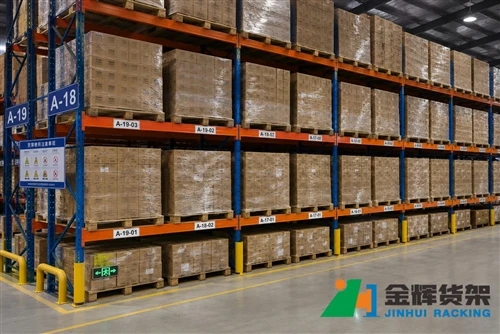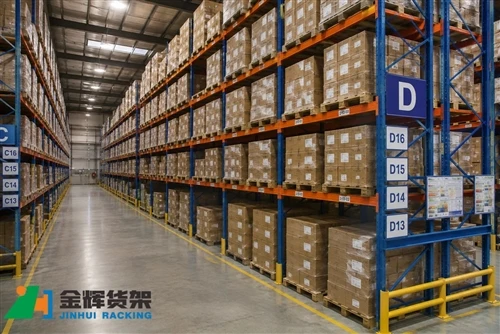
E-commerce warehouses operate differently from many traditional storage facilities. Instead of simply storing full pallets until they are shipped, an e-commerce warehouse may receive palletized inventory, break pallets down into individual orders, replenish picking locations, consolidate shipments, and process a large number of orders every day.
Because of this, pallet racking for an e-commerce warehouse needs to support more than high-density pallet storage. The rack layout should work together with picking areas, replenishment routes, packing stations, staging zones, and shipping operations.
The right solution depends on how inventory enters the warehouse, how products are picked, how frequently SKUs move, and how much pallet-level storage is required.
Quick Answer
For an e-commerce warehouse, pallet racking should be selected according to SKU variety, pallet inventory, order frequency, picking methods, replenishment requirements, forklift equipment, and available floor space. Selective pallet racking is often useful for flexible pallet storage, while the overall layout should leave enough room for picking, packing, staging, and order fulfillment.
Why E-commerce Warehouses Need a Different Storage Strategy
A traditional warehouse may move pallets from receiving directly into pallet storage and later retrieve complete pallets for shipment.
E-commerce operations are often more complicated.
A typical inventory flow may look like:
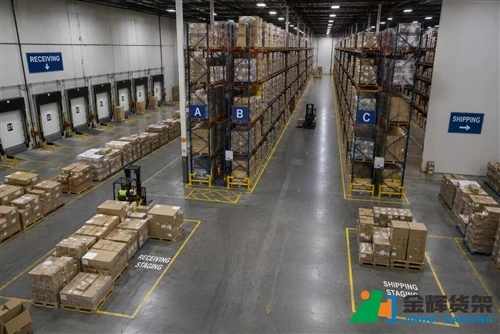
Receiving → Pallet Storage → Replenishment → Picking → Order Consolidation → Packing → Shipping
Some products may remain on pallets, while other products are moved from pallet storage to carton-level or piece-picking locations.
This creates a need to separate reserve pallet storage from active picking inventory where appropriate.
Therefore, the best e-commerce warehouse rack layout is not necessarily the layout with the highest number of pallet positions.
It is the layout that provides the right balance between storage capacity and order fulfillment efficiency.
What Should Pallet Racking Accomplish in an E-commerce Warehouse?
A pallet racking system may serve several purposes within an e-commerce distribution facility.
- Store reserve inventory
- Provide replenishment stock for picking areas
- Organize products by SKU
- Support inventory growth
- Use vertical warehouse space
- Provide forklift access to palletized products
- Separate different product categories
- Connect storage with the picking operation
The rack system should therefore be evaluated as part of the complete fulfillment process.
How SKU Variety Affects E-commerce Pallet Racking
E-commerce warehouses can contain hundreds, thousands, or even more individual SKUs.
High SKU variety changes the way pallet storage should be organized.
If every SKU needs direct access, selective pallet racking can provide flexibility because operators can access individual pallet positions without moving other stored pallets.
For products with multiple pallets in reserve, deeper storage configurations may provide better space utilization.
The important point is to identify which SKUs require direct pallet access and which products can be grouped into higher-density storage zones.
This is different from designing a warehouse simply around the total number of pallets.
Reserve Storage vs. Picking Storage
One of the most important decisions in an e-commerce warehouse is separating reserve inventory from active picking inventory.
Reserve storage contains additional inventory that is used to replenish picking locations.
Picking storage contains the products that warehouse operators access regularly to fulfill customer orders.
Keeping all inventory in pallet racks may not be the most efficient solution if individual units need to be picked frequently.
Instead, pallet racking can be used as the reserve storage layer, while lower-level picking locations or other order-picking equipment handle daily order fulfillment.
This approach allows the warehouse to use vertical space for reserve inventory while keeping frequently picked products accessible to workers.
Why Selective Pallet Racking Is Commonly Considered for E-commerce
Selective pallet racking can be a practical choice for e-commerce warehouses that need flexible access to many different products.
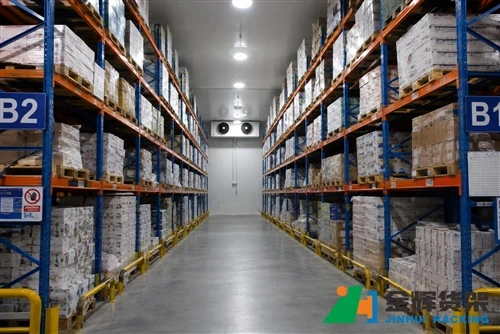
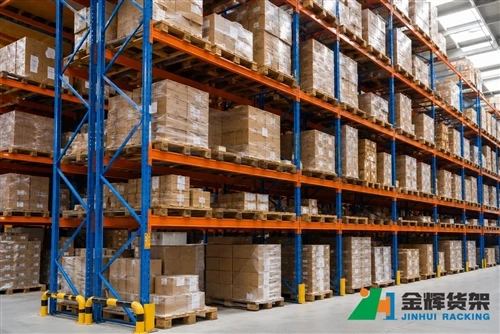
Each rack bay can be configured with multiple beam levels, allowing the warehouse to store palletized reserve inventory vertically.
Advantages may include:
- Direct access to individual pallet positions
- Flexible beam-level configuration
- Easy SKU organization
- Compatibility with common forklift operations
- Adaptability to changing inventory requirements
- Efficient use of vertical space
Selective racking does not necessarily provide the highest possible storage density, but accessibility can be more valuable in an e-commerce environment where product variety and inventory movement are high.
How Pallet Rack Height Affects E-commerce Storage
E-commerce warehouses often have valuable unused vertical space.
Increasing rack height can provide additional pallet positions without increasing the warehouse footprint.
However, the maximum practical rack height depends on several factors.
- Warehouse clear height
- Forklift lifting capability
- Pallet height
- Maximum pallet weight
- Required clearance
- Building structure
- Fire protection arrangements
Higher racks should therefore be planned as part of the complete warehouse design.
Adding another beam level may increase theoretical capacity, but the additional storage position only creates value if pallets can be safely accessed and replenished.
How E-commerce Order Volume Changes Rack Layout
Order volume is another important factor.
A warehouse processing a small number of large wholesale orders has different requirements from a fulfillment center processing thousands of small orders.
High order volume usually increases movement between storage, picking, packing, and shipping areas.
In such facilities, the warehouse layout should minimize unnecessary travel and avoid creating bottlenecks around picking and replenishment areas.
Pallet racks should support the operation rather than force forklifts and order pickers to compete for the same traffic space.
Fast-Moving Products Should Be Easy to Replenish
Fast-moving SKUs require frequent replenishment.
If reserve pallets are stored at locations that are difficult or time-consuming to access, replenishment can become a recurring operational bottleneck.
For this reason, fast-moving inventory may benefit from being positioned closer to the areas where it is consumed.
However, product placement should be based on actual movement data rather than assumptions.
A product that sells frequently but is extremely small may have very different storage requirements from a product that sells frequently in full pallets.
How Pallet Racking Works With Picking Areas
E-commerce warehouses often combine pallet storage with other picking systems.
For example, pallet racking may store reserve inventory while lower-level shelving or carton flow locations are used for order picking.
This creates a two-level storage strategy:
- Reserve level: palletized inventory stored in rack positions
- Picking level: inventory positioned for easy access by order pickers
The exact arrangement depends on product dimensions, order characteristics, and picking methods.
The important principle is that replenishment from pallet storage should be straightforward and should not unnecessarily interfere with order picking.
How Forklift Aisles Affect E-commerce Warehouse Efficiency
Forklift aisles provide access to pallet rack positions, but they also consume valuable floor space.
In an e-commerce warehouse, forklifts may need to operate alongside order-picking workers, carts, conveyors, and other equipment.
This makes traffic planning especially important.
Aisle dimensions should be based on the actual forklift and load configuration.
Our previous article on warehouse aisle width and pallet racking explains why aisle selection should be considered together with the handling equipment.
How to Organize E-commerce Pallet Storage Zones
Instead of putting every product into one large storage area, an e-commerce warehouse can divide reserve inventory into logical zones.
Possible zones include:
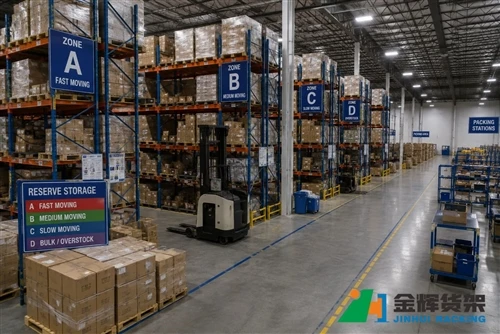
- Fast-moving inventory
- Medium-moving inventory
- Slow-moving inventory
- Oversized products
- High-value products
- Seasonal products
- New product inventory
- Returns and inspection inventory
Different zones can use different storage methods when necessary.
This can help prevent a slow-moving product from occupying prime storage locations that could otherwise be used for frequently accessed inventory.
Why Warehouse Zoning Matters for E-commerce
Warehouse zoning creates a logical relationship between products and operational activities.
For example, frequently picked products can be positioned closer to order fulfillment areas, while slow-moving reserve stock can be stored in less accessible locations.
Large or awkward products may require dedicated storage zones instead of being mixed into standard pallet rack bays.
Similarly, products with special handling requirements may need separate storage areas.
The rack layout should reflect these differences.
How to Plan Pallet Rack Rows for E-commerce Fulfillment
Rack rows should be arranged according to the building shape and the movement of goods.
Important factors include:
- Receiving dock location
- Shipping dock location
- Picking zones
- Packing stations
- Staging areas
- Forklift aisles
- Cross aisles
- Building columns
- Emergency access
Long rack rows can provide efficient pallet storage, but cross aisles may be required in larger facilities to prevent excessive travel distances.
There is no universal rack orientation that works for every e-commerce warehouse.
The correct layout should be developed around the actual material flow.

Reserve pallet storage can be organized into different inventory zones to support replenishment and e-commerce order fulfillment.
How Pallet Racking Supports Replenishment
Replenishment connects reserve pallet storage with active picking locations.
If the replenishment route is poorly planned, warehouse workers may experience delays even when the rack system itself has sufficient capacity.
Reserve pallet positions should therefore be accessible to forklifts without unnecessarily crossing high-volume pedestrian picking areas.
Where possible, replenishment traffic should use clearly defined routes that reduce interaction with order-picking traffic.
Should E-commerce Warehouses Use High-Density Pallet Racking?
High-density pallet racking can be useful in some e-commerce warehouses, but it should not automatically replace selective storage.
The decision depends on the number of pallets stored per SKU.
If a SKU has only one or two reserve pallets, deep storage may provide limited benefits because individual access remains important.
If a small number of SKUs account for a large percentage of inventory volume, higher-density storage may be more attractive.
Possible systems include:
- Drive-in pallet racking
- Push-back racking
- Pallet flow racking
- Double-deep pallet racking
- Shuttle-based storage
The right choice depends on the balance between density, selectivity, equipment, and inventory turnover.
When Push-Back Racking May Be Useful
Push-back racking can provide multiple pallet positions in depth while maintaining forklift access from the operating aisle.
It may be worth considering for e-commerce reserve inventory when products are stored in batches and several pallets of the same SKU are kept together.
However, if every pallet needs immediate individual access, selective racking may provide a more flexible solution.
The storage strategy should be determined before selecting the rack type.
When Pallet Flow Racking May Be Useful
Pallet flow racking can support controlled pallet movement through storage lanes.
It may be considered when inventory rotation is important and pallets are handled in a relatively structured sequence.
For e-commerce operations handling products with defined batch or date requirements, this type of storage can be useful in the appropriate application.
It should not, however, be selected solely because it provides high density. The pallet type, load characteristics, rotation strategy, and operating process all need to be considered.
How Building Columns Affect E-commerce Rack Layout
Existing structural columns can interrupt otherwise regular rack rows.
This is common when an e-commerce operation is installed in an existing industrial building.
Rather than ignoring the columns and creating unusable spaces, rack bays and aisle positions can be planned around the building structure.
Our previous article, How Warehouse Columns Affect Pallet Racking Layout, discusses this issue in more detail.
Planning E-commerce Storage for Future Growth
E-commerce inventory requirements can change quickly.
A warehouse that is properly sized for today's order volume may require additional storage positions after the product range expands.
Future growth should therefore be considered during the initial rack layout.
Possible strategies include:
- Leaving expansion space
- Using adjustable beam levels
- Standardizing rack bay dimensions
- Reserving space for additional rack rows
- Planning future picking areas
- Allowing additional forklift routes where practical
A layout that can be expanded without completely reorganizing the warehouse can reduce future disruption.
Our previous article How to Plan Pallet Racking for Future Warehouse Growth provides additional guidance.
How to Choose Pallet Racking for an E-commerce Warehouse
Before selecting a rack system, collect the following information:
- Warehouse dimensions: Measure length, width, and clear height.
- Pallet dimensions: Confirm the actual pallet size used in the operation.
- Maximum pallet weight: Use the heaviest expected loaded pallet.
- SKU quantity: Determine how many individual products require storage.
- Inventory volume: Estimate how many pallets are kept in reserve.
- Order volume: Review daily and peak order activity.
- Picking method: Identify whether orders are picked by piece, carton, case, or pallet.
- Forklift equipment: Confirm lifting height, load capacity, and aisle requirements.
- Receiving and shipping flow: Map how products enter and leave the facility.
- Future growth: Estimate expected inventory and order growth.
With this information, the rack configuration can be designed around the actual operation rather than a generic warehouse layout.
Common E-commerce Pallet Racking Mistakes
Using All Warehouse Space for Pallet Storage
Leaving insufficient room for picking, packing, replenishment, and staging can create operational bottlenecks.
Ignoring Product Velocity
Fast-moving and slow-moving products may have different ideal storage locations.
Mixing Reserve and Picking Inventory Without a Clear Strategy
Clear separation can make replenishment and inventory control easier.
Choosing the Highest-Density Rack Without Considering Accessibility
Maximum pallet density does not necessarily mean maximum fulfillment efficiency.
Ignoring Future Inventory Growth
A warehouse layout should ideally provide a practical path for future expansion.
Planning Rack Rows Before Mapping Material Flow
Rack rows should support receiving, storage, picking, and shipping instead of forcing operators to travel unnecessarily long distances.
FAQ About Pallet Racking for E-commerce Warehouses
What pallet racking is best for an e-commerce warehouse?
Selective pallet racking is often suitable for reserve inventory that requires flexible access to individual pallets. However, the best solution depends on SKU variety, inventory volume, picking methods, and storage density requirements.
Can pallet racks be used together with picking shelves?
Yes. Many e-commerce warehouses use pallet racking for reserve inventory and lower-level shelving, carton flow, or other picking equipment for active order fulfillment.
Should fast-moving products be stored closer to shipping?
They may benefit from shorter travel distances, but product placement should be based on actual order frequency, replenishment requirements, product size, and the overall warehouse flow.
How can an e-commerce warehouse increase pallet storage capacity?
Potential approaches include optimizing rack height, reviewing aisle dimensions, improving rack layout, using available vertical space, and evaluating higher-density storage systems where appropriate.
Can pallet racking be customized for an e-commerce warehouse?
Yes. Rack height, depth, beam levels, bay configuration, and overall layout can be developed according to pallet dimensions, load requirements, building conditions, and operational requirements.
How should reserve pallet storage be positioned?
Reserve storage should be positioned so that forklifts can replenish active picking areas efficiently while minimizing unnecessary interaction with high-volume pedestrian and order-picking routes.
Final Thoughts
Choosing pallet racking for an e-commerce warehouse requires more than calculating how many pallets can fit inside the building.
The rack system needs to support the complete fulfillment process, including receiving, reserve storage, replenishment, picking, packing, staging, and shipping.
Selective pallet racking can provide flexibility for diverse inventory, while higher-density systems may be appropriate for products stored in larger quantities. In many e-commerce facilities, the most effective solution is a combination of pallet reserve storage and dedicated picking areas.
The most important step is to understand the movement of inventory before deciding where and how the pallet racks should be installed.
Planning pallet storage for an e-commerce warehouse? Jinhui Rack can help evaluate your pallet dimensions, load requirements, SKU profile, warehouse dimensions, forklift equipment, and fulfillment workflow to develop a suitable pallet racking configuration.
Talk to Jinhui Rack About Your E-commerce Warehouse
Whether you are building a new e-commerce fulfillment center, expanding an existing warehouse, or improving pallet reserve storage, the right rack configuration can help create a more organized and scalable operation.
Send us your warehouse dimensions, pallet size, maximum pallet weight, required pallet positions, forklift type, SKU information, and warehouse flow for a customized storage solution.
WhatsApp: +86 185 0252 7163
Email: info@jhrack.com