Pallet rack guide rails are warehouse accessories used to help control the movement of forklifts, pallets, or other material-handling equipment around storage areas. When correctly positioned, they can provide a physical reference point that helps operators maintain a consistent travel path and pallet position.
Guide rails can be particularly useful in areas where forklifts operate close to rack structures, where pallet positioning must remain consistent, or where traffic follows a defined route. However, guide rails are not a replacement for proper rack design, forklift operating procedures, or rack protection systems.
This guide explains how pallet rack guide rails work, where they can be used, how they differ from other rack protection accessories, and what should be considered before installation.
What Are Pallet Rack Guide Rails?
Pallet rack guide rails are physical rails or guide structures installed along defined warehouse travel or storage paths. Their purpose is to provide a reference or boundary that helps keep forklifts, pallets, or handling equipment within the intended operating area.
The exact design varies according to the application. Some guide rails are positioned at floor level along forklift routes, while other guide arrangements are integrated into specific storage systems to help keep pallets aligned during loading and retrieval.
Because the term "guide rail" can describe different warehouse components, the intended application should always be defined before selecting a product.
| Guide Rail Application | Primary Purpose | Typical Consideration |
|---|---|---|
| Forklift guide rail | Help define or control vehicle movement | Forklift dimensions, turning path, aisle clearance |
| Pallet alignment guide | Help maintain pallet position | Pallet dimensions, load stability, rack configuration |
| Pallet flow guide rail | Help guide pallets through storage lanes | Pallet construction, lane depth, roller configuration |
| Traffic guide rail | Separate equipment movement from defined areas | Traffic pattern, floor space, pedestrian movement |
Why Are Guide Rails Used Around Pallet Racking?
Forklifts operate in relatively constrained spaces when loading and retrieving pallets from rack bays. The closer the equipment operates to the rack, the more important consistent positioning becomes.
Guide rails can provide a physical reference that helps define the intended travel path. They may also help separate a forklift route from a nearby structure, working area, or other traffic zone.
However, a guide rail should not be considered a device that makes an unsuitable aisle safe. The warehouse layout, rack dimensions, forklift characteristics, and operating requirements must still be evaluated as a complete system.
How Guide Rails Help Control Forklift Movement
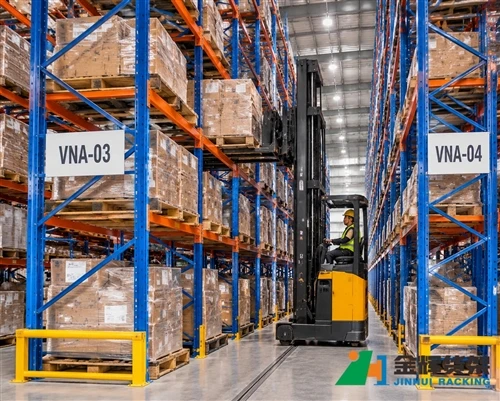
Forklift operators need sufficient clearance to enter an aisle, approach a pallet, position the forks, and remove the load. In some warehouse environments, a physical guide can help make the intended path more predictable.
This can be useful in areas where vehicle movement follows a relatively fixed route. For example, a guide rail may help define the edge of a travel lane or keep equipment from drifting toward a protected zone.
Before installing a guide rail, the warehouse should verify the actual operating envelope of the forklift, including its overall dimensions, turning requirements, mast movement, pallet dimensions, and load projection.
A rail that is positioned too close to the forklift path can reduce usable clearance rather than improve control.
Guide Rails for Pallet Positioning and Alignment
Guide rails can also be used to help maintain pallet alignment in applications where consistent positioning is important.
A pallet that is placed at an angle can reduce available clearance and may interfere with neighboring storage positions or handling equipment. A suitable guide arrangement can help establish a repeatable pallet position.
However, the guide should work with the pallet and rack configuration rather than forcing a pallet into a position that does not match its dimensions.
Before specifying pallet alignment guides, confirm:
- Pallet length and width
- Pallet construction
- Rack depth
- Beam configuration
- Load dimensions
- Required pallet clearance
- Forklift approach direction
Guide Rails vs Pallet Rack Column Guards
Guide rails and column guards serve different purposes and should not automatically be treated as interchangeable rack protection accessories.
| Feature | Guide Rails | Column Guards |
|---|---|---|
| Main function | Guide or define movement and positioning | Protect rack uprights from impact |
| Typical location | Along travel or storage paths | Around exposed rack uprights |
| Primary focus | Movement control and alignment | Structural protection |
| Forklift interaction | Helps define the intended path | Reduces direct impact risk to the rack |
| Rack protection role | Indirect | Direct |
Jinhui also provides information about pallet rack column guards, which are specifically intended to protect exposed rack uprights from forklift impact.
Where Are Pallet Rack Guide Rails Commonly Used?
Guide rails can be considered in several warehouse environments, but their suitability depends heavily on the physical layout and handling equipment.
- Forklift travel routes close to storage structures
- Areas with clearly defined vehicle paths
- Loading and unloading approaches
- Specific pallet alignment applications
- Storage lanes requiring consistent pallet positioning
- Areas where vehicle movement needs a physical boundary
They are most useful when the movement path is predictable and the rail can be installed without compromising the clearance required for normal warehouse operations.
How Guide Rails Affect Warehouse Aisle Clearance
One of the most important considerations is that a guide rail occupies physical space.
If a rail is installed inside or beside a forklift aisle, its position can change the effective operating width available to the vehicle. This is particularly important in narrow aisles, where even a small obstruction can affect turning and pallet handling.
Before installation, check the relationship between the guide rail and:
- Rack upright faces
- Pallet overhang
- Forklift overall width
- Forklift turning radius
- Load dimensions
- Pedestrian routes
- Emergency access areas
Warehouse aisle requirements should be evaluated using the actual forklift and load configuration. Jinhui's selective pallet racking systems can be configured around warehouse dimensions, pallet specifications, and forklift operating requirements.
Guide Rails and Pallet Flow Racking
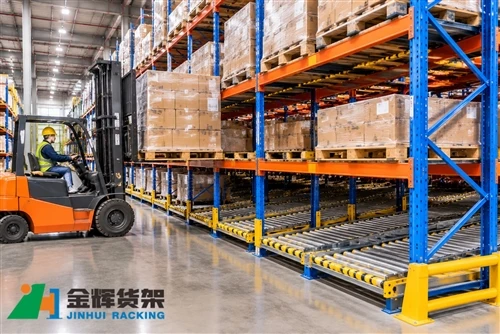
Guide rails have a different function when they are used inside pallet flow storage lanes.
In pallet flow racking, pallets move along roller tracks from the loading side toward the picking side. Guide components can help keep the pallet traveling along the intended lane rather than drifting sideways.
In this application, guide rails need to be considered together with roller tracks, pallet construction, lane inclination, braking devices, pallet separators, and end stops.
Jinhui's existing technical information on pallet flow systems explains that guide rails work as part of the overall pallet movement system rather than as an independent control device.
How Guide Rails Work With Rack Protection
A warehouse may require several different protection measures because each accessory addresses a different operating risk.
For example, a guide rail can help define a forklift route, while a column guard can protect the lower section of a rack upright from accidental contact. End-of-aisle protection can address vehicle movement around the end of a rack row.
These components should therefore be selected according to the actual traffic pattern rather than installing every type of accessory throughout the warehouse.
For a high-traffic pallet storage area, the warehouse manager should identify where forklifts enter, turn, reverse, load, unload, and cross between rack rows. This traffic map can then be used to determine where guidance and physical protection are useful.

How to Choose Pallet Rack Guide Rail Position
The position of a guide rail should be determined from the actual operating path rather than from the rack dimensions alone.
Start by identifying the normal forklift travel line and the closest rack or fixed structure. Then check the complete operating envelope of the forklift and loaded pallet.
The review should include:
- Forklift dimensions and turning requirements.
- Maximum pallet and load dimensions.
- Rack face and upright positions.
- Required aisle clearance.
- Potential pedestrian movement.
- Emergency access requirements.
- Guide rail height and physical profile.
- Potential impact points.
- Floor condition and anchoring requirements.
- Maintenance and inspection access.
The final position should be confirmed against the actual warehouse layout and the applicable engineering or safety requirements.
Guide Rail Dimensions Should Match the Application
There is no universal guide rail dimension that works for every warehouse.
A rail intended to guide a forklift has different requirements from a rail used to align pallets inside a storage lane. The height, position, length, strength, mounting method, and clearance should therefore be determined according to the specific application.
Warehouse operators should avoid selecting a guide rail simply because it fits a nominal rack size. The complete operating environment is more important than one dimension.
Common Guide Rail Installation Mistakes
Installing Rails Too Close to the Forklift Path
A guide rail that reduces the usable travel envelope can make forklift operation more difficult. Clearance should be checked before the rail is fixed to the floor.
Using Guide Rails as a Substitute for Rack Protection
A guide rail is not automatically equivalent to a rack column guard. If the primary concern is forklift impact against an upright, an appropriate rack protection solution should be evaluated separately.
Ignoring Pallet Overhang
The pallet itself may extend beyond the rack beam or the intended load footprint. Guide rail placement should account for the complete loaded pallet, not only the pallet base.
Failing to Check the Floor
Floor condition, anchoring, concrete thickness, and the installation method can affect the final guide rail arrangement. These conditions should be reviewed before installation.
Installing Rails Without Reviewing Traffic Flow
A rail may work correctly in one travel direction but create an obstruction when forklifts need to turn, reverse, or approach from another direction.
How Guide Rails Can Support More Consistent Warehouse Operations
Consistent forklift positioning can help make repetitive storage operations more predictable. This is particularly relevant in warehouses where vehicles repeatedly approach the same rack locations or follow fixed routes.
Guide rails can provide a visible or physical reference for these movements. However, the improvement depends on correct placement and appropriate operating procedures.
The warehouse should also maintain clear aisle markings, suitable rack protection, regular equipment inspections, and operator training. Guide rails should be treated as one element within the overall warehouse operating environment.
Guide Rail Installation Checklist
| Check Item | What to Confirm |
|---|---|
| Application | Define whether the rail guides forklifts, pallets, or storage-lane movement. |
| Forklift | Confirm vehicle dimensions, turning requirements, and operating method. |
| Pallet | Check pallet dimensions, load dimensions, and potential overhang. |
| Aisle clearance | Make sure the rail does not reduce required operating space. |
| Rack protection | Determine whether separate column or end-of-aisle protection is required. |
| Floor | Verify floor condition and suitable anchoring arrangements. |
| Traffic flow | Check normal travel, turning, reversing, and crossing movements. |
| Maintenance | Ensure the rail can be inspected and maintained without creating access problems. |
Frequently Asked Questions About Pallet Rack Guide Rails
What is the main purpose of a pallet rack guide rail?
Its purpose depends on the application. A guide rail may help define forklift movement, maintain pallet alignment, or guide pallets through a storage lane.
Are guide rails the same as rack column guards?
No. Guide rails primarily help control movement or alignment, while column guards are designed to protect rack uprights from forklift impact. The two may be used together when the warehouse conditions require both functions.
Can guide rails be installed in narrow warehouse aisles?
They can be considered, but the available clearance must be checked carefully. A rail should not reduce the effective operating space below what is required for the actual forklift and load.
Do pallet flow racks use guide rails?
Guide components can be part of pallet flow rack lanes, where they help keep pallets aligned as they move along roller tracks. Their design needs to match the pallet, roller system, lane configuration, and other flow-control components.
Can guide rails prevent forklift accidents?
Guide rails can help define movement paths, but they should not be treated as a substitute for proper warehouse layout, forklift operating procedures, training, rack protection, and applicable safety requirements.
Final Thoughts
Pallet rack guide rails can provide useful physical guidance for forklift movement and pallet positioning when they are designed around the actual warehouse operating conditions.
The most important step is to define the guide rail's purpose before selecting its dimensions or installation position. Forklift characteristics, pallet dimensions, rack configuration, aisle clearance, traffic flow, floor conditions, and rack protection should all be considered together.
For warehouses using pallet racking, guide rails can be one part of a broader approach to controlling material-handling movement and protecting storage areas. Jinhui Rack provides customized industrial heavy duty pallet racks and warehouse pallet rack solutions designed around pallet dimensions, load requirements, warehouse layout, and forklift operations.
Planning a pallet racking project or adding rack accessories? Send Jinhui Rack your warehouse dimensions, pallet specifications, maximum load, forklift information, and rack layout for a project-specific recommendation.
Website: https://www.jinhui-rack.com/
Email: info@jhrack.com
WhatsApp: +86 185 0252 7163