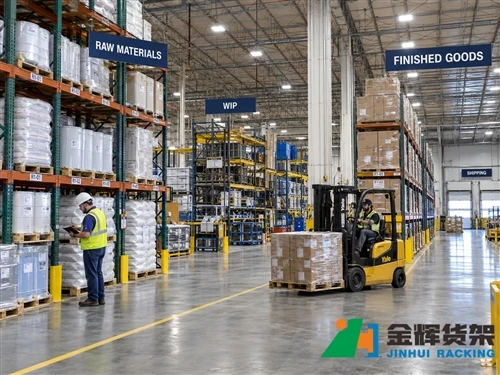
Choosing the right pallet rack bay width is an important part of warehouse racking design. The width of each rack bay affects how many pallets can be stored, which beam length is required, how pallets are positioned, and how efficiently the available warehouse space can be used.
Bay width is sometimes treated as a simple measurement between two upright frames. In practice, however, it needs to be determined from the pallet dimensions, number of pallet positions, required clearances, beam configuration, loading method, and warehouse operating conditions.
For most warehouses, the goal is not simply to make each bay as wide as possible. The better approach is to select a bay width that accommodates the intended pallets safely while using the available floor space efficiently.
Quick Answer
Pallet rack bay width is mainly determined by pallet dimensions, the number of pallets stored across each beam level, required side clearances, beam length, and the rack manufacturer's design. A two-pallet bay generally requires a different beam length from a three-pallet bay, so pallet dimensions should be confirmed before the rack structure is finalized.
What Is Pallet Rack Bay Width?
Pallet rack bay width is the horizontal distance occupied by one rack bay between its upright frames.
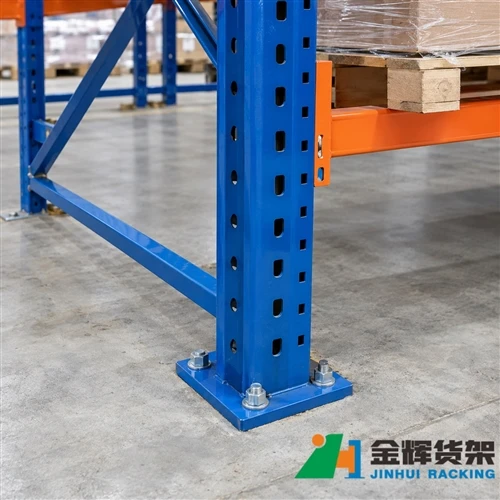
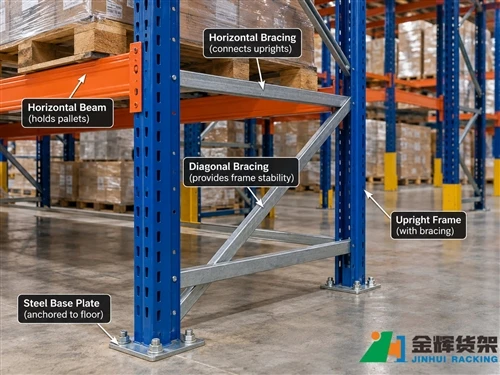
A typical selective pallet rack consists of vertical upright frames connected by horizontal beams. The space between two adjacent frames forms a rack bay.
Depending on the warehouse application, a bay may be designed to hold two, three, or another number of pallet positions at each beam level.
The bay width therefore needs to provide enough horizontal space for the intended pallet configuration without creating unnecessary gaps.
Why Bay Width Matters in Warehouse Racking
Bay width has a direct relationship with several important warehouse design factors.
- Number of pallets stored per level
- Beam length
- Rack storage density
- Pallet positioning
- Forklift operation
- Available floor space
- Total number of rack bays
- Overall warehouse capacity
A small change in bay width may appear insignificant when looking at one rack bay. However, when the same dimension is repeated across dozens or hundreds of bays, the effect on the total warehouse layout can become substantial.
How Pallet Dimensions Affect Rack Bay Width
The first information required when determining bay width is the actual pallet size.
For example, a warehouse may use pallets measuring:
- 1200 × 1000 mm
- 1200 × 800 mm
- 1100 × 1100 mm
- 48 × 40 inches
- Other customized pallet dimensions
These dimensions should be measured based on the pallets actually used in the warehouse rather than relying on a general assumption about pallet standards.
Different pallet dimensions can result in different beam lengths and bay configurations.
If a warehouse uses multiple pallet sizes, the rack design should consider the largest or most demanding configuration where appropriate.
For more information about how pallet dimensions influence rack design, see our previous guide on how pallet size affects pallet racking design.
Two-Pallet Bay vs. Three-Pallet Bay
One of the most common decisions in selective pallet racking is whether to design a beam level for two pallets or three pallets.
Two-Pallet Bay
A two-pallet configuration is commonly used when each pallet requires relatively substantial horizontal space or when the warehouse layout benefits from a larger number of flexible rack bays.
Advantages can include:
- Simple pallet positioning
- Easy inventory organization
- Suitable for larger pallet dimensions
- Convenient access for many warehouse operations
Three-Pallet Bay
A three-pallet configuration uses a longer beam to accommodate three pallet positions across the rack level.
It can provide more pallet positions per bay, but the longer beam and overall rack configuration need to be properly engineered for the intended load.
Three-pallet bays may be attractive when the warehouse stores standardized pallets and wants to increase the number of pallet positions without unnecessarily increasing the number of rack frames.
Important:
The number of pallets that physically appear to fit in a bay should not be used as the final design basis. Required pallet clearances, beam capacity, forklift operation, pallet overhang, and the rack manufacturer's engineering requirements must also be considered.
How to Determine the Basic Bay Width
At a conceptual planning level, bay width can be considered as the combined width of the pallet positions plus the required clearances.
For example, if a rack level is designed for two pallets, the basic horizontal space needs to accommodate both pallet widths as well as the appropriate gaps between pallets and the rack structure.
The same principle applies to three-pallet configurations.
However, there is no universal formula that should be used to determine the final rack beam length for every application.
The final dimension should be confirmed based on the actual pallet configuration and the rack manufacturer's design standards.
Why Pallet Overhang Should Be Considered
Pallets do not always sit entirely within the nominal beam span without any overhang.
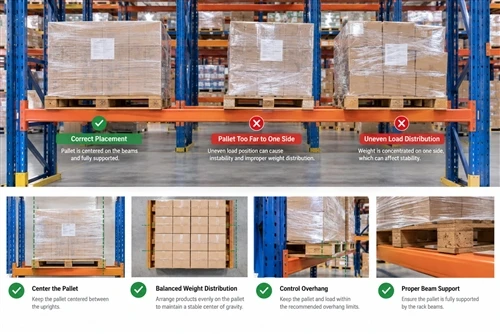
Depending on the rack configuration, pallets may be positioned with controlled overhang relative to the beams.
This can affect the required rack depth, beam position, and overall storage configuration.
Unplanned overhang can reduce clearance or create unsuitable loading conditions.
For this reason, the rack supplier should know the actual pallet dimensions and how the pallets are expected to sit on the beams.
Bay Width and Beam Length Are Closely Connected
The beam is the horizontal load-bearing component spanning between the upright frames.
As the required bay width changes, the beam length also changes.
Beam selection should therefore be considered together with:
- Bay width
- Pallet positions
- Maximum pallet weight
- Number of storage levels
- Load distribution
- Required rack height
A longer beam is not simply a larger version of a shorter beam. The structural requirements change with the span and load configuration.
For this reason, warehouse buyers should provide complete application information before requesting a final beam specification.
Does a Wider Bay Always Mean More Storage?
Not necessarily.
A wider bay can accommodate more pallet positions across a beam level, but it also consumes more horizontal space.
For example, if a warehouse has a fixed wall-to-wall dimension, using very wide bays may reduce the number of bays that can be installed along a rack row.
On the other hand, very narrow bays may increase the number of upright frames and reduce the number of pallet positions available per bay.
The best solution is therefore a balance between:
- Pallet positions per bay
- Number of bays per row
- Rack component requirements
- Warehouse dimensions
- Forklift access
- Storage density
How Bay Width Affects Warehouse Storage Density
Storage density should be evaluated across the entire warehouse rather than by looking at one individual rack bay.
A rack layout may use longer bays to increase pallet positions per bay, while another layout may use shorter bays to better fit building columns, doors, or other structural limitations.
This is particularly important in existing warehouses where the available floor plan cannot be changed.
Rack bay dimensions should work together with aisle width, rack depth, building columns, loading areas, and emergency access requirements.
Bay Width and Forklift Operation
Forklift operation is another consideration when designing pallet rack bays.
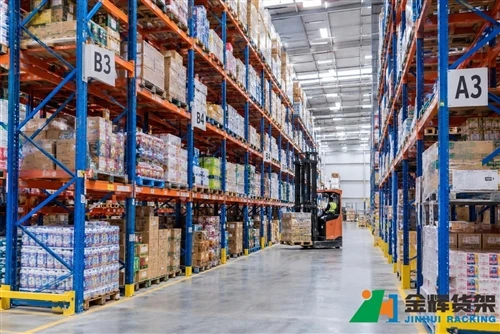
The forklift needs sufficient room to approach, lift, position, and retrieve pallets without interfering with adjacent stored loads.
The bay itself does not determine the complete forklift aisle requirement, but the rack configuration and pallet positioning must be compatible with the selected handling equipment.
Common handling equipment may include:
- Counterbalance forklifts
- Reach trucks
- Electric pallet trucks
- Order pickers
- Other specialized warehouse equipment
For this reason, rack dimensions should be finalized together with the warehouse handling equipment rather than independently.
How Rack Depth and Bay Width Work Together
Bay width is only one part of the rack's overall dimensional configuration.
Rack depth determines how far the structure extends into the warehouse, while bay width determines the horizontal storage space between upright frames.
Both dimensions need to match the pallet configuration.
For example, a pallet that is wider than expected may require a different bay width, while a pallet that is deeper may require a different rack depth.
This is why a pallet rack should be designed as a complete system rather than selecting individual dimensions independently.

Rack bay width is determined by pallet dimensions, pallet positions, clearances, and the overall warehouse storage layout.
How Building Columns Can Change Rack Bay Width
Existing warehouse columns can make standard rack layouts more difficult.
A rack row may need to pass around or terminate near structural columns, fire protection equipment, walls, doors, or other building features.
In these situations, using one standard bay width throughout the entire warehouse may not be the most efficient approach.
The layout may instead combine standard bays with carefully planned positions around building constraints.
Our previous article on warehouse columns and pallet rack layout explains this issue in more detail.
Standard Bay Width vs. Customized Bay Width
Standardized rack dimensions can simplify purchasing and installation, but customized dimensions may provide better utilization when a warehouse has unusual requirements.
A customized pallet rack layout may be useful when:
- Pallet dimensions are non-standard
- Warehouse columns are irregularly spaced
- Ceiling height is limited
- Existing racks need to be integrated
- Storage areas have different product requirements
- Specific forklift equipment is being used
The objective is not to customize every dimension unnecessarily. Instead, customization should be used where it provides a clear operational or space-utilization benefit.
How Bay Width Affects the Number of Rack Frames
There is an important relationship between bay width and the number of upright frames required along a rack row.
If the rack row has a fixed overall length, wider bays generally mean fewer bays are required, while narrower bays can result in more individual bays.
However, the number of pallet positions does not depend on bay width alone.
The rack designer also needs to consider pallet positions per bay, beam levels, aisle layout, building constraints, and the actual storage requirements.
This is why the most efficient layout is not necessarily the one with the fewest upright frames.
Bay Width for Selective Pallet Racking
Selective pallet racking is particularly flexible when it comes to bay configuration.
Its modular structure allows warehouse designers to configure different rack heights, beam levels, bay widths, and storage arrangements according to the application.
Selective racking is commonly used where direct access to individual pallets is more important than achieving the absolute maximum storage density.
Typical applications include:
- Manufacturing warehouses
- Distribution centers
- 3PL warehouses
- Automotive parts storage
- Industrial warehouses
- Retail distribution
For warehouses with a high number of SKUs, direct pallet access can be more valuable than simply increasing the number of pallets stored per bay.
When a Different Racking System May Be Better
Bay width is particularly important for selective pallet racking, but not every warehouse should use a conventional selective configuration.
When storage density is the primary objective, other systems may be more appropriate.
Drive-In Racking
Drive-in racking stores pallets in deep lanes and allows forklifts to enter the rack structure.
It is commonly considered when warehouses store large quantities of similar products and want to reduce the number of operating aisles.
Push Back Racking
Push back racking can store multiple pallets deep while allowing loading and retrieval from the same operating aisle.
It can be useful for batch storage where higher density is required without moving to a drive-in configuration.
Pallet Flow Racking
Pallet flow racking uses gravity-assisted pallet movement and is commonly considered where FIFO inventory rotation and high throughput are important.
The right system depends on the warehouse's inventory profile rather than bay width alone.
How to Choose the Right Pallet Rack Bay Width
Before finalizing the rack dimensions, warehouse managers should prepare the following information:
- Measure the pallet length and width.
- Record the maximum loaded pallet weight.
- Determine how many pallets should be stored per beam level.
- Confirm the required number of storage levels.
- Identify the forklift or handling equipment being used.
- Measure the available warehouse length and width.
- Record building column locations.
- Identify doors, loading areas, fire equipment, and other obstructions.
- Determine the required aisle configuration.
- Ask the rack manufacturer to confirm the final bay and beam dimensions.
Common Pallet Rack Bay Width Mistakes
Using a Standard Dimension Without Checking the Pallet
A standard bay width may not be suitable for every pallet size. Always confirm the actual pallet dimensions first.
Ignoring Pallet Overhang
Unplanned pallet overhang can affect clearance and storage safety.
Choosing the Widest Possible Bay
Wider does not automatically mean better. The total warehouse layout needs to be considered.
Ignoring Forklift Requirements
Rack configuration and material handling equipment need to work together.
Designing the Rack Without the Building Layout
Structural columns, doors, walls, fire protection equipment, and other obstructions can affect the final rack arrangement.
Changing Beam Length Without Reviewing Capacity
Changing beam span can affect the structural design. Beam length should be confirmed with the rack manufacturer.
FAQ About Pallet Rack Bay Width
What is the standard pallet rack bay width?
There is no single standard bay width suitable for every warehouse. The required width depends on pallet dimensions, pallet positions, clearances, beam configuration, and the rack design.
How many pallets can fit in one pallet rack bay?
A bay can commonly be configured for two or three pallet positions per beam level, but the actual number depends on pallet dimensions and the required clearances.
Does bay width affect rack capacity?
Yes. Bay width is related to beam span, and beam span is an important factor in determining the structural capacity of the beam configuration.
Should all bays in a warehouse have the same width?
Not necessarily. Standardized bays can simplify the layout, but warehouses with structural columns, irregular spaces, or different storage requirements may benefit from customized configurations.
Can pallet rack bay width be customized?
Yes. Industrial pallet racking can be designed with different bay widths according to pallet dimensions, storage requirements, warehouse conditions, and engineering requirements.
What information should I provide when ordering pallet racks?
Provide pallet dimensions, maximum pallet weight, number of pallets per level, required storage levels, warehouse dimensions, forklift information, and building layout information. These details allow the manufacturer to develop a more suitable configuration.
Final Thoughts
The right pallet rack bay width is a balance between pallet dimensions, storage capacity, structural requirements, and warehouse space utilization.
Choosing a bay that is too narrow may create clearance and loading problems, while choosing an unnecessarily wide bay can consume valuable floor space and affect the overall rack layout.
For this reason, bay width should be determined as part of the complete pallet racking design rather than treated as an isolated dimension.
For warehouses planning a new storage system, the best approach is to provide accurate pallet, load, forklift, and building information to the rack manufacturer before finalizing beam and bay dimensions.
Need help determining the right pallet rack configuration? Jinhui Rack can develop customized warehouse pallet racking solutions based on your pallet dimensions, load requirements, warehouse layout, and storage objectives.
Talk to Jinhui Rack About Your Warehouse Racking Project
Whether you need selective pallet racking for direct pallet access or a higher-density storage system, our team can help evaluate the appropriate configuration for your warehouse.
Send us your warehouse dimensions, pallet size, maximum pallet weight, required storage height, and forklift information for a more accurate racking solution.
WhatsApp: +86 185 0252 7163
Email: info@jhrack.com