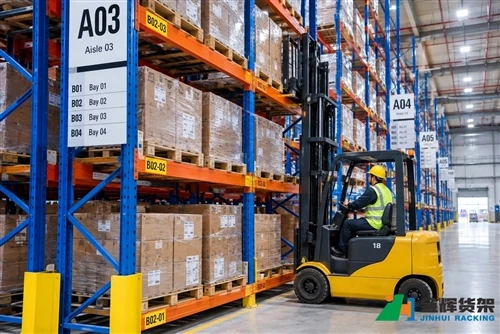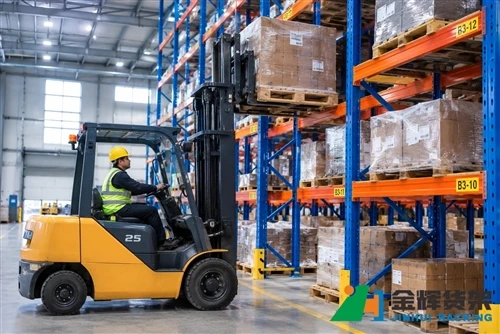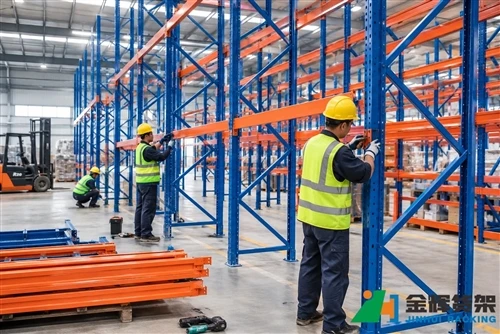
A pallet racking system provides the physical storage structure, but effective warehouse operation also depends on knowing exactly where each pallet should be stored. Without a clear storage location system, workers may spend more time searching for inventory, forklifts may travel unnecessarily, and inventory records can become difficult to maintain.
Pallet rack storage location management is the process of assigning, labeling, and maintaining specific locations for pallets and inventory within a warehouse. A practical system normally combines aisle numbers, rack or bay numbers, storage levels, and position codes so that every location can be identified quickly.
What Is a Pallet Rack Storage Location?
A pallet rack storage location is a specific position within a warehouse racking system where a pallet or other unit load is stored. Depending on the warehouse configuration, a location may be identified by the aisle, rack bay, level, and position.
For example, a warehouse might use a location code such as A03-B12-L03-P02. The exact coding system can vary, but the purpose is the same: warehouse employees should be able to identify the physical location from the code without having to search through the entire rack system.
| Location Element | Example | Purpose |
|---|---|---|
| Aisle | A03 | Identifies the warehouse aisle. |
| Bay | B12 | Identifies the rack bay or section. |
| Level | L03 | Identifies the vertical storage level. |
| Position | P02 | Identifies the pallet position within the bay. |
Why Storage Location Management Matters
A warehouse can have hundreds or thousands of pallet positions. When storage locations are not clearly organized, employees may have difficulty locating products, returning pallets to the correct position, or keeping inventory records accurate.
A well-structured location system can help warehouses:
- Find stored pallets faster.
- Reduce unnecessary forklift travel.
- Improve inventory accuracy.
- Make receiving and put-away easier to manage.
- Improve picking and replenishment operations.
- Identify available storage positions more easily.
- Train new warehouse employees more efficiently.
- Keep physical rack locations consistent with warehouse management software.
Location management is therefore not only a labeling exercise. It connects the physical warehouse layout with the way inventory is controlled and moved.
How to Create a Pallet Rack Location Numbering System
A good numbering system should be simple enough for warehouse employees to understand and consistent enough to remain useful as the warehouse grows.
One practical approach is to identify locations in a fixed sequence:
- Warehouse zone.
- Aisle number.
- Rack bay number.
- Storage level.
- Pallet position.
For example, a location could be identified as Z1-A04-B15-L02-P01. This could represent Zone 1, Aisle 04, Bay 15, Level 02, Position 01.
The exact format is less important than consistency. Avoid changing the meaning of a code from one warehouse area to another because inconsistent numbering can create confusion during receiving, picking, replenishment, and inventory counting.
Divide the Warehouse into Storage Zones
Large warehouses often benefit from dividing pallet racking into logical storage zones. The zones can be based on product characteristics, inventory turnover, operational requirements, temperature conditions, or other warehouse-specific factors.
| Possible Zone | Typical Use |
|---|---|
| Fast-Moving Zone | Products that are frequently picked or replenished. |
| Standard Storage Zone | Regular inventory with normal picking frequency. |
| Slow-Moving Zone | Products with relatively low picking frequency. |
| Inbound Zone | Temporary staging before products are put away. |
| Outbound Zone | Prepared orders waiting for shipment. |
Not every warehouse needs all of these zones. The appropriate structure depends on the company's inventory flow and operating process.
Assign SKUs to Appropriate Rack Locations
Once storage locations have been defined, the warehouse needs rules for assigning products to those locations. SKU assignment should consider more than simply finding an empty pallet position.
Useful factors include:
- Product turnover rate.
- Pallet dimensions.
- Pallet weight.
- Product compatibility requirements.
- Picking frequency.
- Required storage conditions.
- Relationship between related SKUs.
- Available rack capacity and storage levels.
High-turnover products may benefit from locations that reduce travel distance, while slow-moving inventory can potentially be assigned to less accessible positions when the rack configuration and warehouse operating rules allow it.
The goal is to match inventory characteristics with physical storage locations instead of treating every pallet position as identical.
How Rack Location Labels Should Be Positioned
Rack labels should be easy for forklift operators and warehouse employees to identify from the normal operating position. A label that is technically present but difficult to see does not provide much operational value.
Labels should normally be positioned consistently across the warehouse and should clearly correspond with the warehouse's location database or inventory system.
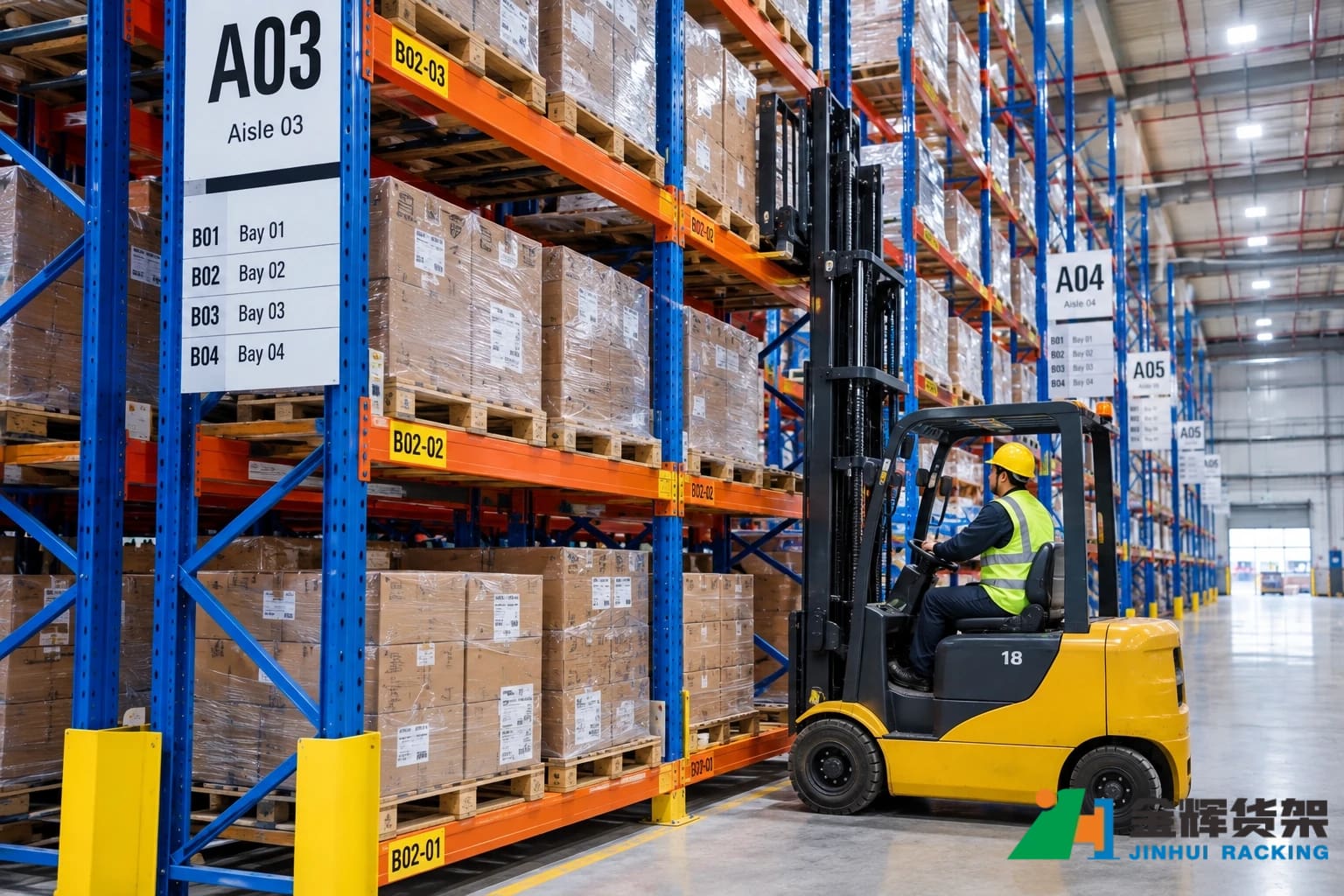
Depending on the warehouse system, location information may be displayed using printed labels, barcodes, QR codes, or other identification methods. The important point is that the physical label and the digital warehouse record must refer to the same location.
Use Aisle, Bay, Level, and Position Codes
A multi-part location code makes it possible to describe a storage position more precisely than using only a bay number.
For example, consider a warehouse with four aisles and multiple rack bays. A location code could use the following structure:
| Code | Meaning |
|---|---|
| A02 | Aisle 02 |
| B08 | Rack Bay 08 |
| L03 | Storage Level 03 |
| P02 | Pallet Position 02 |
Combined together, A02-B08-L03-P02 identifies a specific storage location.
For warehouses with back-to-back rack rows, the location system should also distinguish the two sides or rack faces. This prevents two physically different positions from accidentally receiving the same code.
Organize Locations According to Inventory Turnover
Not every pallet needs to be equally close to receiving, picking, or shipping areas. Warehouse managers can review inventory movement and assign storage locations according to operational demand.
Fast-moving products that are frequently picked may be positioned in areas that reduce unnecessary forklift travel. Products with lower movement frequency can be assigned to other suitable storage positions.
However, location assignment should always remain consistent with the rack's designed loading configuration, pallet dimensions, and warehouse operating requirements.
Keep Physical Locations and Inventory Records Consistent
A location management system only works when the physical warehouse matches the information recorded in the inventory system.
For example, if the warehouse system says that SKU A100 is stored at A03-B12-L02-P01, the pallet should actually be located there. If a pallet is moved to another position without updating the inventory record, the warehouse may technically have the product but still be unable to locate it efficiently.
Warehouse teams should therefore establish a clear procedure for:
- Creating new storage locations.
- Assigning pallets to locations.
- Moving pallets between locations.
- Removing empty locations from active inventory records.
- Updating location information after rack changes.
- Checking physical locations against inventory records.
Manage Empty Pallet Rack Locations
Empty rack positions should also be managed rather than treated as untracked space. A warehouse management system can distinguish between available, occupied, reserved, blocked, and temporarily unavailable locations.
This becomes particularly useful when a warehouse has different rack configurations or storage requirements. An apparently empty position may not be suitable for every pallet size or load weight.
Warehouse employees should therefore check the location's assigned characteristics before putting away a new pallet.
Common Pallet Rack Location Management Mistakes
Location management problems are often caused by inconsistent processes rather than by the physical rack itself.
- Using different numbering rules in different warehouse areas.
- Missing or damaged rack location labels.
- Using labels that are difficult to read from the aisle.
- Assigning two physical locations the same code.
- Moving pallets without updating the inventory record.
- Assigning pallets to locations that are not suitable for their dimensions.
- Ignoring temporary storage positions during inventory management.
- Changing rack layouts without updating location records.
- Allowing old labels to remain after a location is renumbered.
How to Keep Rack Location Information Accurate
Location accuracy should be maintained as part of normal warehouse operations rather than corrected only during annual inventory counts.
A practical control process can include regular checks of physical labels, location records, and pallet positions. When rack bays are added, removed, or rearranged, the corresponding location database should be updated at the same time.
Warehouse managers should also establish responsibility for location changes. Employees should know who can create a new location, who can change a location code, and who is responsible for updating the warehouse management system.
How Pallet Racking Supports Organized Storage
The physical configuration of the pallet racking system affects how easily storage locations can be organized. A well-planned selective pallet racking system, for example, can provide individual access to many pallet positions and make location-based inventory management straightforward.
For warehouses that need organized access to individual pallets, selective pallet racking systems can be configured around pallet dimensions, storage levels, aisle arrangements, and warehouse operating requirements.
For larger industrial applications, the warehouse pallet rack solutions can also be planned around the warehouse's overall storage and operational requirements.
Example of a Practical Rack Location System
Consider a warehouse with three storage zones, six aisles, and multiple rack bays. The warehouse could use a location structure such as:
Zone → Aisle → Bay → Level → Position
For example:
Z2-A04-B16-L03-P02
This code can be interpreted as:
- Z2: Storage Zone 2.
- A04: Aisle 04.
- B16: Bay 16.
- L03: Level 03.
- P02: Pallet Position 02.
The exact code format can be simplified or expanded depending on warehouse size. The most important requirement is that employees can understand the code quickly and use it consistently.
FAQ About Pallet Rack Storage Locations
What information should a pallet rack location code contain?
A location code commonly identifies the warehouse zone, aisle, rack bay, storage level, and pallet position. The exact structure depends on the warehouse layout and inventory management system.
Should every pallet rack bay have a location label?
For organized warehouse operations, each active storage position should be identifiable. The label should correspond with the location information used in the warehouse's inventory system.
Should fast-moving products be stored closer to the shipping area?
They can be assigned to locations that reduce unnecessary travel when the warehouse layout and rack configuration allow it. The actual arrangement should also consider pallet dimensions, load requirements, picking processes, and available storage capacity.
Can rack location numbers be changed after installation?
Yes, but changes should be controlled carefully. Physical labels, warehouse maps, inventory records, and operating procedures should all be updated so that the new numbering system remains consistent.
How can barcode or QR labels improve location management?
Barcode and QR systems can reduce manual data entry when integrated with suitable warehouse software. They can allow operators to scan a location and connect the physical rack position with inventory information.
Final Thoughts
Effective pallet rack storage location management connects the physical warehouse with its inventory management process. Clear location numbers, consistent rack labels, logical storage zones, and accurate inventory records can make it easier for warehouse teams to find, store, move, and manage pallets.
The best location system is not necessarily the most complicated one. It should be easy for employees to understand, consistent throughout the warehouse, and flexible enough to support future changes in storage requirements.
If you are planning a new warehouse racking project and need help determining rack configuration, storage locations, and pallet storage requirements, contact Jinhui Rack for a project-specific solution.
WhatsApp: +86 185 0252 7163
Email: info@jhrack.com
Website: https://www.jinhui-rack.com/