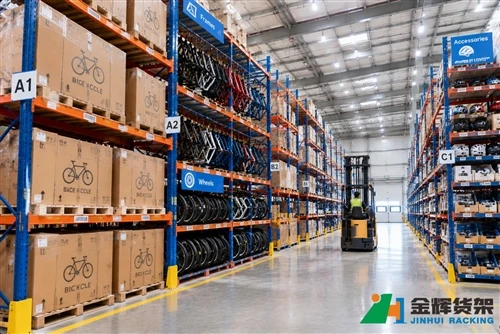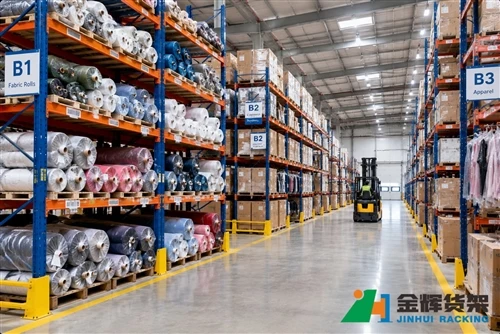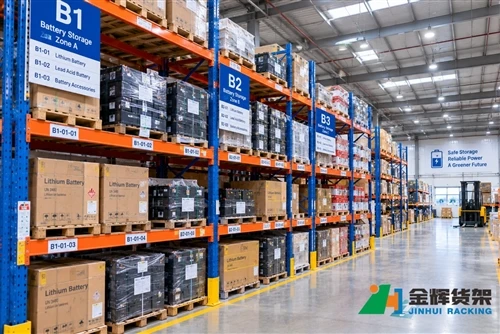
Textile and apparel warehouses often handle a combination of fabric rolls, folded garments, boxed clothing, accessories, and seasonal inventory. These products differ in dimensions, weight, packaging, handling requirements, and storage turnover. A warehouse that stores fabric rolls for production may need a very different layout from a distribution facility handling finished garments by style, color, and size.
Warehouse racking for textile and apparel storage should reflect these differences. The goal is not simply to add more storage positions, but to organize inventory so that products remain identifiable, accessible, and protected throughout receiving, storage, replenishment, picking, and dispatch.

1. Understand the Storage Requirements of Textile and Apparel Products
Textile warehouses can contain several product groups within the same facility. Fabric rolls may arrive in different diameters and lengths, while finished clothing is commonly stored in cartons, totes, or other containers. Accessories and smaller textile products may require shelf-based storage rather than pallet positions.
These differences affect how storage locations should be designed and assigned. Before selecting a racking configuration, identify the physical characteristics of the inventory and the way each product group moves through the warehouse.
- Fabric rolls: Roll diameter, length, weight, packaging, and support requirements influence the storage arrangement.
- Garment cartons: Carton dimensions, pallet configuration, and order quantities determine suitable rack positions.
- Color and size variations: Similar-looking products may need separate inventory locations to prevent picking errors.
- Seasonal inventory: Demand changes can affect the number of active picking locations and reserve storage positions.
- Accessories and small items: Buttons, labels, trims, and other small products may need compartmentalized or shelf-based storage.
- Packaging protection: Fabric and finished garments should be protected from moisture, dirt, crushing, and unnecessary handling.
A practical layout begins by separating products with different storage and handling requirements while maintaining clear connections between receiving, reserve storage, picking, and dispatch.
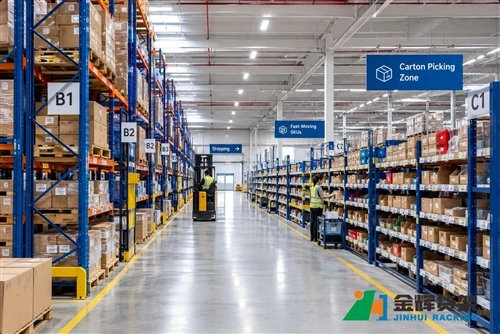
2. Divide the Warehouse into Functional Storage Zones
Organizing textile inventory into functional zones makes it easier to control stock and manage different handling processes. The exact arrangement depends on whether the facility primarily stores raw materials, finished garments, or a combination of both.
| Storage Zone | Typical Inventory | Planning Consideration |
|---|---|---|
| Receiving and inspection | Incoming fabric rolls, garment cartons, and textile accessories. | Allow space for quantity checks, packaging inspection, and identification before storage. |
| Fabric roll storage | Raw fabric rolls and other rolled textile materials. | Match the storage arrangement to roll dimensions, weight, support requirements, and handling equipment. |
| Reserve carton storage | Bulk quantities of finished clothing and packaged textile products. | Plan pallet positions around carton dimensions, SKU grouping, and replenishment requirements. |
| Active picking area | Frequently ordered garments and accessories. | Provide clear location labels and convenient access to commonly picked products. |
| Small-item shelving | Labels, trims, accessories, and other small textile components. | Use suitable compartments, containers, and identification methods to separate similar items. |
| Dispatch and consolidation | Picked cartons and completed customer orders. | Allocate staging space without blocking rack aisles or required access routes. |
These zones do not always need physical walls or separate rooms. Clear location assignments, appropriate signage, and consistent operating procedures can establish functional separation within an open warehouse.
3. Select Suitable Racking for Fabric Rolls
Fabric rolls are different from ordinary palletized cartons. Their dimensions, shape, weight distribution, and packaging can affect how they should be supported and retrieved. A storage method that works for boxed garments may not be suitable for long or heavy fabric rolls.
Evaluate Roll Dimensions and Support Requirements
Before designing fabric storage, record the typical and maximum roll diameter, length, weight, and packaging condition. Determine whether the rolls arrive individually, on pallets, or in specially designed containers.
Storage supports must be appropriate for the roll geometry and the intended loading method. Rolls should not be placed on unsuitable rack beams or stored in a way that allows them to roll, shift, or become unstable. Any dedicated cradles, supports, or handling attachments should be evaluated as part of the complete storage arrangement.
Use Pallet Racking for Compatible Palletized Textile Loads
Selective pallet racking systems may be suitable for textile inventory that arrives on compatible pallets or in standardized load units. They provide direct access to individual pallet positions, which can help when a warehouse stores many fabric types, colors, or production batches.
The design must account for the actual pallet footprint, load weight, roll stability, rack beam arrangement, and material-handling equipment. If rolls require special support or cannot be safely handled as conventional pallet loads, the storage configuration should be adapted accordingly rather than assuming standard pallet racking will fit every application.
Keep Fabric Identification Visible
Fabric rolls can look similar even when their material composition, color, width, finish, or production batch differs. Labels should identify the relevant product information and remain accessible for checking without unnecessary movement of adjacent stock.
Where rolls are stored in racks, location labels should be coordinated with the warehouse inventory system. This helps operators identify the correct roll and reduces the risk of selecting an incorrect material for production.
4. Organize Garment Cartons by Style, Color, and Size
Finished apparel inventory can contain many closely related SKUs. A single garment style may be available in multiple colors and sizes, and each variation may have a different stock quantity or order frequency.
Grouping products only by broad category, such as shirts or trousers, may not provide enough control for accurate picking. A more effective arrangement uses the warehouse's actual product coding and order patterns to assign storage locations.
- Separate distinct SKUs: Keep different style, color, or size combinations identifiable within the storage system.
- Use consistent location codes: Make aisle, rack, level, and position references easy to understand.
- Group compatible cartons: Consider carton dimensions and handling requirements when assigning pallet positions.
- Prioritize active inventory: Place frequently picked products where they can be accessed efficiently without disrupting other operations.
- Maintain reserve stock: Separate bulk reserve inventory from active picking stock when this improves replenishment control.
- Verify product identity: Use barcode scanning or other appropriate checks where available.
The layout should also accommodate changes in clothing collections. Seasonal styles may move from high-demand picking locations to reserve storage as demand changes, so location assignments should allow controlled adjustment without losing inventory accuracy.
5. Decide Between Pallet Racking and Shelf-Based Storage
Textile warehouses often need more than one storage method. Pallet racking can support bulk cartons and compatible palletized materials, while shelving can be useful for smaller products, accessories, and individual picking operations.
| Storage Method | Potential Application | Key Consideration |
|---|---|---|
| Selective pallet racking | Palletized garment cartons, packaged textile products, and compatible raw-material loads. | Pallet dimensions, load capacity, forklift access, and SKU variety. |
| Shelf-based storage | Small accessories, samples, labels, and items picked individually. | Shelf load limits, compartment organization, and picking ergonomics. |
| Dedicated roll storage | Fabric rolls with specific dimensional or support requirements. | Roll stability, suitable supports, handling equipment, and safe retrieval. |
| Floor-level storage positions | Selected loads that require specific handling or do not fit the available rack configuration. | Stable placement, clear routes, stacking restrictions, and floor capacity. |
A combined storage approach can be more practical than forcing all textile products into one system. The decision should reflect actual inventory characteristics and operating requirements rather than a preference for one rack type.
6. Protect Textile Inventory from Moisture, Dust, and Compression
Textile products can be affected by storage conditions and handling practices. Fabric may absorb moisture or collect dust, while finished garments can be damaged by crushed cartons, torn packaging, or unsuitable stacking. Storage planning should therefore consider product protection as well as accessibility.
Useful practices include:
- Inspect incoming packaging: Check for moisture, tears, contamination, and visible damage before placing inventory into storage.
- Maintain suitable storage conditions: Follow the product and facility requirements for humidity, ventilation, cleanliness, and temperature.
- Keep goods off unsuitable surfaces: Use appropriate pallets, shelves, or supports where direct floor contact could expose products to moisture or dirt.
- Follow carton stacking limits: Avoid excessive stacking pressure that may deform packages or damage the goods inside.
- Prevent unstable roll placement: Use supports appropriate to the roll dimensions and storage design.
- Separate damaged inventory: Identify and hold products requiring inspection instead of mixing them with available stock.
- Maintain housekeeping: Keep storage areas clean and prevent loose packaging from obstructing aisles.
Not every textile product has the same environmental requirements. Storage procedures should follow the relevant product specifications and facility conditions instead of applying one rule to all fabrics and garments.
7. Plan Replenishment and Picking for Different Order Patterns
Some textile warehouses supply manufacturing operations with raw fabric, while others fulfill wholesale or retail orders for finished garments. These workflows have different movement patterns and should influence the placement of inventory.
Raw-material operations may need to deliver the correct fabric roll to a production area according to material specifications and production schedules. Apparel distribution operations may instead pick cartons or individual items by style, color, and size before consolidating them into customer orders.
To coordinate these processes:
- Separate reserve and active stock: Use clearly defined locations when bulk storage and frequent picking have different requirements.
- Define replenishment triggers: Establish when active picking locations should be refilled from reserve inventory.
- Coordinate with production: Where fabric supplies manufacturing, align material identification and movement with production needs.
- Organize order consolidation: Provide sufficient space to combine picked cartons without blocking storage aisles.
- Reduce unnecessary relocation: Assign locations that limit repeated handling of fabric rolls and garment cartons.
- Review seasonal demand: Adjust picking arrangements when product collections or order volumes change.
Replenishment rules should be consistent with the warehouse management system and the physical layout. Frequent changes to storage locations without updating inventory records can undermine otherwise efficient warehouse operations.
8. Improve Inventory Accuracy with Clear Location Management
Textile inventory can be difficult to control when many products share similar packaging. Style codes, fabric specifications, color references, sizes, and production batches may all be relevant to identifying the correct item.
A location management system should connect the physical rack position with the product record. The location code should be easy to read and consistent across receiving, put-away, replenishment, picking, and stocktaking.
For better inventory control:
- Assign each storage position a unique location code.
- Keep product codes consistent between labels and inventory records.
- Record fabric specifications or garment variants where they are required for identification.
- Update records immediately after relocation or stock movement.
- Use barcode verification where appropriate to reduce manual identification errors.
- Conduct regular inventory checks based on the warehouse's operational requirements.
- Keep unverified returns and damaged stock separate from available inventory.
These practices help maintain traceability when similar-looking products are stored in adjacent locations or when inventory moves between reserve storage and active picking areas.
9. Common Mistakes in Textile Warehouse Storage
| Common Mistake | Potential Problem | Recommended Approach |
|---|---|---|
| Treating fabric rolls like ordinary cartons | Unsuitable support may allow rolls to shift or become unstable. | Check roll geometry, load weight, support requirements, and handling method. |
| Mixing similar apparel SKUs without clear identification | Incorrect colors, sizes, or styles may be picked. | Use clear SKU records, location codes, and appropriate verification procedures. |
| Using the same storage method for every product | Small accessories, garment cartons, and fabric rolls may not be stored efficiently. | Choose storage methods based on product dimensions, load characteristics, and picking needs. |
| Ignoring packaging and environmental conditions | Moisture, dust, or excessive compression may damage inventory. | Follow product storage requirements and establish suitable inspection and housekeeping procedures. |
| Placing fast-moving items far from active picking areas | Travel and replenishment workloads may increase. | Use actual order and movement data to guide location assignments. |
| Changing locations without updating records | Inventory may become difficult to locate or reconcile. | Record location changes as part of the warehouse's standard stock movement process. |
10. What to Prepare Before Planning a Textile Warehouse Racking System
Before selecting a storage system, collect the information needed to assess the facility, inventory, and daily handling process. This helps ensure that the proposed layout reflects real operating conditions.
- Product dimensions: Fabric roll length and diameter, carton dimensions, pallet sizes, and package heights.
- Load information: Typical and maximum weights, pallet condition, and any special support requirements.
- Inventory structure: Number of fabric types, garment styles, colors, sizes, accessories, and product variants.
- Movement data: Receiving volume, picking frequency, replenishment needs, and seasonal demand changes.
- Building information: Usable floor area, clear height, columns, doors, and other obstructions.
- Handling equipment: Forklift or handling equipment specifications and required operating clearances.
- Storage objectives: Required capacity, accessibility, inventory accuracy, and anticipated growth.
- Product protection: Relevant requirements for packaging, cleanliness, humidity, and handling.
Use this information to compare storage capacity, access to individual products, handling workload, and inventory control. The most suitable arrangement is the one that supports the facility's actual textile and apparel operations rather than maximizing storage density in isolation.
For palletized textile cartons and compatible loads, review JINHUI RACK selective pallet racking systems. The suitability of any rack configuration should be confirmed against the actual load specifications and intended storage method.
Frequently Asked Questions
What type of racking is suitable for a textile warehouse?
The right system depends on the inventory. Selective pallet racking may suit compatible palletized garment cartons and textile products, while smaller accessories may be better organized on suitable shelving. Fabric rolls may require dedicated supports or a storage configuration designed around their dimensions and handling requirements.
How should fabric rolls be stored in a warehouse?
Storage should account for roll diameter, length, weight, packaging, and handling method. Use suitable supports to prevent rolling or instability, and ensure that the storage arrangement is compatible with the load and retrieval equipment.
How can apparel warehouses reduce picking errors?
Maintain distinct SKU records for style, color, and size variations, use consistent storage location codes, and update inventory records whenever stock moves. Barcode scanning or other verification procedures may provide additional control where appropriate.
Should fabric rolls and finished garment cartons share the same storage area?
They may share a warehouse, but they do not necessarily need the same storage configuration. Separate zones can help accommodate different support, access, identification, and handling requirements while keeping the overall material flow coordinated.
What information is needed before selecting textile warehouse racking?
Important information includes roll and carton dimensions, load weights, pallet specifications, SKU variety, inventory turnover, building dimensions, handling equipment, and any relevant product protection requirements.
Conclusion
Warehouse racking for textile and apparel storage should be designed around the physical characteristics and movement patterns of fabric rolls, garment cartons, and smaller textile products. Clear storage zones, suitable support arrangements, accurate SKU identification, and practical replenishment procedures help keep inventory organized and accessible.
Before choosing a system, assess the actual loads, storage conditions, building layout, and handling process. A well-planned arrangement can support more reliable inventory control, reduce unnecessary handling, and help textile warehouses manage changing product ranges and seasonal demand.
Contact JINHUI RACK
Planning storage for fabric rolls, garment cartons, or mixed textile inventory? Contact JINHUI RACK to discuss your product dimensions, storage requirements, and warehouse layout.
Email: info@jhrack.com
WhatsApp: +86 185 0252 7163