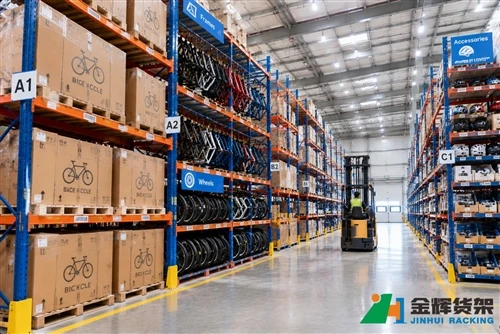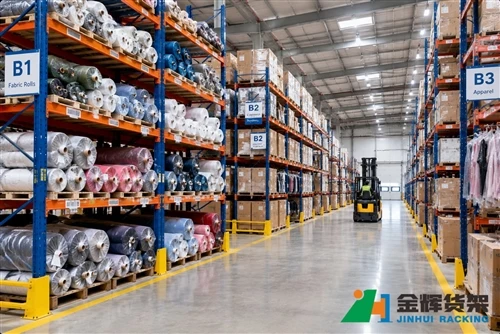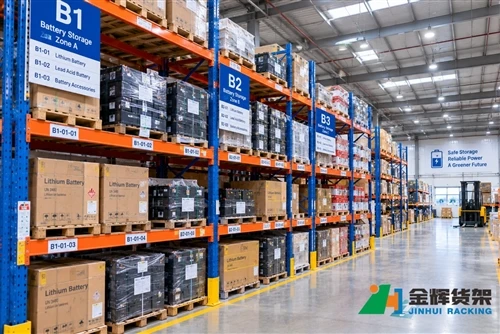
Bicycle and outdoor equipment distributors often store a wide variety of products in the same warehouse. Complete bicycles may arrive in cartons, while replacement frames, wheel sets, handlebars, helmets, repair parts, and accessories come in different sizes and packaging formats. These products require different storage arrangements, and their inventory turnover can vary significantly throughout the year.
A suitable warehouse racking layout helps distributors organize bulk inventory, maintain clear product locations, and support efficient picking and replenishment. The right solution depends on product dimensions, packaging, load weights, SKU variety, order profiles, and the equipment used to move products through the facility.

1. Understand the Storage Needs of Bicycle Distribution Warehouses
Bicycle distribution is different from storing a single category of uniform cartons. A distributor may handle complete bicycles, partially assembled units, replacement components, protective equipment, and seasonal outdoor products. Some inventory arrives on pallets, while other products are packed in cartons that vary in length, width, height, and weight.
Before selecting a racking configuration, classify the inventory according to its physical characteristics and handling requirements.
- Boxed bicycles: Carton dimensions and packaging strength determine how products can be stacked or stored in rack positions.
- Bicycle frames: Frame geometry varies by model and size. Storage must prevent products from shifting or being damaged by contact with other items.
- Wheel sets and tires: These products may require different storage arrangements depending on packaging, quantities, and handling methods.
- Replacement components: Smaller parts may need organized shelves, bins, or compartmentalized storage.
- Protective equipment: Helmets, gloves, and other accessories may be picked individually or in small quantities.
- Seasonal products: Demand for certain models and accessories can change throughout the year, affecting storage and picking priorities.
Grouping products by storage requirements helps avoid the common mistake of using one storage method for every item. The goal is to match each inventory group with a suitable location while keeping the overall warehouse flow coordinated.
2. Divide the Warehouse into Practical Storage Zones
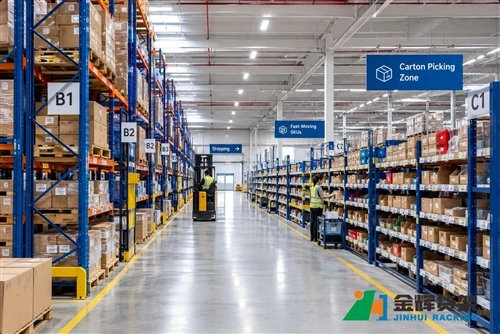
A bicycle distribution warehouse can benefit from clearly defined zones for receiving, bulk storage, component storage, order picking, and dispatch. The arrangement should reflect the volume and movement patterns of each product group.
| Warehouse Zone | Typical Products | Main Planning Consideration |
|---|---|---|
| Receiving and inspection | Incoming bicycle cartons, component cartons, and palletized stock. | Allow space for quantity checks, carton inspection, and product identification. |
| Bulk bicycle storage | Palletized or otherwise compatible boxed bicycles. | Match rack positions to carton dimensions, pallet configuration, and actual load weights. |
| Frame and wheel storage | Replacement frames, wheel sets, and selected oversized components. | Provide suitable supports and prevent movement or damaging contact. |
| Small-parts storage | Brake components, cables, pedals, fasteners, and repair accessories. | Use clear SKU identification and organized bins or shelves. |
| Active picking | Frequently ordered models, components, and accessories. | Prioritize convenient access and accurate product identification. |
| Order consolidation and dispatch | Picked cartons and completed customer orders. | Provide sufficient staging space without obstructing aisles or access routes. |
These zones can be established through location coding, signage, and operating procedures without necessarily requiring separate rooms. Their size should be based on actual stock volumes and movement frequency rather than equal allocation of floor space.
3. Select Pallet Racking for Boxed Bicycles
Boxed bicycles can be suitable for pallet racking when the packaging, pallet configuration, and load characteristics meet the requirements of the selected system. However, bicycle cartons can be relatively long or tall, and their dimensions may vary between models.
Check Carton Dimensions and Pallet Configuration
Record the length, width, height, and weight of representative bicycle cartons before deciding on rack bay dimensions. Include the maximum expected load rather than planning only around the most common model.
Confirm that pallets provide suitable support for the stored cartons and that the complete load can be handled safely by the intended equipment. Cartons should remain stable within the designated storage position, and loading arrangements should follow the approved rack design.
Consider Selective Pallet Racking for Mixed Models
Selective pallet racking systems may be suitable for distributors storing multiple bicycle models, frame sizes, and product variants. Each pallet position can be accessed independently, which can be helpful when orders require specific models or when inventory is spread across many SKUs.
This flexibility can be valuable when different bicycle models have different carton dimensions or sales volumes. Nevertheless, rack dimensions and load capacities must be based on the actual products, pallets, and handling equipment.
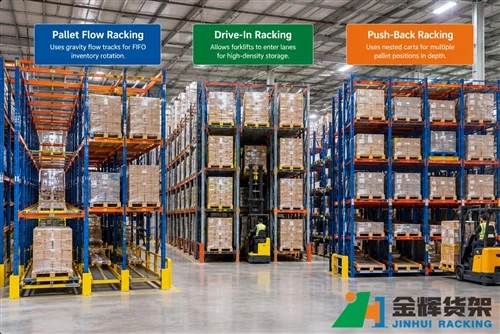
For warehouses storing large quantities of a smaller number of compatible products, other pallet storage configurations may also be worth evaluating. Any increase in storage density should be balanced against access requirements, inventory control, and the ability to retrieve the correct product safely.
Keep Product Labels Visible
Bicycle cartons may look similar even when they contain different frame sizes, model years, colors, or component specifications. Storage locations should therefore be linked to reliable product records.
Use consistent location codes and product identification procedures so that workers can distinguish between similar models before moving or picking a carton. Where available, barcode scanning can support verification during receiving, put-away, replenishment, and dispatch.
4. Organize Bicycle Frames, Wheels, and Oversized Components
Not every bicycle-related product should be stored as a conventional pallet load. Frames, wheel sets, handlebars, and other components may have different shapes and support requirements. Their storage arrangements should be designed around the actual product geometry and the method used to handle each item.
Bicycle Frames
Frame dimensions vary according to bicycle type, frame size, and design. A suitable storage method should prevent frames from sliding, becoming entangled, or contacting adjacent products in ways that could damage surfaces or components.
Where frames are stored in containers or cartons, verify that the packaging provides adequate support. Where a dedicated frame-storage arrangement is used, its supports and load limits should be appropriate for the specific products.
Wheel Sets and Tires
Wheel sets may be stored in protective cartons, suitable containers, or designated storage positions. The appropriate method depends on whether the wheels are packaged individually, assembled into sets, or supplied on pallets.
Do not assume that loose wheels or tires can be stored safely on ordinary pallet rack beams without suitable containment or support. The storage arrangement should prevent unintended movement and allow workers to retrieve the products without disturbing neighboring stock.
Long Components and Irregular Packages
Handlebars, forks, seat posts, and other elongated components may require shelving, bins, or a dedicated storage arrangement depending on their dimensions and packaging. The selected system should allow clear identification and prevent products from projecting into aisles or obstructing adjacent storage positions.
When planning specialized supports, confirm the intended loads, dimensions, retrieval method, and compatibility with the warehouse's handling equipment. Avoid improvising supports that have not been evaluated for the intended use.
5. Use Shelving and Bins for Bicycle Parts and Accessories
Small components can account for a large number of SKUs even when their individual storage volume is limited. Brake pads, pedals, cables, fasteners, lights, grips, and repair kits may have similar packaging but different specifications.
For these products, shelf-based storage and compartmentalized bins may provide easier access than placing every item in pallet storage.
- Separate similar components: Distinguish parts by product code, size, specification, or compatibility where relevant.
- Use consistent labels: Ensure that shelf and bin labels match the inventory records.
- Organize by picking frequency: Position frequently ordered products in convenient locations when this suits the workflow.
- Keep reserve quantities identifiable: Separate reserve stock from active picking quantities where necessary.
- Control small-item containers: Use appropriate bins or dividers to prevent products from mixing.
- Allow replenishment access: Make it possible to refill picking locations without disrupting order preparation.
For mixed operations, pallet racking and shelf-based storage can complement one another. Bulk bicycle cartons can occupy suitable pallet positions while small components are stored in organized picking areas.
6. Protect Products During Storage and Handling
Bicycles and their components can be affected by poor packaging, unstable loads, excessive pressure, and unnecessary handling. A storage plan should therefore consider product protection as well as storage capacity.
Useful practices include:
- Inspect incoming cartons: Identify crushed corners, torn packaging, moisture, or other visible damage before put-away.
- Follow packaging limits: Do not exceed approved stacking limits or place loads in ways that can deform cartons.
- Secure compatible loads: Use appropriate pallets and load-stabilization methods according to the product and handling requirements.
- Keep products within rack positions: Prevent cartons and components from projecting into forklift aisles or pedestrian routes.
- Separate damaged goods: Record and hold damaged products for inspection instead of mixing them with available inventory.
- Reduce unnecessary handling: Assign locations and replenishment procedures that avoid repeated movement of the same cartons.
- Maintain suitable conditions: Follow relevant product requirements for cleanliness, moisture protection, and storage environment.
Product protection should be reviewed together with the storage method. A dense arrangement is not beneficial if it increases carton damage, makes retrieval difficult, or creates unstable loads.
7. Manage Model Variations, SKU Accuracy, and Seasonal Demand
Bicycle distributors often manage inventory across model types, frame sizes, colors, product generations, and component specifications. These differences can create picking challenges when multiple products share similar packaging.
A consistent SKU and location management process helps prevent incorrect product selection and makes it easier to adjust the warehouse as inventory changes.
Establish Clear Location Codes
Each storage position should have a unique location reference. The code should identify the relevant aisle, rack, level, and position according to the warehouse's chosen convention.
Connect each location to the correct product record and update the record whenever stock is moved. This is particularly important when a warehouse temporarily relocates products to make room for seasonal inventory or newly received models.
Plan for Seasonal Changes
Demand for bicycles and outdoor products may vary with the season, regional conditions, promotions, and product launches. The warehouse should be able to accommodate changes in stock levels without losing location accuracy.
Review movement history to identify products that frequently require replenishment or occupy a large proportion of active picking capacity. Use this information to adjust location assignments where practical, while maintaining clear separation between similar models and components.
Control Reserve and Picking Stock
Where the operation handles many individual orders, separating reserve inventory from active picking stock can help simplify replenishment. Bulk cartons remain in reserve positions, while selected quantities are moved to locations designed for frequent order preparation.
The process should specify when replenishment occurs, how stock movements are recorded, and how discrepancies are investigated. Clear procedures help maintain accurate inventory even when products move between storage zones.
8. Plan Forklift Aisles and Order-Picking Routes
A racking layout should support the equipment and movement patterns used in the warehouse. Long bicycle cartons may require additional consideration during turning and maneuvering, while small-part picking may follow a different route from pallet handling.
Review the following factors when planning warehouse traffic:
- Equipment dimensions: Confirm aisle requirements using the actual forklift or handling equipment specifications and load configuration.
- Turning and maneuvering: Check that equipment can handle the intended loads without contacting rack structures or adjacent products.
- Pedestrian movement: Provide clearly defined routes and apply the facility's traffic-management procedures.
- Receiving and dispatch: Keep staging areas organized so that waiting cartons do not obstruct rack aisles.
- Picking sequence: Group order lines and storage locations where this reduces unnecessary travel.
- Replenishment timing: Coordinate reserve-stock movement with picking operations to reduce avoidable congestion.
Aisle dimensions must be determined from the selected equipment, load characteristics, building layout, and applicable safety requirements. They should not be reduced solely to increase rack capacity without a proper technical assessment.
9. Common Mistakes in Bicycle Warehouse Storage
| Common Mistake | Potential Impact | Better Practice |
|---|---|---|
| Planning racks around only one carton size | Other bicycle models may not fit the intended positions or load arrangement. | Check representative and maximum carton dimensions before finalizing the layout. |
| Storing frames and wheels without suitable support | Products may shift, fall, or become damaged during retrieval. | Use a storage arrangement designed for the product geometry and handling method. |
| Mixing similar models in poorly labeled locations | Picking errors and inventory discrepancies may increase. | Use consistent SKU identification and location verification procedures. |
| Using pallet positions for every product category | Small accessories may become difficult to identify and pick efficiently. | Combine suitable pallet storage with shelving or bins for small components. |
| Ignoring seasonal inventory changes | Active picking locations may become congested or poorly matched to demand. | Review stock movement and adjust location assignments with inventory records kept up to date. |
| Reducing aisles without checking equipment requirements | Maneuvering may become difficult and operating risks may increase. | Confirm aisle dimensions using the intended equipment, loads, and applicable requirements. |
10. What to Prepare Before Selecting Bicycle Warehouse Racking
Before requesting a storage proposal, prepare the information needed to assess the inventory and the facility. Clear specifications help ensure that the proposed system reflects the actual products and daily workflow.
- Product dimensions: Record the length, width, and height of bicycle cartons, frame packages, wheel sets, and other large items.
- Load weights: Identify typical and maximum weights for individual cartons, pallets, and complete stored loads.
- Pallet specifications: Provide pallet dimensions, load configuration, and any special handling requirements.
- SKU profile: Estimate the number of bicycle models, sizes, colors, components, and accessories that require separate identification.
- Inventory volume: Identify current pallet quantities, reserve stock requirements, and anticipated seasonal changes.
- Handling equipment: Specify forklift types, lifting heights, load capacities, and other relevant equipment characteristics.
- Building information: Provide usable floor dimensions, clear height, column positions, doors, and other obstructions.
- Workflow requirements: Describe receiving, put-away, replenishment, order picking, consolidation, and dispatch processes.
These details help determine whether selective pallet racking, dedicated component storage, shelving, or a combination of systems is appropriate. The final configuration should be checked against the intended loads, storage method, handling equipment, and facility requirements.
For compatible palletized bicycle cartons and other packaged inventory, review JINHUI RACK selective pallet racking systems. The suitability of the system should be confirmed using the actual product and pallet specifications.
Frequently Asked Questions
What type of racking is suitable for a bicycle distribution warehouse?
The appropriate system depends on the products being stored. Selective pallet racking may suit compatible palletized bicycle cartons, while smaller parts and accessories may be better organized using suitable shelves or bins. Frames and wheels may need dedicated storage arrangements based on their dimensions and support requirements.
Can boxed bicycles be stored on selective pallet racking?
They may be stored on selective pallet racking when the pallet configuration, carton dimensions, load weight, and handling method are compatible with the rack design. The complete stored load should remain stable, and the rack system must be specified for the intended application.
How should bicycle frames and wheel sets be stored?
Use an arrangement appropriate to the product shape, packaging, and handling method. Frames should be protected against shifting and damaging contact, while wheel sets should be supported or contained to prevent unintended movement. Do not assume that loose components can be placed safely on ordinary rack beams without suitable support.
How can bicycle warehouses reduce picking errors?
Use distinct product records for relevant model, size, color, and component variations. Assign clear location codes, maintain accurate inventory records, and verify product identity during picking. Barcode scanning can provide additional verification where available.
Should bicycle parts and complete bicycles share the same storage system?
Not necessarily. Complete bicycles in compatible cartons may use pallet racking, while small components may require shelf-based storage and selected frames or wheels may need dedicated supports. A combined layout can provide more suitable storage for different product categories.
Conclusion
Warehouse racking for bicycle and outdoor equipment distribution should reflect the different storage needs of boxed bicycles, frames, wheel sets, replacement components, and accessories. A well-organized layout combines suitable storage methods with clear product identification, practical picking routes, and consistent inventory procedures.
Before selecting a system, evaluate product dimensions, load characteristics, pallet configurations, SKU variety, seasonal demand, and handling equipment. Matching these requirements to the storage layout can help distributors protect inventory, improve picking accuracy, and manage warehouse operations more effectively.
Contact JINHUI RACK
Planning a bicycle distribution warehouse or reorganizing storage for boxed bicycles and components? Contact JINHUI RACK to discuss your product dimensions, pallet requirements, and warehouse layout.
Email: info@jhrack.com
WhatsApp: +86 185 0252 7163