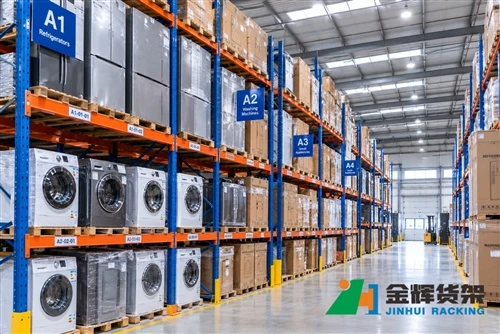
E-commerce fulfillment warehouses face a different storage challenge from traditional bulk-storage facilities. They must handle a large number of stock-keeping units (SKUs), process frequent small orders, replenish picking locations quickly, and maintain accurate inventory records. During promotional campaigns and seasonal peaks, inefficient storage arrangements can create congestion, increase picking time, and delay order dispatch.
A well-planned warehouse racking system helps connect inventory storage with daily picking and replenishment activities. The right configuration depends on product dimensions, order profiles, inventory turnover, handling equipment, and available warehouse space. Rather than maximizing storage density alone, e-commerce operators should design a layout that balances accessible inventory, picking efficiency, and safe material handling.
1. Why E-commerce Warehouses Need a Different Racking Strategy
Many e-commerce operations store thousands of individual products in a single facility. These products may range from small accessories and boxed consumer goods to bulky cartons and multipacks. Order profiles can also vary significantly: one order may contain a single item, while another may require products from several different storage locations.
Traditional pallet storage remains useful for reserve inventory, but it may not provide the most efficient access to every item needed for individual orders. An effective fulfillment layout separates bulk replenishment stock from active picking inventory where appropriate.
- High SKU variety: Products need clearly defined locations to reduce search time and picking errors.
- Frequent order picking: Fast-moving items should be positioned for convenient access without obstructing other operations.
- Regular replenishment: Picking locations must be replenished without creating unnecessary interference with order fulfillment.
- Variable demand: Storage and picking capacity may need to accommodate seasonal peaks and promotional campaigns.
- Inventory accuracy: Consistent location labels and inventory records help staff identify the correct product and quantity.
These requirements make warehouse racking selection a workflow decision as much as a storage decision.
2. Divide the Warehouse into Functional Storage Zones
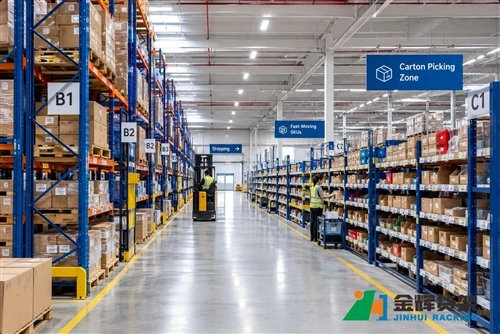
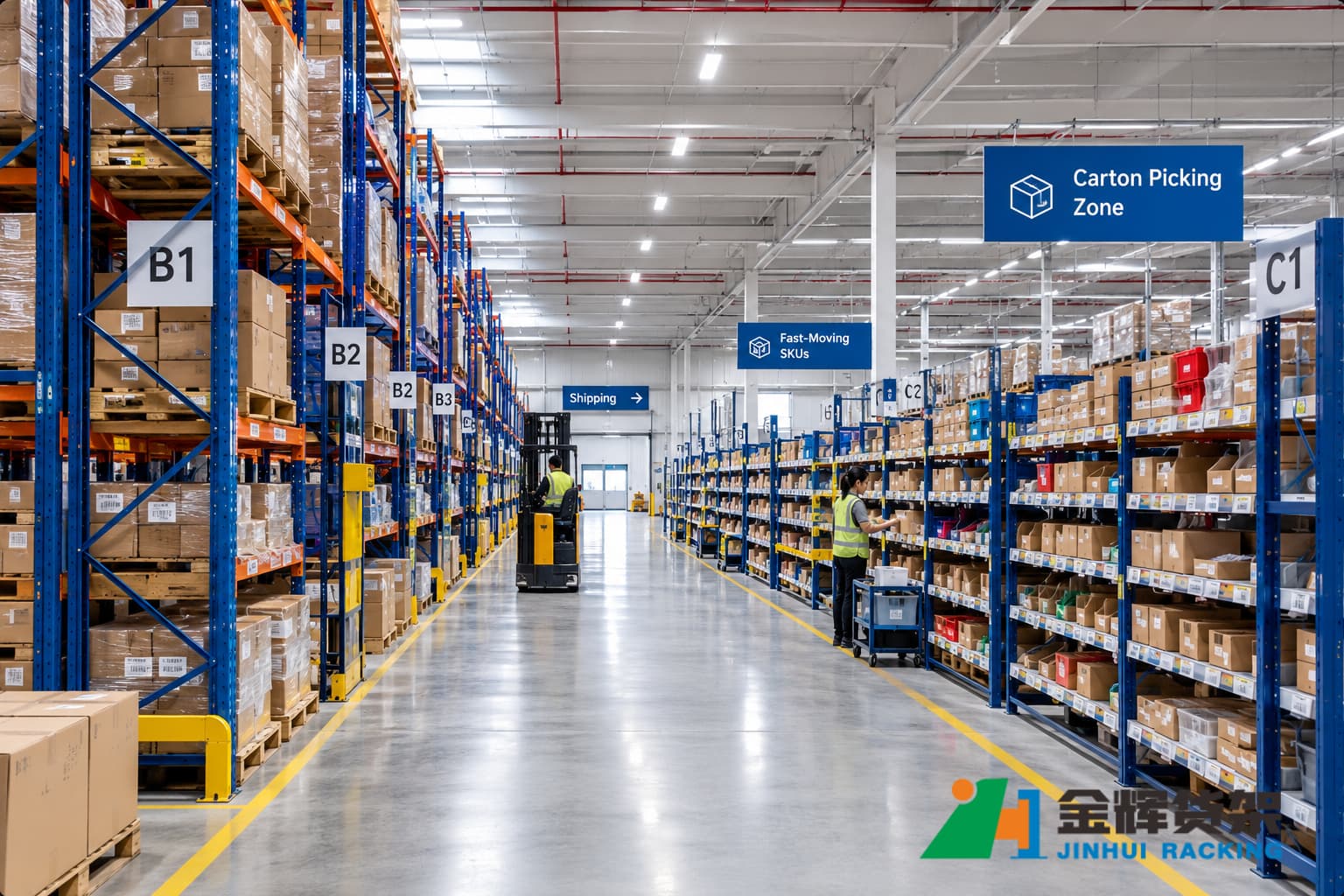
A practical e-commerce warehouse layout usually separates receiving, reserve storage, active picking, packing, dispatch, and returns processing. The exact arrangement depends on the building shape, order volume, equipment, and the direction of material flow.
| Warehouse Zone | Main Function | Storage or Layout Consideration |
|---|---|---|
| Receiving and inspection | Check incoming products and quantities | Provide temporary staging space outside main travel routes. |
| Reserve inventory | Store replenishment stock and full pallets | Use pallet racking suited to pallet dimensions and handling equipment. |
| Active picking | Hold items frequently picked for customer orders | Prioritize product accessibility, location visibility, and ergonomic reach. |
| Packing and consolidation | Combine picked items, verify orders, and prepare parcels | Position near outbound operations where the building layout allows. |
| Dispatch staging | Organize completed orders for collection | Keep staging lanes identified and clear of required access routes. |
| Returns and exception handling | Inspect returned, damaged, or unidentified products | Separate unverified inventory from available-to-sell stock. |
These zones should be connected by a clear material flow. If incoming pallets, replenishment movements, order picking, and outbound staging all compete for the same narrow area, congestion may increase even when the warehouse has sufficient storage capacity.
3. Match Racking Types to Different Inventory Requirements
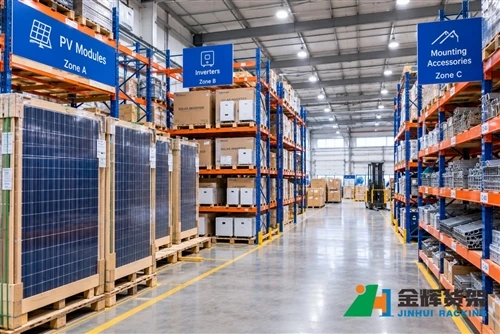
No single racking system is ideal for every e-commerce SKU. Many fulfillment facilities benefit from combining pallet reserve storage with accessible shelving or carton-picking locations.
Selective Pallet Racking for Reserve Inventory
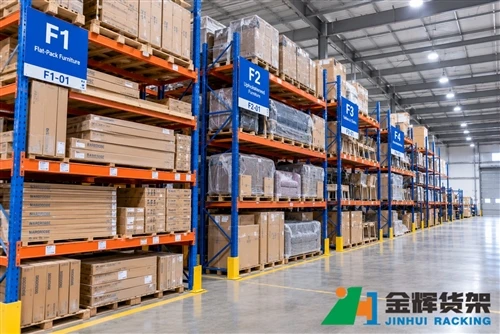
Selective pallet racking systems provide direct access to individual pallet locations. This can be useful when a warehouse holds many product lines, needs frequent replenishment, or manages different stock quantities across SKUs.
Reserve pallets can be stored in designated locations and replenished into active picking areas as needed. Rack height, beam levels, load capacity, aisle width, and forklift requirements should be evaluated together before the layout is finalized.
Heavy-Duty Industrial Racking for Bulk Stock
Heavy-duty industrial racking systems can support suitable palletized reserve inventory when the system is designed for the actual loads and operating conditions. They may be appropriate for cartons stored on pallets, bulk packaging materials, and replenishment stock.
The selected configuration must match pallet size, load weight, beam capacity, rack height, and the material-handling equipment used in the facility. Operators should follow the specified load limits and avoid placing incompatible loads in rack locations.
Carton and Small-Item Picking Locations
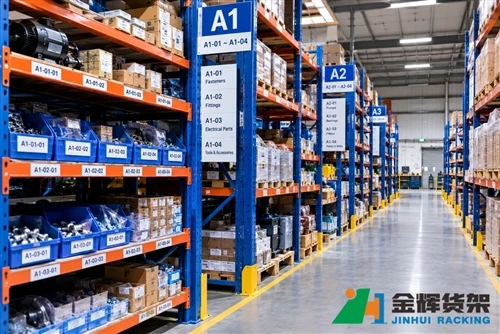
Small products and individual cartons often need more frequent access than reserve pallets. Shelving or purpose-designed carton-picking arrangements can help organize these items by SKU, order frequency, size, and picking method.
Frequently picked products should be located where workers can retrieve them efficiently and safely. Heavier items should be positioned with manual handling requirements in mind, while small components should have clear labels and suitable containers to prevent mixing.
Cantilever Racking for Selected Long or Awkward Products
For e-commerce operations that handle long items such as certain rails, tubes, or elongated packaged products, cantilever storage rack systems may be worth evaluating. This system is suitable only when the product shape, load, support requirements, and handling method match the rack design.
Product-specific storage areas can reduce the need to force irregular items into standard pallet or carton locations.
4. Position Fast-Moving SKUs for Efficient Picking
Inventory slotting is the process of assigning products to storage locations based on operational requirements. For e-commerce fulfillment, sales volume is important, but it should not be the only factor. Order-line frequency, product dimensions, weight, compatibility, replenishment needs, and picking methods also affect the best location.
A practical slotting review can follow these steps:
- Analyze order history: Identify SKUs that appear frequently in orders, as well as products commonly ordered together.
- Classify inventory: Group products by movement frequency, size, weight, fragility, and special storage requirements.
- Assign picking locations: Place frequently picked items in accessible positions that fit the handling process.
- Separate reserve and active stock: Where appropriate, maintain reserve inventory in pallet locations and replenish dedicated picking locations.
- Review performance: Track picking time, replenishment frequency, stockouts, and errors to identify opportunities for improvement.
Fast-moving items do not always need to be placed at the very front of the warehouse. Their locations should reflect the complete picking route, order combinations, congestion risks, and the need to keep replenishment movements manageable.
5. Improve Picking Routes and Replenishment Flow
Warehouse layout affects how far employees travel and how often picking and replenishment activities intersect. A poorly designed route may require repeated backtracking, while an undersized staging area can create queues near packing stations.
To improve the flow, warehouse planners should consider:
- Clear travel routes: Define pedestrian paths, forklift aisles, and staging areas according to the operation and applicable safety requirements.
- Logical picking sequences: Arrange locations and order-picking methods to limit unnecessary travel and repeated handling.
- Replenishment timing: Refill active picking locations before they run out, using demand patterns and inventory records to guide the schedule.
- Separate work where practical: Avoid unnecessary overlap between bulk pallet movement and manual picking activity.
- Accessible packing areas: Keep picked orders moving toward verification, packing, and dispatch without blocking storage aisles.
When demand grows, reviewing the layout and actual movement data can help determine whether the next improvement should be a slotting change, an additional picking area, a different rack configuration, or a revised operating schedule.
6. Use Clear Rack Labels and Inventory Location Codes
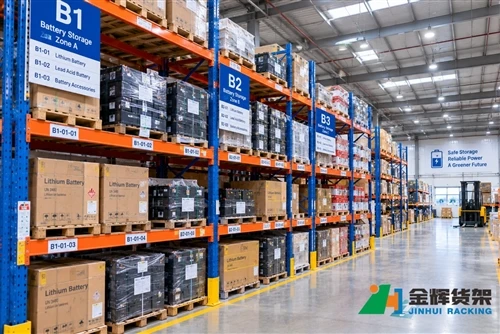
Accurate location identification is essential when many similar products are stored close together. A consistent location code helps employees and warehouse management systems identify the correct aisle, rack section, level, and position.
For example, a warehouse might use a code such as A03-R02-L04-P05, representing an aisle, rack section, level, and picking position. The exact structure should match the facility's layout and inventory software.
Good location-labeling practices include:
- Use consistent location codes throughout the facility.
- Place labels where staff can read them without climbing or reaching into unsafe positions.
- Make labels visible from the normal picking or equipment approach.
- Keep product identity, SKU, and quantity information aligned with inventory records.
- Update records promptly when stock is moved, replenished, counted, or returned.
- Verify that location labels remain readable and securely attached.
Consistent labeling supports both manual picking and warehouse management system (WMS) workflows.
7. Prepare the Racking Layout for Seasonal Demand
Promotional campaigns, holidays, and product launches can increase order volumes and change the mix of fast-moving SKUs. A layout that works under normal conditions may become congested when picking, replenishment, packing, and dispatch all operate at higher capacity.
Before a peak period, warehouse teams can:
- Review demand forecasts and identify products likely to experience higher picking frequency.
- Confirm that active picking locations have enough capacity for expected demand.
- Check reserve inventory and replenishment schedules for critical SKUs.
- Review packing supplies, dispatch staging space, and access to outbound areas.
- Remove obsolete or incorrectly stored stock from active picking locations through controlled inventory procedures.
- Test temporary layout changes before implementing them at full operating scale.
Temporary slotting adjustments can improve access to seasonal products, but changes should preserve rack load limits, stable storage conditions, required clearances, and safe travel routes. Any structural rack changes should be assessed and carried out by qualified personnel as appropriate.
8. Common E-commerce Racking Mistakes to Avoid
| Common Mistake | Potential Impact | Better Practice |
|---|---|---|
| Choosing racks based only on storage density | Picking access may become inefficient. | Balance capacity with SKU access and workflow requirements. |
| Mixing reserve and active picking stock without clear rules | Replenishment becomes difficult to control. | Define dedicated locations and replenishment procedures. |
| Using inconsistent location codes | Picking and inventory errors may increase. | Standardize labels and maintain accurate inventory records. |
| Ignoring peak-period order patterns | Picking areas and packing stations may become congested. | Review forecasts and test capacity before busy periods. |
| Allowing temporary stock to block aisles | Access, movement, and safety can be compromised. | Use designated staging areas and keep required routes clear. |
| Changing rack levels without checking the design | The revised arrangement may not meet load or stability requirements. | Verify the system design and approved load information before making changes. |
9. How to Evaluate an E-commerce Warehouse Racking Project
Before selecting a racking system, operators should gather enough operational information to compare possible layouts. A useful assessment includes:
- Inventory profile: SKU count, dimensions, weights, packaging types, and stock quantities.
- Order profile: Orders per day, order lines per order, picking frequency, and seasonal variation.
- Handling method: Manual picking, pallet handling, carts, forklifts, or other equipment used in the facility.
- Building constraints: Available floor area, clear height, columns, doors, exits, and building services.
- Storage and picking requirements: Reserve capacity, active picking capacity, replenishment frequency, and access requirements.
- Future growth: Expected changes in inventory range, order volume, and fulfillment processes.
Compare proposed layouts using measurable operating criteria, such as storage capacity, average picking travel, replenishment workload, inventory accuracy, and safe access. A system that provides the highest theoretical pallet count may not be the best solution if it increases picking complexity or creates operational bottlenecks.
For projects involving existing pallet racks, it is important to consider how physical storage locations and digital inventory records will work together.
Frequently Asked Questions
What type of racking is best for an e-commerce warehouse?
The best choice depends on SKU variety, inventory volume, product dimensions, picking methods, and handling equipment. Selective pallet racking is often useful for accessible reserve pallets, while shelving or carton-picking systems may suit individual items. Many warehouses combine several storage types.
Should fast-moving products be stored near the packing area?
Often, placing frequently picked products in convenient locations can reduce travel. However, the final position should account for the complete picking route, replenishment access, congestion, and other operational requirements rather than distance from packing alone.
How can warehouse racking help reduce picking errors?
Clearly labeled storage locations, consistent SKU organization, accurate inventory records, and standardized picking procedures help workers identify the correct items and quantities. Where available, barcode scanning and WMS-supported workflows can further improve verification.
Can pallet racking and carton-picking shelves be used together?
Yes. A combined layout can keep bulk inventory in reserve pallet locations while storing frequently picked units in accessible picking locations. The replenishment process should define how stock moves between these areas and how inventory records are updated.
What should be checked before expanding warehouse rack capacity?
Review the building's usable dimensions, floor conditions, rack and beam capacities, load characteristics, handling equipment, aisle requirements, access routes, and relevant local safety requirements. Any proposed changes should be checked against the rack design and the facility's operating conditions.
Conclusion
Effective e-commerce warehouse racking is about coordinating storage capacity with the speed and accuracy of order fulfillment. By separating reserve inventory from active picking stock where appropriate, organizing fast-moving SKUs, maintaining clear location labels, and planning replenishment routes, operators can create a more manageable warehouse workflow.
The right solution depends on the facility's inventory profile, order patterns, handling equipment, and future requirements. Evaluating these factors together helps businesses choose a racking configuration that supports efficient picking without compromising safe storage and access.
Contact JINHUI RACK
Planning a new e-commerce fulfillment warehouse or upgrading your existing storage layout? Contact JINHUI RACK to discuss your warehouse dimensions, inventory profile, and racking requirements.
Email: info@jhrack.com
WhatsApp: +86 185 0252 7163
Explore our products: Selective Pallet Racking Systems | Heavy-Duty Industrial Racking Systems
Contact page: Contact JINHUI RACK