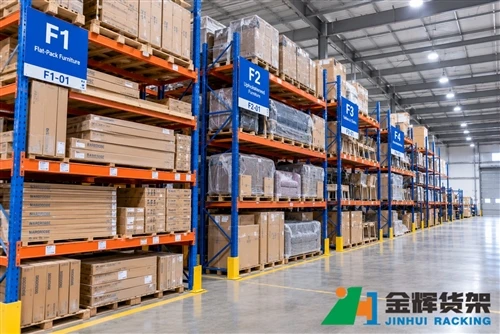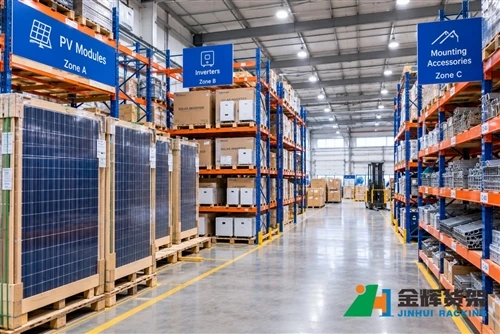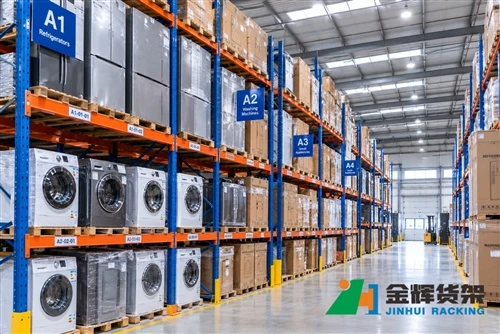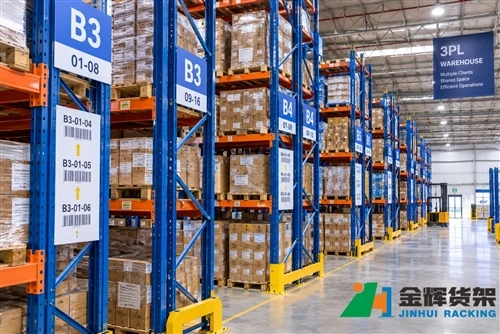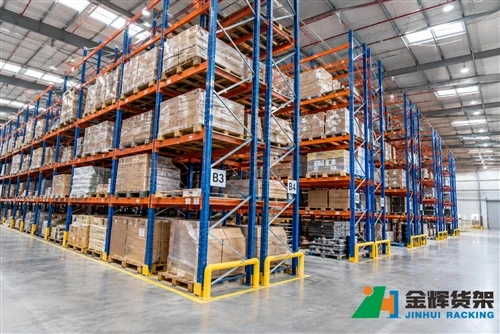
Solar equipment warehouses handle a wide range of products, from packaged photovoltaic (PV) modules and solar inverters to mounting rails, brackets, cables, and installation accessories. These items differ significantly in dimensions, weight, packaging, fragility, and order frequency. A storage system that works for one product category may not be suitable for another.
Choosing the right warehouse racking for solar equipment helps businesses organize inventory, protect products during storage, improve order picking, and make better use of available warehouse space. The key is to match the storage method to each product's physical characteristics and handling requirements rather than placing every item on the same type of rack.
1. Identify the Main Solar Equipment Storage Categories
Before planning a warehouse racking layout, divide inventory into practical product categories. Different solar products require different storage and picking methods, so categorization should consider packaging dimensions, load characteristics, handling equipment, and order patterns.
| Product Category | Typical Storage Considerations | Possible Storage Approach |
|---|---|---|
| Solar panels and PV modules | Large packaging dimensions, fragile components, packaging orientation, and handling restrictions | Manufacturer-approved packaging storage, designated floor locations, or suitable pallet racking when the load configuration permits |
| Solar inverters | Model variations, carton weight, electronic components, and identification requirements | Pallet racking for unit loads or shelving for smaller packages, subject to load and packaging requirements |
| Mounting rails and long profiles | Long dimensions, bending risk, bundle stability, and safe handling | Suitable cantilever racking or other engineered long-material storage solutions |
| Brackets, clamps, and fasteners | Small quantities, numerous SKUs, and frequent picking | Labeled bins, shelving, or organized carton locations |
| Cables and electrical accessories | Coil or reel dimensions, product identification, and protection from unsuitable storage conditions | Dedicated reel supports, shelves, or designated pallet locations appropriate to the packaging |
These are planning options rather than universal specifications. The final storage method must follow the product manufacturer's instructions, packaging restrictions, actual load dimensions, and the warehouse's handling procedures.
2. Select Racking According to Product Characteristics
Selective Pallet Racking for Palletized Solar Equipment
Selective pallet racking systems can be considered for palletized inverters, packaged accessories, and other compatible unit loads. Their individual pallet access can help warehouses manage multiple models, product batches, and customer orders without requiring every item to be stored in a deep lane.
When evaluating selective racking, confirm pallet dimensions, load weight, beam configuration, rack height, forklift access, and the condition of the packaging. Solar modules should only be stored on pallet racks when the packaging, pallet support, orientation, and loading arrangement are approved for that use.
Heavy-Duty Racking for Suitable Bulk Loads
Heavy-duty industrial racking systems may be suitable for heavier palletized solar equipment or bulk accessory inventory when the rack configuration is designed for the actual loads.
Do not assume that a heavy-duty rack is automatically suitable for fragile panels or unusually shaped packages. The rack design must account for load distribution, pallet dimensions, support positions, and safe handling requirements. Confirm the rated capacity of the complete configuration before use.
Cantilever Racking for Long Mounting Rails
Solar mounting rails and other long profiles can be difficult to store in conventional pallet rack bays when their lengths exceed the available support arrangement. A properly designed cantilever storage rack system may provide more practical access to bundled long materials.
Check the length and weight of each bundle, arm loading, required support points, and the method used to prevent materials from shifting or rolling. If profiles are flexible or easily damaged, the storage design should minimize unsupported spans and handling impacts.
3. Create Separate Storage Zones for Different Products
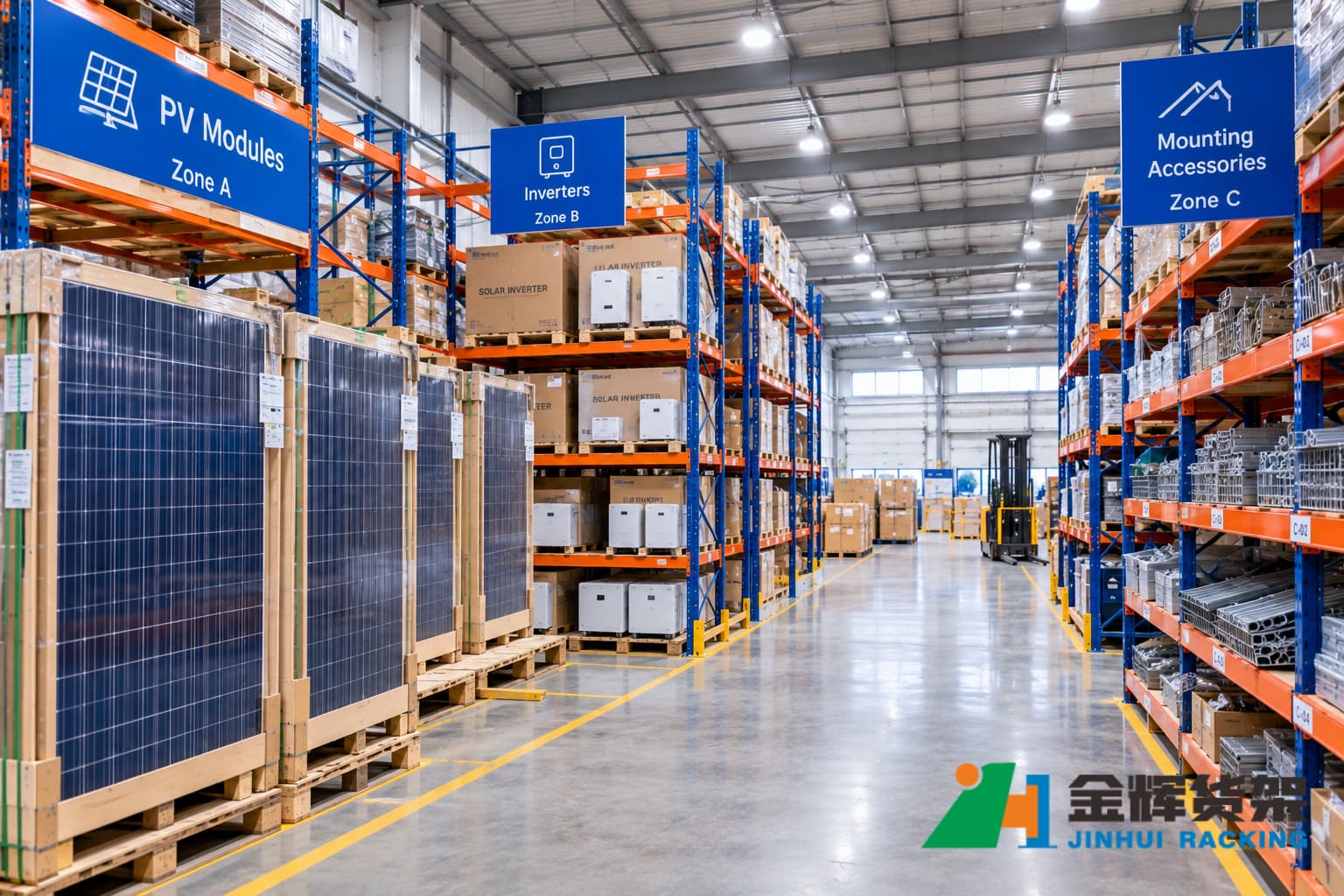
A solar equipment warehouse becomes easier to manage when products are assigned to clearly defined storage zones. Rather than organizing the entire facility by product name alone, consider packaging type, handling requirements, order frequency, and the relationship between products commonly shipped together.
- PV module zone: Use designated locations for module packaging and maintain clear handling instructions. Avoid stacking or changing package orientation unless the manufacturer permits it.
- Inverter zone: Separate models and specifications using clear location labels and SKU identification.
- Long-material zone: Keep mounting rails, profiles, and similar products in storage designed for their dimensions and support requirements.
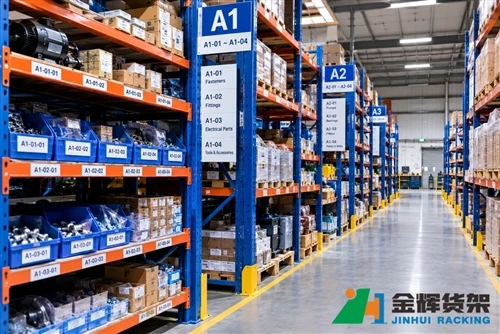
- Small-parts zone: Organize brackets, clamps, fasteners, and connectors in labeled bins or shelves.
- Receiving and inspection zone: Provide space to check incoming quantities, packaging condition, model numbers, and delivery documents before put-away.
- Order consolidation zone: Group picked products for shipment while keeping fragile modules and heavy materials protected from unnecessary movement.
Clearly marked zones reduce the risk of mixing similar-looking models and help warehouse employees find the correct items. Maintain suitable working clearances and do not allow temporary staging to block aisles, exits, or access to safety equipment.
4. Protect Fragile Modules and Electronic Equipment
Solar modules and electronic equipment may be damaged by impact, improper support, moisture, or handling that conflicts with packaging instructions. Warehouse planning should therefore include product protection as well as storage capacity.
- Inspect incoming packages for crushed corners, punctures, broken seals, and visible signs of impact.
- Follow the manufacturer's specified storage orientation, stacking limits, and handling instructions.
- Use appropriate lifting equipment and approved handling points for the package or load.
- Avoid placing loads where forklift movement or adjacent operations could cause collisions.
- Keep electronic products in storage conditions that meet the manufacturer's environmental requirements.
- Separate damaged or questionable inventory from available stock until it has been inspected and its status recorded.
- Use suitable rack protection where vehicle impact is a foreseeable risk, without obstructing inspection or access.
Protective packaging should not be treated as proof that a product can withstand any stacking or rack arrangement. Confirm the permitted load configuration before storing fragile products at height.
5. Improve SKU Identification and Inventory Accuracy
Solar equipment often comes in multiple electrical specifications, dimensions, connector types, and product revisions. Similar cartons can represent different products, so warehouse location labels should make both the storage position and the item identity easy to verify.
Consider using a consistent location format that identifies the zone, rack row, bay, and level. For example, a location code such as INV-R02-B04-L02 could represent an inverter zone, row 02, bay 04, level 02. This is an illustrative naming convention; adapt it to the warehouse's actual layout and inventory system.
For reliable inventory control:
- Assign unique SKUs to products with different specifications or revisions.
- Record the quantity and unit of measure for each item, including packs, cartons, bundles, or individual units as appropriate.
- Use barcode labels where the warehouse's scanning process supports them.
- Record lot, serial, or batch information when required for traceability.
- Keep physical location records synchronized with the warehouse management system or inventory spreadsheet.
- Perform regular cycle counts, prioritizing high-value items and products with frequent movements.
For more guidance on location control, see How to Label Pallet Rack Locations for Accurate Warehouse Inventory Tracking.
6. Plan Receiving, Picking, and Shipping Flow
A well-organized racking layout should support the movement of goods through the warehouse, not just maximize the number of storage positions. Solar equipment orders may combine modules, inverters, mounting hardware, and electrical accessories, making coordinated picking and consolidation particularly important.
- Receiving: Check delivered quantities, item codes, packaging condition, and any required documentation.
- Put-away: Assign each product to an appropriate storage location based on its handling requirements and available capacity.
- Picking: Use clear location labels and picking instructions to reduce selection errors.
- Consolidation: Match picked items against the order and keep fragile or long products in suitable staging positions.
- Dispatch: Verify quantities and packaging condition before loading, and secure shipments according to product and transport requirements.
Review aisle widths, turning space, staging locations, and pedestrian routes against the actual material-handling equipment and warehouse traffic. If products are frequently moved between storage and packing areas, consider whether their locations create avoidable travel or congestion.
7. Common Solar Equipment Warehouse Storage Mistakes
| Common Mistake | Potential Consequence | Recommended Action |
|---|---|---|
| Storing every product category in the same rack configuration | Poor support, difficult access, or unsuitable storage conditions | Match storage methods to product dimensions, packaging, and handling requirements |
| Ignoring package orientation and stacking instructions | Product damage or unstable loads | Follow manufacturer-approved storage and stacking requirements |
| Mixing similar models in unmarked locations | Picking errors and incorrect shipments | Use distinct SKU identification, location labels, and scanning checks where available |
| Storing long rails without suitable support | Material deformation, shifting, or difficult retrieval | Evaluate an appropriate long-material storage solution and safe support arrangement |
| Using rack capacity figures without checking the actual configuration | Unsafe loading or rack damage | Verify the applicable rack ratings, load distribution, and installation requirements |
| Allowing picked goods to accumulate in aisles | Congestion, blocked access, and increased handling risk | Designate staging areas and maintain clear travel routes |
8. How to Plan a Solar Equipment Racking Project
Before selecting a racking system, prepare accurate information about the products, building, and warehouse operations. A structured planning process helps the supplier evaluate practical storage options and reduces the risk of designing around incomplete assumptions.
- Product information: Provide the dimensions, weights, packaging details, and handling restrictions for each product category.
- Inventory profile: Estimate SKU count, stock levels, order frequency, and expected inventory changes.
- Warehouse drawings: Share building dimensions, column positions, door locations, floor constraints, and any known obstructions.
- Equipment details: Identify the forklifts or other handling equipment, including relevant operating and clearance requirements.
- Operational priorities: Explain whether the main goal is direct pallet access, long-material storage, higher storage density, or faster order picking.
- Safety and compliance: Confirm applicable local requirements, rack load ratings, anchoring, inspection, and fire-protection clearances.
For a broader overview of system selection, read How to Choose the Right Pallet Racking System for Your Warehouse. The final design should be based on verified site conditions, product data, and the selected rack configuration.
Conclusion
Effective warehouse racking for solar equipment starts with understanding the differences between photovoltaic modules, inverters, mounting rails, and small installation accessories. By assigning suitable storage methods, establishing clear product zones, protecting fragile goods, and maintaining accurate location records, warehouse operators can improve inventory visibility and daily handling efficiency.
The right solution depends on the actual products, packaging, inventory profile, building conditions, and material-handling equipment. A carefully planned layout can support current operations while leaving room for future changes in product range and demand.
Contact JINHUI RACK
Looking for a warehouse racking solution for solar equipment or photovoltaic products? Contact JINHUI RACK to discuss your product dimensions, storage requirements, and warehouse layout.
Email: info@jhrack.com
WhatsApp: +86 18502527163
Contact Us: https://www.jinhui-rack.com/contact-us