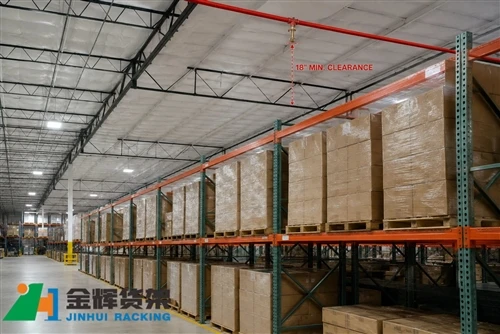
Why Proper Space Between Pallet Racks Is Critical
The space between pallet racks, also known as aisle width, directly affects warehouse efficiency, safety, and storage capacity. Insufficient spacing can restrict movement and increase the risk of damage, while excessive spacing reduces storage density and wastes valuable floor space.
Optimizing aisle width requires balancing operational efficiency with maximum storage utilization. A properly designed pallet racking system should always consider both space and workflow.

Standard Aisle Width Between Pallet Racks
The recommended space between pallet racks depends mainly on the type of handling equipment used. Below is a general guideline:
| Equipment Type | Aisle Width (Meters) | Aisle Width (Feet) | Typical Application |
|---|---|---|---|
| Standard Forklift | 3.0 – 3.5 m | 10 – 12 ft | General warehouse operations |
| Reach Truck | 2.5 – 3.0 m | 8 – 10 ft | Medium-density storage |
| Very Narrow Aisle (VNA) | 1.5 – 2.0 m | 5 – 6.5 ft | High-density storage systems |
Minimum Clearance Requirements
In addition to aisle width, proper clearance between pallets and rack components is essential for safe operation. These requirements are closely related to overall pallet rack load capacity, as improper spacing can lead to uneven loading and structural stress.
| Clearance Type | Recommended Value | Purpose |
|---|---|---|
| Side Clearance (Pallet to Upright) | 75 – 100 mm | Prevent collision and allow positioning tolerance |
| Vertical Clearance (Pallet to Beam) | 100 – 150 mm | Ensure safe loading/unloading |
| Back-to-Back Rack Spacing | 150 – 300 mm | Avoid pallet interference |
How to Calculate the Ideal Space Between Pallet Racks
The correct aisle width is not fixed and should be calculated based on equipment and pallet dimensions. A simplified formula is:
Aisle Width = Turning Radius + Pallet Length + Safety Clearance
Example calculation:
- Turning radius: 1.8 m
- Pallet length: 1.2 m
- Safety clearance: 0.3 m
Total aisle width ≈ 3.3 m
This calculation ensures sufficient maneuvering space while maintaining efficiency. Proper spacing also supports correct pallet racking installation and reduces operational risks.
Factors That Influence Rack Spacing
1. Handling Equipment Specifications
Different equipment types require different turning radii and working space.
2. Pallet Dimensions and Load Type
Larger or irregular loads require additional clearance.
3. Rack Height and System Design
Taller racks require precise alignment and proper assembly to ensure stability.
4. Operational Workflow
High-frequency operations may require wider aisles to improve efficiency and reduce congestion.
Common Mistakes in Pallet Rack Spacing
- Aisles too narrow, causing operational difficulty
- Overly wide aisles, reducing storage capacity
- Ignoring equipment specifications
- Not considering future scalability
Improper spacing can also lead to safety issues. Learn more about anchoring pallet racks and maintaining system stability.
Best Practices for Optimizing Warehouse Layout
- Match aisle width to equipment requirements
- Maintain consistent spacing across all rack rows
- Balance storage density with accessibility
- Plan layout with future expansion in mind
Regular rack inspection is also important to ensure spacing remains safe and effective over time.
Final Thoughts
Determining the correct space between pallet racks is essential for maximizing warehouse efficiency and ensuring safe operations. By using proper calculations, maintaining recommended clearances, and aligning with equipment requirements, businesses can create a highly optimized storage system.