Understanding the Difference Between Selective Pallet Racking and Pallet Flow Racking
Heavy duty selective pallet racking and pallet flow racking are among the most widely used warehouse storage systems for palletized goods. Although both improve warehouse organization and storage efficiency, they operate in very different ways.
Selective pallet racking provides direct access to every pallet position. Each pallet can be loaded or retrieved independently, making the system ideal for warehouses with a large number of SKUs and frequent inventory movement.
Pallet flow racking, sometimes called gravity flow racking, stores pallets on slightly inclined roller lanes. When a pallet is loaded from the rear of the lane, gravity automatically moves it toward the picking face. This creates a continuous First In, First Out (FIFO) inventory flow without requiring additional handling.
The right choice depends on product turnover, warehouse layout, inventory management requirements, and available floor space.

What Is Heavy Duty Selective Pallet Racking?
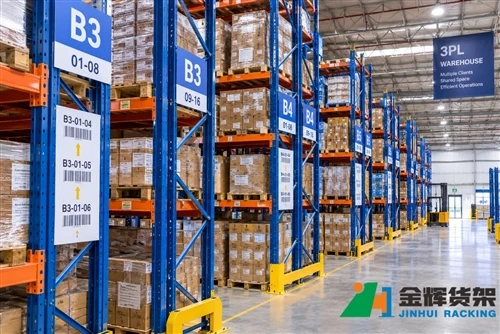
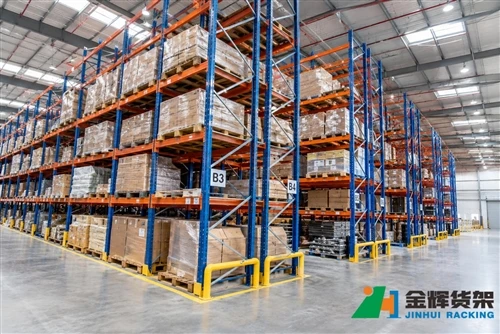
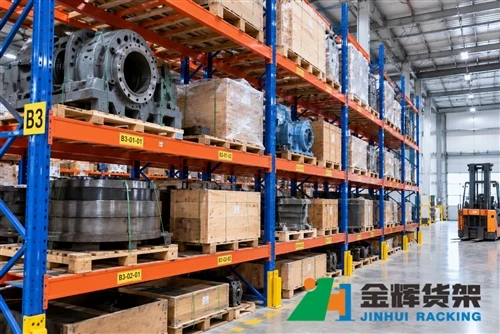
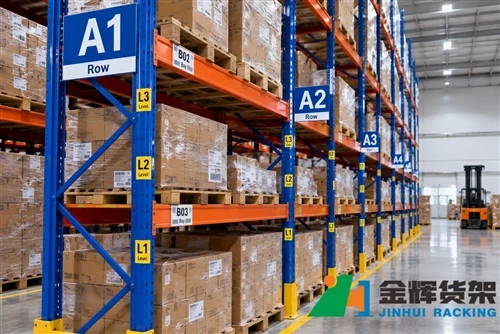
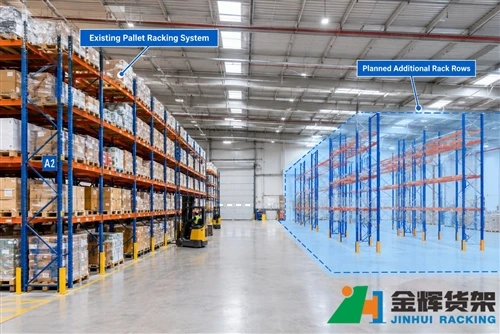
Heavy duty selective pallet racking is the most common warehouse storage system used across manufacturing, logistics, retail, and distribution industries. Every pallet location remains independently accessible, allowing forklifts to retrieve any pallet without moving adjacent inventory.
The modular design consists of upright frames, load beams, bracing, base plates, and optional safety accessories. Because beam levels can be adjusted easily, the system accommodates different pallet sizes and changing storage requirements.
The Heavy Duty Selective Pallet Racking System from Jinhui Rack is engineered for high-strength industrial applications and can be customized for various warehouse layouts, ceiling heights, and load capacities.
What Is Pallet Flow Racking?
Pallet flow racking is a high-density storage system that uses gravity rollers installed on inclined lanes. Pallets are loaded from the rear and automatically move toward the front picking position as previous pallets are removed.
This automatic pallet movement minimizes forklift travel inside storage areas while maintaining continuous FIFO inventory rotation.
Pallet flow systems are widely used in:
- Food processing facilities.
- Beverage warehouses.
- Cold storage distribution centers.
- Pharmaceutical logistics.
- High-volume manufacturing operations.

Accessibility Comparison
Selective pallet racking provides immediate access to every stored pallet, making it highly suitable for warehouses handling hundreds or thousands of SKUs.
Pallet flow racking offers excellent picking efficiency for products with high turnover but is generally designed for storing multiple pallets of the same product within each flow lane.
If inventory flexibility is the priority, selective pallet racking has a clear advantage. If continuous FIFO movement is more important, pallet flow racking offers significant operational benefits.
Storage Density Comparison
Pallet flow racking typically provides higher storage density than selective pallet racking because pallets are stored multiple positions deep while maintaining separate loading and unloading faces.
Selective pallet racking requires more forklift aisles but provides greater flexibility for mixed-product storage and changing warehouse layouts.
| Comparison Item | Selective Pallet Racking | Pallet Flow Racking |
|---|---|---|
| Pallet Access | Direct access to every pallet | Front picking position only |
| Storage Density | Medium | High |
| Inventory Rotation | FIFO Supported | Automatic FIFO |
| SKU Flexibility | Excellent | Best for fewer SKUs |
| Warehouse Flexibility | Very High | Moderate |
Forklift Operation Comparison
Forklift efficiency plays a major role in warehouse productivity. The number of trips, travel distance, and handling time all influence labor costs and order fulfillment speed.
Heavy duty selective pallet racking is designed with dedicated access aisles, allowing forklifts to retrieve or store any pallet directly. Operators do not need to wait for other pallets to be removed, making the system highly efficient for warehouses with constant inventory movement.
Pallet flow racking separates the loading and unloading operations. Forklifts load pallets from the rear of the rack while operators retrieve pallets from the front. Gravity automatically moves the remaining pallets forward after each retrieval, reducing unnecessary forklift travel within the storage area.
For facilities with continuous inbound and outbound operations, both systems offer excellent efficiency, but pallet flow racking provides additional advantages for high-volume FIFO inventory.
FIFO Inventory Management Advantages
One of the biggest advantages of pallet flow racking is its ability to maintain automatic First In, First Out (FIFO) inventory rotation.
As pallets are loaded from the rear of the lane, gravity rollers move the oldest pallet toward the picking face. This minimizes manual inventory rotation while reducing product aging and improving stock control.
Selective pallet racking also supports FIFO inventory management because every pallet can be accessed individually. However, maintaining proper inventory rotation depends on warehouse management practices rather than the rack itself.
Businesses handling products with expiration dates or strict batch control often benefit from pallet flow systems, particularly in industries such as:
- Food manufacturing.
- Beverage distribution.
- Pharmaceutical logistics.
- Cold chain warehousing.
- Consumer packaged goods.
Cost Comparison
Investment costs vary depending on warehouse dimensions, pallet quantity, storage depth, and engineering requirements.
Heavy duty selective pallet racking generally has a lower initial purchase cost because of its straightforward structural design. Installation is relatively simple, and future expansion can usually be completed with minimal disruption.
Pallet flow racking requires additional components, including gravity rollers, brake mechanisms, and flow lane guides. While the initial investment is typically higher, businesses with high inventory turnover may recover costs through increased operational efficiency and improved warehouse throughput.
When comparing the two systems, companies should evaluate:
- Equipment investment.
- Warehouse space utilization.
- Labor efficiency.
- Forklift operating time.
- Long-term maintenance costs.
- Future warehouse expansion.
Maintenance Requirements
Routine inspections are essential for maintaining safe warehouse operations regardless of the storage system used.
Selective pallet racking requires regular inspection of upright frames, load beams, safety locks, anchor bolts, and structural alignment. Since the design contains relatively few moving parts, maintenance is generally straightforward.
Pallet flow racking requires all of the above inspections in addition to checking roller tracks, braking devices, wheel assemblies, and lane alignment. Any damaged flow components should be repaired promptly to ensure smooth pallet movement.
Preventive maintenance helps extend equipment life and reduces the risk of unexpected operational downtime.
Which Warehouses Should Choose Heavy Duty Selective Pallet Racking?
Heavy duty selective pallet racking is the preferred solution for businesses requiring flexibility and rapid access to inventory.
Typical applications include:
- Third-party logistics providers.
- E-commerce fulfillment centers.
- Retail distribution warehouses.
- Automotive parts storage.
- Industrial manufacturing facilities.
- General merchandise warehouses.
Because every pallet is directly accessible, the system supports warehouses with a large number of SKUs and changing inventory levels.
Which Warehouses Benefit Most from Pallet Flow Racking?
Pallet flow racking performs best in facilities where products move continuously and FIFO inventory management is essential.
Typical industries include:
- Food processing.
- Dairy and beverage production.
- Pharmaceutical distribution.
- Cold storage facilities.
- Fast-moving consumer goods warehouses.
For operations with high-volume inventory and consistent product turnover, pallet flow racking helps reduce handling time while maximizing storage efficiency.
Advantages and Limitations
| System | Advantages | Limitations |
|---|---|---|
| Heavy Duty Selective Pallet Racking |
|
|
| Pallet Flow Racking |
|
|
Frequently Asked Questions
Is pallet flow racking better than selective pallet racking?
Not necessarily. Pallet flow racking is ideal for high-volume FIFO inventory, while selective pallet racking offers greater flexibility and direct access to every pallet.
Which system provides higher storage density?
Pallet flow racking generally provides higher storage density because multiple pallets are stored deep within each gravity lane.
Which warehouse storage system is easier to expand?
Heavy duty selective pallet racking is usually easier to modify or expand because of its modular structure.
Can pallet flow racking improve warehouse productivity?
Yes. By reducing forklift travel and maintaining continuous FIFO inventory flow, pallet flow systems can significantly improve handling efficiency in suitable applications.
How do I choose between these two systems?
The decision should be based on SKU quantity, inventory turnover, warehouse space, forklift operations, and long-term business growth rather than storage density alone.
Conclusion
Heavy duty selective pallet racking and pallet flow racking each provide unique advantages for warehouse operations. Selective pallet racking remains the preferred solution for businesses requiring direct pallet access, operational flexibility, and support for diverse inventory. Pallet flow racking excels in high-volume environments where automatic FIFO inventory rotation and improved storage density are essential.
Carefully evaluating warehouse workflows, inventory characteristics, and future expansion plans will help businesses choose the storage solution that delivers the greatest long-term value.
Optimize Your Warehouse with Jinhui Rack
Jinhui Rack designs and manufactures customized warehouse storage systems for manufacturing plants, logistics centers, retail distribution facilities, and industrial warehouses. Whether you need flexible Heavy Duty Selective Pallet Racking or a high-density storage solution, our experienced engineering team can develop a system tailored to your operational requirements.
WhatsApp
+8618502527163
Email
info@jhrack.com