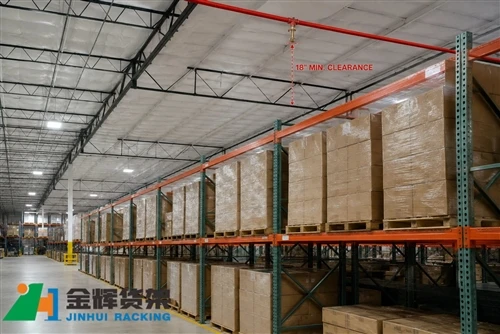
Why Heavy Duty Selective Pallet Racking Is Used Across So Many Industries
No two warehouses operate in exactly the same way. A food distributor processes thousands of pallets every day, while an automotive manufacturer may store heavy components for months before they move into production. An e-commerce fulfillment center focuses on rapid order picking, whereas a pharmaceutical warehouse prioritizes inventory traceability and regulatory compliance.
Despite these differences, one storage solution consistently meets the needs of a wide variety of industries-heavy duty selective pallet racking.
Its modular design, excellent accessibility, and ability to accommodate different pallet sizes make it one of the most adaptable warehouse storage systems available. Instead of forcing businesses to change their operating procedures, selective pallet racking can be configured around existing workflows, available building space, and future expansion plans.
Whether the objective is maximizing storage density, improving inventory accuracy, or creating a safer working environment, selective pallet racking remains one of the first choices for warehouse planners worldwide.

What Makes Selective Pallet Racking Suitable for Different Industries?
The biggest advantage of heavy duty selective pallet racking is flexibility. Unlike highly automated storage systems that often require standardized operations, selective racks can be adapted to warehouses of almost any size and industry.
Warehouse managers can customize:
- Rack height according to building clearance.
- Beam levels for different pallet dimensions.
- Bay widths for various load sizes.
- Aisle widths based on forklift types.
- Load capacities for light or heavy products.
- Expansion layouts as business grows.
This adaptability allows companies to improve storage efficiency without replacing their existing warehouse processes.
The Heavy Duty Selective Pallet Racking System from Jinhui Rack is engineered for these diverse operational requirements, offering customized dimensions, load capacities, and layouts for warehouses across multiple industries.
Manufacturing Facilities
Manufacturing plants require storage systems capable of supporting raw materials, semi-finished products, production components, and finished goods simultaneously. Inventory movement varies throughout the production cycle, making direct pallet access extremely important.
Heavy duty selective pallet racking allows manufacturers to organize inventory according to production schedules while keeping every pallet immediately accessible.
Typical manufacturing applications include:
- Steel products.
- Industrial machinery parts.
- Packaging materials.
- Chemical raw materials.
- Finished products awaiting shipment.
- Production spare parts.
Because production environments often involve heavy loads, racks are commonly designed with higher load capacities and reinforced structural components.
Third-Party Logistics (3PL) Warehouses
Third-party logistics providers manage inventory for multiple customers, each with different storage requirements. Products may arrive and leave the warehouse several times a day, making operational flexibility essential.
Selective pallet racking enables 3PL operators to assign dedicated storage locations while maintaining fast pallet access for inbound and outbound operations.
Its modular design also makes future warehouse reconfiguration relatively simple as customer requirements evolve.
E-commerce Fulfillment Centers
Rapid order fulfillment is the foundation of successful e-commerce operations. Warehouses must process thousands of SKUs while maintaining accurate inventory records and short delivery times.
Heavy duty selective pallet racking supports this environment by creating organized pallet storage that works efficiently alongside picking shelves, mezzanine systems, and conveyor equipment.
Benefits include:
- Fast inventory replenishment.
- Easy SKU organization.
- Direct pallet accessibility.
- Flexible warehouse expansion.
- Improved inventory visibility.

Food and Beverage Distribution Centers
Warehouses storing food products must balance storage efficiency with hygiene, traceability, and inventory rotation. Products often have expiration dates, requiring organized pallet locations that simplify stock management.
Selective pallet racking works well in food distribution because operators can quickly locate individual pallets without disturbing surrounding inventory.
For facilities operating under FIFO inventory management, selective racks provide clear pallet visibility and efficient stock rotation when combined with proper warehouse management procedures.
Automotive Parts Warehouses
The automotive industry stores an enormous variety of products, from small fasteners to engines, transmissions, body panels, and heavy industrial components. Storage systems must support high loads while allowing technicians to retrieve individual pallets quickly.
Heavy duty selective pallet racking offers the structural strength needed for automotive inventory while maintaining excellent accessibility for daily warehouse operations.
Many automotive warehouses also install upright protectors and end-of-row barriers to reduce the risk of forklift damage caused by continuous material handling.
Industry Comparison for Heavy Duty Selective Pallet Racking
| Industry | Typical Products | Primary Storage Requirement |
|---|---|---|
| Manufacturing | Raw materials, finished goods | High load capacity |
| 3PL Logistics | Mixed customer inventory | Flexible storage layout |
| E-commerce | Consumer products | Fast inventory access |
| Food & Beverage | Packaged food and beverages | Inventory organization |
| Automotive | Heavy vehicle components | Heavy-duty storage |
Cold Storage Warehouses
Cold storage facilities present unique challenges for warehouse storage systems. Low temperatures, condensation, and continuous forklift traffic can place additional stress on rack structures. For this reason, cold storage operators often choose heavy duty selective pallet racking with corrosion-resistant finishes and reinforced components.
Selective racking performs well in refrigerated and frozen environments because it provides direct access to individual pallets, helping operators retrieve products quickly and reduce door-open time.
Common cold storage applications include:
- Frozen foods.
- Meat and seafood products.
- Dairy products.
- Temperature-sensitive ingredients.
- Export food inventory.
Galvanized accessories and wire mesh decking are also frequently used in cold storage facilities to improve durability and airflow.
Pharmaceutical and Healthcare Warehouses
Pharmaceutical distributors require accurate inventory control, batch traceability, and strict storage organization. Because many products are regulated, warehouse operators must be able to identify and access individual pallets quickly.
Heavy duty selective pallet racking supports these requirements by creating clearly defined storage locations while maintaining excellent accessibility for inventory management and auditing.
Additional accessories commonly used in pharmaceutical warehouses include:
- Rack identification labels.
- Wire mesh backing.
- Pallet stops.
- Safety barriers.
- Inventory location markers.

Retail Distribution Centers
Retail supply chains depend on fast inventory movement and accurate stock replenishment. Distribution centers often receive products in full pallets and then redistribute them to individual stores.
Selective pallet racking allows operators to store high volumes of merchandise while maintaining quick access for order preparation and outbound shipping.
Retail operators benefit from:
- High storage flexibility.
- Easy SKU management.
- Fast replenishment.
- Scalable warehouse expansion.
- Efficient seasonal inventory handling.
How Different Industries Configure Their Racking
| Industry | Common Rack Configuration | Typical Accessories |
|---|---|---|
| Cold Storage | Corrosion-resistant heavy-duty racks | Galvanized accessories, wire decking |
| Pharmaceutical | High-visibility selective racks | Labels, pallet stops, back mesh |
| Retail Distribution | Multi-level selective storage | Wire decking, row protectors |
| Automotive | Heavy-load reinforced racks | Column guards, end barriers |
| Food & Beverage | FIFO-oriented selective storage | Wire decking, rack labels |
What to Consider Before Choosing Selective Pallet Racking
Even though selective pallet racking is suitable for many industries, the system should still be engineered around the specific requirements of the warehouse.
Important considerations include:
- Maximum pallet weight.
- Pallet dimensions.
- Warehouse ceiling height.
- Forklift type and lifting height.
- Inventory turnover rate.
- Temperature and humidity conditions.
- Future storage expansion plans.
- Required safety accessories.
Working with an experienced rack manufacturer helps ensure that the final design matches both operational requirements and long-term business growth.
Frequently Asked Questions
Which industry uses selective pallet racking the most?
Selective pallet racking is widely used in logistics and distribution centers because it provides direct access to every pallet and supports high inventory turnover.
Can selective pallet racking be used in cold storage warehouses?
Yes. With appropriate corrosion-resistant finishes and accessories, selective pallet racking performs effectively in refrigerated and frozen warehouse environments.
Is selective pallet racking suitable for heavy industrial products?
Absolutely. Heavy duty selective pallet racking can be engineered to support substantial loads, making it suitable for manufacturing, automotive, and industrial applications.
Why do pharmaceutical warehouses prefer selective racks?
Direct access to each pallet improves inventory traceability, stock rotation, and regulatory compliance.
Can the same rack system be expanded later?
Yes. One of the major advantages of selective pallet racking is its modular design, which allows additional bays and storage levels to be added as warehouse capacity requirements increase.
Conclusion
Heavy duty selective pallet racking remains one of the most versatile warehouse storage solutions available today. Its ability to accommodate different pallet sizes, support heavy loads, and provide direct access to every storage location makes it suitable for manufacturing plants, logistics centers, e-commerce warehouses, food distribution facilities, automotive parts storage, pharmaceutical warehouses, and cold storage operations.
By selecting a rack configuration that matches the specific requirements of your industry, businesses can improve storage efficiency, enhance warehouse safety, and create a scalable foundation for future growth.
Find the Right Heavy Duty Selective Pallet Racking for Your Industry
Jinhui Rack has more than 20 years of experience supplying customized heavy duty selective pallet racking systems for warehouses across a wide range of industries. Whether you operate a manufacturing facility, logistics center, food warehouse, automotive parts depot, or cold storage facility, our engineering team can design a storage solution tailored to your operational requirements.
Explore our Heavy Duty Selective Pallet Racking System to discover how a customized warehouse storage solution can improve efficiency, safety, and long-term performance.
WhatsApp
+8618502527163
Email
info@jhrack.com