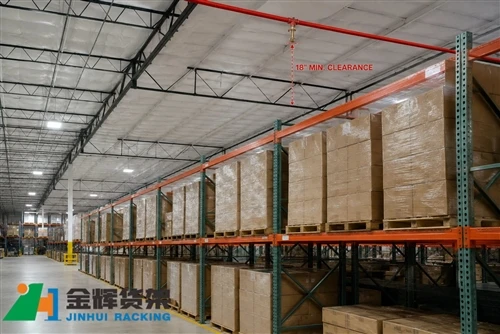
What Is Pallet Rack Overhang and Why Does It Matter?
Pallet rack overhang is the portion of a pallet or its load that extends beyond the supporting rack beams or into the space between rack components. Underhang refers to the opposite situation, where the pallet or load does not extend as far as expected toward the rack support area. Both conditions can affect pallet stability, usable rack depth, clearance, and safe forklift operation.
For warehouse racking projects, overhang and underhang should be considered together with pallet dimensions, rack depth, beam configuration, load placement, and forklift operating requirements. A few inches of unexpected clearance can make a significant difference when a warehouse is designed for thousands of pallet positions.

What Is Pallet Overhang?
Pallet overhang occurs when part of the pallet or load extends beyond the intended supporting area of the rack. The overhang may occur toward the aisle, toward the back of the rack, or at the sides depending on the rack configuration and pallet orientation.
For example, if a pallet is deeper than the effective rack support depth, part of the pallet may extend beyond the front or rear support area. This does not automatically mean that the rack is unsafe, but the condition must be evaluated as part of the complete rack design.
The important point is that pallet overhang should not be treated as unused space that can simply be ignored. It affects the relationship between pallet dimensions and rack dimensions and may also influence forklift clearance and load stability.
What Is Pallet Underhang?
Pallet underhang occurs when the pallet or load occupies less depth than the available rack support area. For example, a rack may be designed for a particular pallet depth, while the actual pallet is significantly shallower.
Underhang can provide additional clearance, but excessive unused rack depth may reduce storage efficiency. It can also change how the load sits on the beams and how much of the pallet is properly supported.
For this reason, warehouse designers should evaluate both the available rack depth and the actual pallet dimensions instead of selecting rack depth independently from the stored load.
How to Calculate Pallet Rack Overhang
A simple way to estimate pallet overhang is to compare the pallet depth with the effective supporting depth of the rack.
Basic calculation:
Pallet Overhang = Pallet Depth − Effective Rack Support Depth
If the result is positive, the pallet extends beyond the reference support area. If the result is negative, the pallet does not occupy the full available depth and the difference can be considered available underhang or unused depth.
| Parameter | Example | Meaning |
|---|---|---|
| Pallet Depth | 1200 mm | Total front-to-back pallet dimension |
| Reference Support Depth | 1100 mm | Effective depth used for the calculation |
| Calculated Difference | 100 mm | Pallet extends 100 mm beyond the reference depth |
This calculation is useful for initial planning, but it should not be used as a universal safety limit. The acceptable pallet position depends on the rack structure, beam arrangement, pallet construction, load characteristics, local requirements, and the rack manufacturer's engineering calculations.
How Pallet Position Changes the Overhang
Overhang is not determined only by pallet size. The actual pallet position on the rack also matters.
- Centered pallet: The available clearance can be distributed more evenly between the front and rear sides.
- Front-positioned pallet: More pallet depth may extend toward the aisle, reducing operating clearance.
- Rear-positioned pallet: The load may reduce rear clearance and potentially interact with back-to-back rack components or building elements.
- Uneven load: A load that extends beyond the pallet footprint can create additional clearance and stability considerations.
In practical warehouse operations, pallet position should therefore be controlled by rack design, loading procedures, and forklift operating practices rather than by pallet dimensions alone.
Why Pallet Overhang Matters in Rack Design
Pallet overhang becomes particularly important when designing high-density warehouse storage. Rack depth, pallet depth, aisle width, and forklift clearance are interconnected. Changing one dimension without reviewing the others can create an inefficient or difficult-to-operate layout.
For example, reducing rack depth may appear to save floor space, but if the pallet does not receive adequate support or creates excessive projection into the aisle, the apparent space saving may introduce operational problems.
Jinhui Rack's existing guidance on how pallet size affects pallet racking design and warehouse layout provides additional information on the relationship between pallet dimensions and rack configuration.
Overhang vs. Underhang: What's the Difference?
| Factor | Overhang | Underhang |
|---|---|---|
| Definition | Pallet or load extends beyond the reference support area | Pallet or load does not use the full available depth |
| Primary Concern | Clearance, support, stability, and aisle interaction | Unused space and potentially inefficient rack depth |
| Typical Design Question | Is the extension acceptable for the rack configuration? | Is the rack deeper than necessary? |
| What Should Be Checked? | Load stability, rack support, aisle clearance, forklift operation | Storage efficiency, pallet support, rack dimensions |
How Pallet Dimensions Affect Rack Depth
Pallet dimensions should be confirmed before finalizing rack depth. A warehouse may use standard pallets, but actual pallet dimensions can vary between regions, suppliers, industries, and applications.
Before selecting rack depth, collect at least the following information:
- Pallet length and width
- Maximum pallet load weight
- Overall load height
- Load center and weight distribution
- Pallet construction and bottom-board configuration
- Forklift type and operating direction
- Required aisle clearance
- Building columns, walls, doors, and other fixed obstructions
For more information about pallet dimensions and rack planning, see how to choose the right pallet rack depth for your warehouse.
Common Problems Caused by Excessive Pallet Overhang
Excessive or uncontrolled pallet overhang can create several practical warehouse problems.
Reduced Aisle Clearance
If a pallet or load extends too far toward the aisle, it can reduce the effective operating space available to forklifts. This becomes especially important in high-density layouts where aisle dimensions are already tightly planned.
Jinhui Rack also provides guidance on how warehouse aisle width affects pallet racking capacity and forklift access.
Load Instability
A pallet should be positioned so that the load remains stable during storage and retrieval. Uneven projection, poorly distributed weight, or unsupported pallet areas can increase the risk of load movement.
Interference With Rack Components
Depending on the rack configuration, excessive projection may interfere with beams, uprights, back-to-back rack components, or other warehouse structures. The actual rack arrangement should therefore be reviewed rather than relying only on a simple depth calculation.
Reduced Storage Efficiency
Underhang can also indicate that a rack configuration is using more depth than the stored pallet requires. When repeated across hundreds or thousands of pallet positions, unused depth can reduce the overall efficiency of the warehouse footprint.
How to Reduce Pallet Overhang Problems
- Confirm pallet dimensions before rack design. Do not design the rack based only on assumed pallet sizes.
- Measure the complete load. The load footprint may be larger than the pallet itself.
- Review rack depth and beam configuration together. Rack components should be selected as part of a complete system.
- Check forklift operating requirements. Pallet projection should not create unnecessary interference with material-handling equipment.
- Control pallet positioning. Consistent loading procedures help maintain predictable clearance.
- Use project-specific engineering calculations. Final dimensions should be confirmed according to the actual warehouse conditions and applicable design requirements.
When Should You Review Pallet Rack Clearance?
Existing warehouse operators should review pallet overhang and clearance when changing pallet sizes, changing stored products, replacing forklifts, increasing storage density, or modifying rack layouts.
A rack configuration that worked well for one pallet type may not automatically be suitable for a different pallet or load. Changes in pallet dimensions or load characteristics should therefore trigger a review of rack depth, support conditions, aisle clearance, and operating procedures.
Pallet Rack Overhang Calculation Checklist
| Check | Question |
|---|---|
| Pallet Size | What are the actual pallet length and depth? |
| Load Size | Does the load extend beyond the pallet footprint? |
| Rack Depth | Is the rack depth appropriate for the pallet and load? |
| Support | Is the pallet adequately supported by the rack configuration? |
| Aisle Clearance | Does the pallet position maintain sufficient forklift operating space? |
| Load Stability | Is the load centered, stable, and suitable for the rack system? |
| Warehouse Conditions | Are walls, columns, doors, sprinklers, and other obstructions considered? |
Frequently Asked Questions About Pallet Rack Overhang
What is pallet rack overhang?
Pallet rack overhang is the portion of a pallet or load that extends beyond the intended reference support area of the rack. The acceptable amount depends on the rack design, pallet type, load characteristics, and operating conditions.
How do you calculate pallet overhang?
A basic calculation is to compare pallet depth with the effective rack support depth: Pallet Overhang = Pallet Depth − Effective Rack Support Depth. The result should then be evaluated against the complete rack design rather than treated as a standalone safety limit.
Is pallet overhang always unsafe?
No. A calculated overhang does not automatically mean that a rack system is unsafe. The important issue is whether the pallet and load are adequately supported and whether the complete system maintains the required stability, clearance, and operating conditions.
What information does a rack manufacturer need to evaluate pallet clearance?
Useful project information includes pallet dimensions, maximum load weight, load dimensions, pallet construction, warehouse dimensions, rack height, forklift type, required storage capacity, and any relevant building or operational constraints.
Need Help Choosing the Right Warehouse Racking Configuration?
Pallet overhang should be evaluated as part of the complete warehouse racking design, not as an isolated dimension. If you are planning a new warehouse, changing pallet sizes, increasing storage density, or reviewing an existing rack configuration, Jinhui Rack can help evaluate the relationship between pallet dimensions, rack depth, load requirements, and warehouse operations.
Send us your warehouse dimensions, pallet size, maximum pallet weight, required storage capacity, and forklift information. Our engineering team can help develop a suitable warehouse racking configuration for your project.
Talk to Jinhui Rack today:
- WhatsApp: +86 18502527163
- Email: info@jhrack.com
- Website: Explore Jinhui Rack warehouse racking solutions
Ready to optimize your warehouse storage? Contact Jinhui Rack today for a customized racking solution and project quotation.