Pallet Rack Beam Deflection: Causes, Limits, and What Warehouse Managers Should Do
Pallet rack beam deflection is the downward bending or deformation of a horizontal rack beam under load. Some beam deflection can occur as part of normal structural behavior, but excessive or permanent deformation may indicate overloading, impact damage, unsuitable beam selection, or another structural problem.
Warehouse managers should therefore distinguish between expected elastic deflection and permanent or excessive deformation. The correct evaluation depends on the beam design, span, load, rack configuration, applicable engineering requirements, and manufacturer specifications.
Quick answer: A pallet rack beam should not be judged unsafe simply because it visibly moves under load, nor should significant permanent bending be ignored. If a beam remains visibly deformed after unloading, shows impact damage, cracking, twisting, or other abnormal conditions, the affected rack should be taken out of normal service and professionally evaluated.

What Is Pallet Rack Beam Deflection?
Pallet rack beam deflection is the vertical displacement of a beam when it carries a pallet load.
When pallets are placed on a rack beam, the beam experiences structural loading. Depending on the beam profile, span, load distribution, material, and rack configuration, the beam may deflect slightly under load.
The important distinction is whether the beam returns to its intended geometry after the load is removed or whether it remains permanently deformed.
| Condition | What It May Indicate | Recommended Action |
|---|---|---|
| Small deflection while loaded | Normal structural response may be possible | Check against the engineered design and applicable requirements |
| Beam returns to normal after unloading | Elastic behavior may be occurring | Continue inspection and verify loading conditions |
| Permanent downward deformation | Possible overload or structural damage | Remove affected load and evaluate the beam |
| Beam is twisted | Possible impact or abnormal loading | Inspect immediately |
| Visible crack or severe damage | Potential structural failure | Remove from normal service and obtain professional assessment |
Is Some Pallet Rack Beam Deflection Normal?
Yes. Structural steel beams can experience some elastic deflection when loaded.
However, there is no single universal deflection value that can be applied to every pallet rack beam. Acceptable limits depend on the beam design, span, load condition, rack system, engineering standard, and manufacturer specifications.
For this reason, warehouse operators should avoid using a generic deflection number as the only basis for deciding whether a rack is safe.
The correct approach is to compare the observed condition with the specifications for the actual rack system.
What Causes Excessive Pallet Rack Beam Deflection?
Excessive or abnormal beam deflection can have several causes.
1. Excessive Pallet Load
Overloading is one of the most obvious causes of excessive beam deformation.
If the actual pallet weight exceeds the rack's designed load condition, the beam may experience greater stress and deflection than intended.
Warehouse operators should design and operate the rack according to the maximum expected pallet load rather than the average load.
For a more detailed explanation, see our guide on pallet rack load capacity.
2. Excessive Beam Span
Beam span is another important factor.
A longer beam span changes the structural loading condition and may require a different beam profile or specification.
This is why beam length should not be selected independently from load requirements.
Our guide on pallet rack beam length explains how beam span, pallet positions, load requirements, and rack configuration are connected.
3. Incorrect Beam Selection
A beam that is not suitable for the intended pallet load or span may experience more deflection than expected.
Beam profile, dimensions, steel specification, span, pallet arrangement, and storage levels should be evaluated together.
See our guide on choosing the right pallet rack beam type for additional information.
4. Uneven Load Distribution
Pallet loads should be positioned according to the rack's intended loading arrangement.
Concentrating excessive weight in one area can create a different loading condition from the one used during rack design.
Operators should follow the manufacturer's loading instructions and avoid placing unusually heavy products on storage levels that were not designed for them.
5. Forklift Impact
Forklift impact can deform a beam, beam connector, upright frame, or other rack component.
Impact damage may be more serious than normal load-related deflection because it can create permanent deformation or affect the connection between structural members.
If a forklift has struck the rack, the affected components should be inspected before normal loading continues.
6. Damaged or Modified Rack Components
Unauthorized modifications, damaged connectors, missing components, or incorrect replacement parts can change the structural behavior of the rack.
Rack components should therefore be compatible with the original system and suitable for the intended loading condition.
Beam Deflection vs Permanent Beam Bending
One of the most important distinctions for warehouse managers is the difference between temporary deflection and permanent deformation.
| Characteristic | Temporary Deflection | Permanent Bending |
|---|---|---|
| Occurs under load | Yes | May occur |
| Returns toward original shape after unloading | Normally expected for elastic behavior | No |
| May indicate overload | Not necessarily | Potentially |
| May indicate impact damage | Not necessarily | Potentially |
| Requires evaluation | According to design requirements | Yes |
A beam that remains visibly bent after the pallet is removed should not simply be treated as normal beam deflection.
How to Inspect a Pallet Rack Beam for Deflection
A practical inspection should begin with the overall condition of the beam and its connections.
- Check whether the beam is visibly sagging.
- Observe whether the beam returns toward its original position after unloading.
- Look for permanent bending or twisting.
- Inspect the beam connectors at both ends.
- Check safety locks or pins.
- Look for impact marks from forklifts.
- Check for cracks, damaged welds, or other abnormal conditions.
- Confirm that the stored pallet weight matches the intended rack loading.
- Check whether the beam has been modified or repaired.
- Document the condition and escalate significant damage for professional evaluation.
For a broader rack condition review, see our pallet rack inspection checklist.
What Should You Do If a Beam Is Permanently Bent?
If a beam remains permanently deformed after unloading, the affected storage location should be treated as a potential safety issue until the condition has been evaluated.
Do not assume that removing some of the load automatically makes a damaged beam safe.
Depending on the severity and cause of the deformation, the appropriate solution may include:
- Removing the affected load
- Restricting use of the affected rack location
- Inspecting the complete beam and connections
- Checking the original rack specifications
- Reviewing the actual pallet loads
- Replacing the damaged beam
- Replacing other damaged components
- Obtaining an engineering assessment where necessary
Field straightening, welding, drilling, or other improvised modifications should not be assumed to restore the original structural capacity.
How Beam Deflection Relates to Pallet Rack Load Capacity
Beam deflection and rack load capacity are closely related, but they are not the same thing.
A beam's performance depends on its profile, material, span, loading arrangement, and support conditions. The complete rack also depends on the upright frames, connections, bracing, anchors, and floor conditions.
Therefore, a rack should not be evaluated based only on how much a beam appears to bend.
The complete loading configuration should be compared with the rack's engineered capacity.
| Design Factor | Relationship to Beam Performance |
|---|---|
| Maximum pallet weight | Higher loads generally create greater structural demand |
| Beam span | Longer spans can increase structural requirements |
| Beam profile | Different profiles provide different structural characteristics |
| Number of pallets per level | Changes the loading arrangement |
| Load distribution | Affects how force is transferred through the beam |
| Number of storage levels | Affects total loading transferred through the rack structure |
| Upright frame capacity | Must be evaluated together with beam capacity |
Can a Pallet Rack Beam Be Repaired?
Whether a damaged beam can be repaired depends on the rack system, the type of damage, and the repair method.
Warehouse operators should not assume that a visibly damaged beam can be safely restored through simple straightening or welding.
For many damaged replaceable components, replacement with a correctly specified component can provide a more straightforward solution.
The replacement beam should be compatible with the rack system and suitable for the required span, pallet arrangement, storage levels, and loading condition.
Our previous guide, Pallet Rack Repair vs Replacement, explains how warehouse managers can evaluate repair and replacement decisions after rack damage.
How Beam Spacing Can Affect Rack Design
Beam spacing determines how storage levels are arranged vertically within the rack.
Changing beam spacing can affect the number of storage levels, overall rack height, pallet clearance, forklift operation, and structural loading.
For this reason, beam spacing should be planned together with pallet height, storage requirements, rack height, and load capacity.
See our guide on pallet rack beam spacing for more information.
Choosing a New Pallet Rack After Beam Damage
If an existing rack has repeated beam damage, unknown specifications, multiple damaged components, or an outdated configuration, replacing the affected system may be an opportunity to improve the warehouse layout.
The new system should be designed around the warehouse's actual operating conditions rather than simply copying the previous rack dimensions.
Important design inputs include:
- Warehouse length and width
- Clear ceiling height
- Pallet dimensions
- Maximum pallet weight
- Required pallet positions
- Number of storage levels
- Forklift type
- Required aisle width
- Fire protection requirements
- Future storage growth
For a complete project, you can review Jinhui warehouse pallet rack solutions to see how different storage requirements can be integrated into a complete rack design.
Selective Pallet Racking for Flexible Warehouse Storage
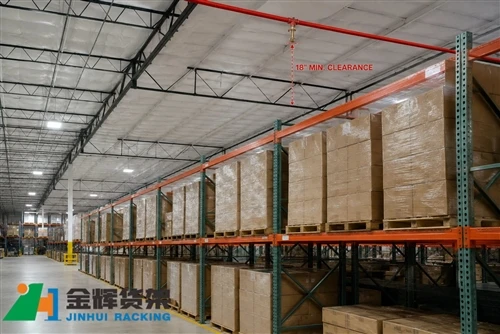
For warehouses that require direct access to individual pallet positions, selective pallet racking is a common solution.
Selective systems can be configured according to pallet dimensions, beam levels, load requirements, warehouse dimensions, and forklift operation.
Learn more about selective pallet racking systems for flexible pallet storage.
Heavy Duty Pallet Racking for Higher Load Requirements
Warehouses storing heavier palletized goods require rack components that are selected according to the actual loading condition.
Heavy-duty pallet racking can be customized according to pallet weight, beam span, rack height, storage levels, and warehouse layout.
For industrial applications, see industrial heavy duty pallet racks.
Common Pallet Rack Beam Deflection Mistakes
- Assuming every visible beam bend is normal
- Using a generic deflection number without checking the actual rack design
- Ignoring permanent deformation after unloading
- Continuing to store pallets on a visibly damaged beam
- Overloading beams based on average rather than maximum pallet weight
- Replacing a beam with an incompatible component
- Ignoring forklift impact marks
- Making unauthorized structural modifications
- Evaluating beam capacity without considering the complete rack system
Practical Beam Inspection Checklist
| Inspection Item | What to Check |
|---|---|
| Beam shape | Check for unusual sagging, bending, twisting, or deformation |
| Beam connectors | Check that connections are properly engaged and undamaged |
| Safety locks | Confirm that required locking components are present and properly positioned |
| Beam surface | Look for impact marks, cracks, severe corrosion, or other damage |
| Pallet loading | Verify that pallet weight and arrangement match the intended design |
| Rack configuration | Check that the current beam levels and components match the approved configuration |
| Forklift impact | Look for evidence of collisions around beams and uprights |
| Permanent deformation | Check the beam condition after unloading where appropriate |
FAQ About Pallet Rack Beam Deflection
What is pallet rack beam deflection?
Pallet rack beam deflection is the vertical displacement of a rack beam when it carries a load. Some elastic deflection may occur during normal loading, but excessive or permanent deformation requires evaluation.
Is a slightly bent pallet rack beam dangerous?
Not every visible movement or deflection means the beam is unsafe. However, permanent bending, severe deformation, twisting, cracking, or impact damage should be evaluated before the beam is returned to normal service.
What causes pallet rack beams to sag?
Possible causes include excessive loading, unsuitable beam selection, excessive span, uneven load distribution, forklift impact, damaged connections, or unauthorized modifications.
Should a permanently bent rack beam be replaced?
A permanently deformed beam should be professionally evaluated. Depending on the damage and rack design, replacement may be the appropriate solution.
Can I straighten a pallet rack beam?
Do not assume that straightening restores the original structural performance. Any repair should follow an approved manufacturer procedure or appropriate engineering assessment.
Does beam length affect deflection?
Yes. Beam span is an important structural design factor. Longer spans can change the required beam specification and loading behavior, so beam length should be selected together with pallet loads and rack configuration.
Final Thoughts
Pallet rack beam deflection should be evaluated as part of the complete rack system rather than as an isolated visual measurement.
Normal elastic movement under load may be acceptable within the engineered design, while permanent bending, twisting, cracking, or impact damage can indicate a condition that requires immediate attention.
The safest approach is to verify the actual pallet loads, beam configuration, span, rack specifications, and component condition before deciding whether the rack can remain in service.
If your warehouse has damaged or visibly deformed pallet rack beams, Jinhui Rack can review the rack configuration, pallet dimensions, loading requirements, and warehouse conditions to help determine an appropriate replacement or new rack solution.
Need help with pallet rack beam selection, replacement, or a complete warehouse racking project?
WhatsApp: +86 185 0252 7163
Email: info@jhrack.com
Website: https://www.jinhui-rack.com/