Third-party logistics (3PL) warehouses often store products for multiple customers in the same building. Each customer may have different SKUs, pallet sizes, inventory volumes, turnover rates, labeling requirements, and order profiles.
This makes 3PL warehouse racking more complex than simply filling available rack positions. The storage system must provide clear inventory separation while still using warehouse space efficiently as customer inventory changes over time.
A practical approach is to organize pallet racking around customer requirements, inventory characteristics, accessibility, and expected changes rather than assigning permanent blocks of space without considering actual utilization.
Why Multi-Customer 3PL Warehouses Need Flexible Rack Organization
A dedicated warehouse usually stores inventory belonging to one company or one operating organization. A 3PL warehouse may manage dozens of customers simultaneously, with each customer occupying a different amount of storage space.
One customer may require only a few pallet positions, while another may need hundreds or thousands. Customer inventory can also increase or decrease according to seasonality, promotions, production schedules, and business growth.
This creates a challenge: fixed customer zones can be easy to manage, but they can also leave unused rack positions when a customer's inventory falls below the allocated amount.
A flexible 3PL pallet racking strategy should therefore balance three objectives:
- Keep different customers' inventory clearly identifiable.
- Provide sufficient access to each customer's products.
- Avoid unnecessary empty rack space caused by rigid allocation.
Start With Customer-Based Storage Rules
Before assigning rack positions, the 3PL operator should define how customer inventory will be identified and separated.
Customer identification can be built into the warehouse location structure, inventory management system, labels, or a combination of these methods.
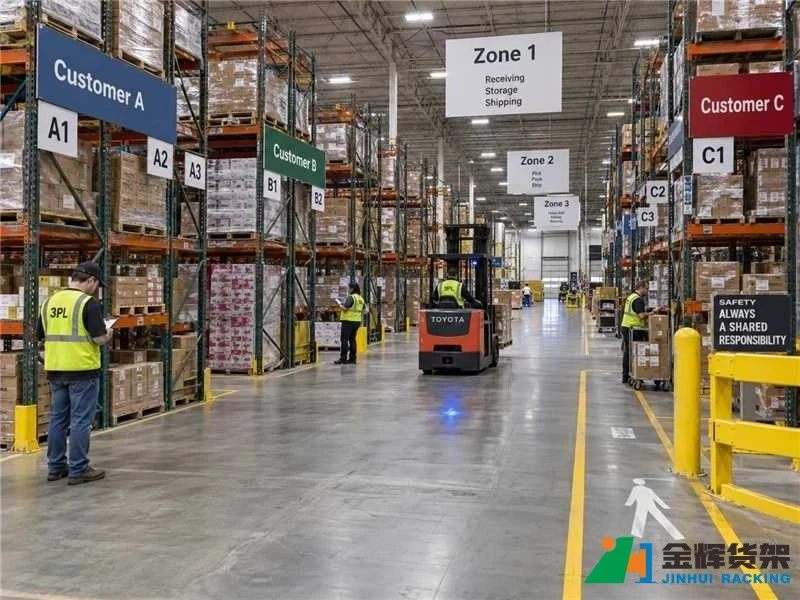
For example, a warehouse may use separate location prefixes for different customers while still allowing several customers to operate within the same rack row when the inventory characteristics make shared storage practical.
| Customer Storage Model | How It Works | Potential Use |
|---|---|---|
| Dedicated zone | A defined rack area is assigned to one customer | Large customers or special handling requirements |
| Shared rack row | Several customers occupy different bays within the same row | Smaller customers with clear location identification |
| Shared storage pool | Available pallet positions are assigned dynamically | Highly variable customer inventory |
| Product-based zone | Inventory is grouped according to product characteristics | Similar handling or storage requirements |
The right model depends on the 3PL's inventory control system and customer requirements.
When Should a 3PL Customer Have a Dedicated Rack Zone?
Dedicated zones can make inventory management straightforward when a customer has a large and relatively stable inventory volume.
A dedicated area may also be useful when a customer requires special handling procedures, specific product segregation, controlled access, or dedicated picking processes.
However, dedicating an entire rack section to a small customer can create unused space. If the customer only occupies a small number of pallets, a flexible shared-location model may use the warehouse footprint more effectively.
The decision should therefore be based on both operational requirements and actual inventory volume.
How to Share Pallet Rack Rows Between Customers
Shared rack rows can be practical in a 3PL warehouse when each customer's inventory can be identified clearly.
For example, Customer A may occupy several bays at one end of a rack row, while Customer B uses the remaining bays. The rack structure itself does not need to be physically separated if the warehouse management system and location labels clearly identify ownership.
However, shared storage should not mean uncontrolled mixing. Each pallet should have a clearly defined storage location and customer identity.
Selective pallet racking can be particularly useful for this operating model because it provides direct access to individual pallet positions and can accommodate multiple SKUs. Jinhui's selective pallet racking systems can be configured according to pallet dimensions, load requirements, forklift operations, and warehouse conditions.
Separate Inventory Without Wasting Rack Space
Physical separation is not always the same as structural separation.
A 3PL warehouse may not need to build a completely separate rack system for every customer. Instead, inventory ownership can be controlled through location codes, barcode identification, warehouse management software, and clearly defined storage rules.
This approach allows the rack structure to remain relatively flexible while maintaining logical separation between customer inventories.
For example, a rack row can contain multiple customer zones while each pallet position remains uniquely identified. This can provide better space utilization than leaving an entire row empty because one customer has temporarily reduced its inventory.
How to Handle Different Pallet Sizes Between Customers
One of the most important challenges in 3PL storage is that different customers may use different pallet sizes.
Customer A may use one standard pallet footprint, while Customer B may ship products on a different pallet dimension. Product heights and load weights may also vary.
This means rack configuration should not be based only on the average pallet used by the warehouse.
Before assigning mixed customer inventory to rack locations, review:
- Pallet length and width
- Maximum pallet height
- Maximum pallet weight
- Load distribution
- Required storage levels
- Forklift type
- Required clearances
Jinhui's warehouse pallet rack solutions are engineered around factors such as pallet size, load capacity, forklift operation, inventory turnover, and warehouse dimensions rather than using one fixed configuration for every project. :contentReference[oaicite:0]{index=0}
Use SKU Characteristics to Organize Customer Inventory
Customer ownership is only one factor in rack organization. SKU characteristics can also influence where inventory should be stored.
A customer may have both fast-moving and slow-moving products. Placing all of that customer's inventory in one fixed area may not produce the most efficient picking workflow.
Within the customer's allocated storage, high-frequency SKUs can be positioned in more accessible locations while slower-moving inventory can use less frequently accessed positions where appropriate.
This creates a two-level organization method: first identify the customer, then organize the customer's inventory according to operational requirements.
How to Manage Customer Inventory That Changes Frequently
3PL customer inventory can change significantly from month to month. A customer may add new products, discontinue SKUs, increase order volume, or temporarily reduce inventory.
If rack locations are permanently assigned based on the original customer volume, the warehouse may eventually contain large areas of unused capacity next to customers that have exceeded their original allocation.
A better approach is to review storage utilization periodically and adjust customer allocations when necessary.
Rack locations can be reassigned as long as the warehouse management system, labeling, and customer inventory records are updated consistently.
Manage Overflow Inventory Without Losing Control
Customer inventory may temporarily exceed its normal storage allocation during seasonal peaks, promotional campaigns, or unexpected inbound shipments.
Overflow storage should have predefined rules.
Instead of placing excess pallets wherever space happens to be available, the warehouse can maintain designated overflow locations and record them as part of the customer's inventory structure.
This makes temporary expansion easier to control and reduces the risk that pallets become physically separated from their inventory records.
How Rack Location Codes Support Multi-Customer Storage
Location coding becomes especially important when several customers share the same warehouse.
A useful location code should allow warehouse staff to identify the physical position of a pallet without relying on memory.
A typical structure can include:
- Warehouse or building zone
- Rack row
- Bay number
- Storage level
- Position within the bay where applicable
The customer account should then be associated with the inventory record rather than relying exclusively on physical rack labels.
This approach allows the physical rack system to remain relatively stable even when customer assignments change.
How to Handle Customers With Different Access Requirements
Not every 3PL customer has the same order frequency or service requirements.
Some customers may require frequent daily picking, while others may only request inventory occasionally. Some may have scheduled outbound orders, while others may require rapid order processing.
Storage locations can be organized to reflect these differences where practical.
High-activity customers may benefit from more accessible storage zones, while low-frequency inventory can occupy locations that require less daily handling.
This does not mean every customer should receive a permanent priority zone. Storage assignments should be reviewed according to actual workload and contractual service requirements.
Choose Rack Configuration Around the Customer Mix
A 3PL warehouse with many customers often has a high level of SKU variety and changing inventory profiles.
Direct-access storage can be valuable when individual pallets need to be retrieved without moving other pallets. In contrast, high-density storage methods may be more appropriate when a customer stores large quantities of similar products.
Jinhui's warehouse pallet rack solutions include selective, drive-in, push-back, pallet flow, and radio shuttle systems, allowing the storage configuration to be matched to different inventory and operational requirements. :contentReference[oaicite:1]{index=1}
The objective is not to use one rack type throughout the entire 3PL facility. Different storage areas can be configured around different customer and inventory requirements when the warehouse operation justifies it.
Prevent Customer Inventory From Becoming Mixed
Mixed inventory can create serious operational problems in a 3PL environment because a pallet may look physically identical to another customer's pallet while having completely different ownership.
Clear pallet labels should identify the relevant customer or account information according to the warehouse's operating procedures.
Location records should also match physical storage. When a pallet is moved, the inventory record should be updated as part of the same workflow.
This becomes particularly important when forklifts move pallets between reserve storage, picking locations, staging areas, and overflow locations.
Use Rack Space Efficiently During Customer Changes
One of the biggest challenges in multi-customer storage is uneven space utilization.
A customer may have reduced inventory while another customer needs additional storage. If every customer has a permanently reserved rack block, the warehouse may have both empty and overcrowded areas at the same time.
A flexible allocation strategy can allow suitable empty positions to be reassigned while still maintaining customer-level inventory control.
Before changing an allocation, confirm that the new locations meet the pallet dimensions, load requirements, handling method, and customer-specific storage conditions.
3PL Pallet Racking Checklist
| Item | What to Review |
|---|---|
| Customer separation | Define how customer ownership is identified physically and digitally. |
| Rack allocation | Decide whether customers need dedicated, shared, or flexible storage zones. |
| Pallet dimensions | Confirm pallet size and height before assigning storage positions. |
| Load capacity | Verify maximum pallet weight and rack capacity for each configuration. |
| SKU profile | Identify high-SKU, fast-moving, slow-moving, and seasonal inventory. |
| Overflow | Define controlled locations for temporary customer inventory increases. |
| Location coding | Use consistent rack row, bay, level, and position identification. |
| Inventory records | Keep physical pallet locations synchronized with warehouse records. |
| Space utilization | Review customer allocations periodically instead of keeping unused fixed space. |
| Future changes | Leave enough flexibility for new customers, SKUs, and changing volumes. |
Common 3PL Pallet Racking Problems
Giving Every Customer a Fixed Rack Block
Fixed blocks can be simple to understand, but they may create unused capacity when customer inventory changes. Flexible allocation can be more efficient for customers with highly variable volumes.
Mixing Customer Inventory Without Clear Identification
Shared rack space should never mean unclear ownership. Every pallet and location should remain traceable to the correct customer account.
Ignoring Different Pallet Dimensions
Two customers may use different pallet footprints or load heights. Rack positions should be assigned only after confirming the physical storage requirements.
Using Aisles as Overflow Storage
Temporary customer inventory should have controlled staging locations. Unplanned pallets in aisles can interfere with forklift traffic and create inventory tracking problems.
Never Reviewing Rack Utilization
Customer storage requirements change. Regular utilization reviews can identify areas that are consistently full, consistently empty, or poorly matched to current demand.
How to Review a Multi-Customer Rack Storage Plan
A 3PL operator can periodically review the rack system using a combination of physical observations and inventory data.
Useful questions include:
- Which customers occupy the most pallet positions?
- Which customer zones have persistent unused capacity?
- Which customers generate the highest picking activity?
- Which pallet sizes create storage constraints?
- How often is overflow storage used?
- Are any customer pallets stored outside their defined locations?
- Which rack areas experience the most congestion?
- Are current storage allocations still appropriate for customer volumes?
This review can help the warehouse adjust storage allocations without automatically replacing the entire racking system.
Frequently Asked Questions
Can different 3PL customers share the same pallet rack row?
Yes. Customers can share rack rows when their inventory can be clearly identified and the storage locations are properly controlled. Shared rows can help reduce unused space compared with rigid customer-only zones.
Should every 3PL customer have a dedicated storage area?
Not necessarily. Large customers or customers with special handling requirements may benefit from dedicated zones, while smaller or more variable accounts may be better suited to flexible or shared storage.
How should different pallet sizes be stored in a 3PL warehouse?
Storage positions should be assigned according to actual pallet dimensions, load weight, height, rack configuration, and handling requirements. A single rack configuration should not automatically be assumed to suit every customer.
How can a 3PL warehouse reduce empty rack space?
Regularly reviewing customer storage allocations and using flexible storage zones can help redistribute available positions when inventory volumes change.
What pallet racking system is suitable for a 3PL warehouse?
The appropriate system depends on customer SKU variety, pallet accessibility requirements, storage density, inventory turnover, pallet characteristics, and material-handling equipment. Selective pallet racking is often useful where individual pallet access and SKU flexibility are important.
Final Thoughts
Organizing pallet racking in a 3PL warehouse is fundamentally a matter of balancing customer separation with storage flexibility.
Dedicated zones can simplify operations for large or specialized accounts, while shared and flexible storage can help smaller or rapidly changing customer inventories use available rack space more efficiently.
The most effective approach is to combine clear customer identification, logical rack location codes, appropriate pallet allocation, controlled overflow storage, and regular utilization reviews.
Jinhui Rack provides customized warehouse pallet rack solutions for logistics and distribution applications. Its selective pallet racking systems provide direct access to individual pallet positions and can be configured around pallet dimensions, load requirements, forklift operations, and warehouse conditions.
Planning a 3PL warehouse storage project? Send Jinhui Rack your warehouse dimensions, customer pallet volumes, pallet sizes, maximum loads, SKU information, forklift type, and required pallet positions for a customized racking proposal.
Website: https://www.jinhui-rack.com/
Email: info@jhrack.com
WhatsApp: +86 185 0252 7163