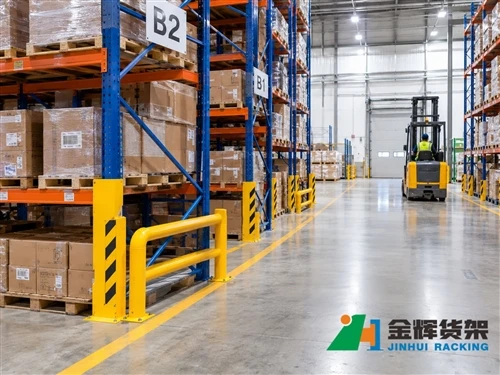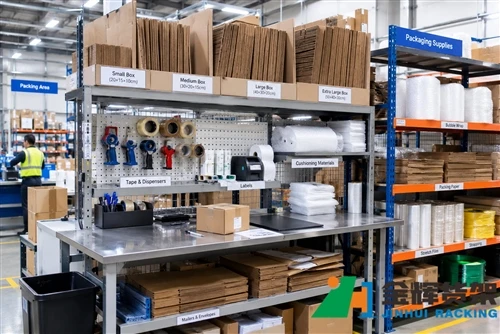
Peak seasons can place significant pressure on warehouse storage capacity. Seasonal promotions, increased customer orders, supplier deliveries, and larger inventory buffers may cause a warehouse to run short of available storage space. When this happens, warehouse teams need a practical way to accommodate additional goods without creating congestion or compromising safe operations.
Temporary warehouse storage can help businesses handle short-term inventory increases while maintaining efficient receiving, storage, picking, and shipping processes. The key is to plan temporary storage around the warehouse's actual inventory profile, available space, material-handling equipment, and operating requirements.
This guide explains how to organize temporary warehouse storage during peak season, when to use existing pallet racking, how to manage overflow inventory, and what safety measures should be considered.
1. Why Warehouses Need Temporary Storage During Peak Season
Warehouse storage demand often changes throughout the year. Retail promotions, holiday sales, agricultural cycles, production schedules, and special customer orders can all increase the volume of inventory that needs to be stored.
Common causes of temporary storage pressure include:
- Seasonal products arriving earlier than expected.
- Increased inventory held to prepare for promotional campaigns.
- Large supplier deliveries arriving within a short period.
- Finished goods accumulating before scheduled shipments.
- Returns and replacement products requiring temporary holding space.
- Additional packaging materials and shipping supplies occupying existing storage areas.
Without a clear storage plan, excess inventory may spread into picking aisles, receiving areas, shipping zones, or other spaces needed for daily operations. A temporary storage strategy helps define where additional goods can be placed and how they will be retrieved when needed.
2. Forecast Storage Demand Before the Peak Season
The first step is to estimate how much additional storage space the warehouse will need. Rather than waiting until the racks are full, review expected inventory levels and delivery schedules before the busy period begins.
Useful information includes:
- Current inventory volume and available pallet positions.
- Forecast sales and expected order volumes.
- Planned inbound deliveries and supplier schedules.
- Expected inventory turnover during the peak period.
- Products that require special handling or environmental conditions.
- Expected duration of the temporary storage requirement.
Separate fast-moving inventory from slow-moving or reserve stock. Products that will be picked frequently should remain accessible, while suitable reserve inventory may be stored in less frequently accessed locations within the approved storage layout.
For larger storage projects, a review of the pallet rack project planning guide can help clarify the warehouse dimensions, pallet specifications, equipment requirements, and storage objectives needed for a suitable racking plan.
3. Identify Suitable Areas for Temporary Warehouse Storage
Not every open floor area is suitable for storing additional pallets. Temporary storage locations should be selected according to floor conditions, handling access, emergency routes, building restrictions, and the warehouse's normal workflow.
Potential options include:
- Available pallet rack positions: Use existing, approved storage locations that are compatible with the pallet dimensions and load requirements.
- Designated floor storage areas: Store suitable goods on the floor where the area has been assessed and approved for the intended loads and handling method.
- Dedicated overflow zones: Establish clearly marked areas for short-term inventory awaiting picking, dispatch, or transfer.
- Separate reserve storage areas: Place appropriate reserve stock in an approved area that does not interfere with normal warehouse operations.
Receiving and shipping areas require particular attention. These spaces must remain available for inbound inspection, order staging, loading, and unloading. Overflow inventory should not gradually consume the space needed for these essential activities.
Temporary storage must also respect fire protection equipment, emergency exits, pedestrian routes, electrical installations, and other site-specific safety requirements. An area that appears empty is not automatically an appropriate storage location.
4. Use Existing Pallet Racking More Efficiently
Before introducing additional storage equipment, review how the existing pallet racking system is being used. Some warehouses have unused approved positions, inconsistent inventory placement, or reserve stock occupying locations that would be more useful for fast-moving products.
Practical steps include:
- Identify available and occupied pallet positions.
- Remove obsolete or unnecessary inventory through approved inventory procedures.
- Consolidate compatible stock where inventory rules permit.
- Assign convenient locations to products with frequent picking activity.
- Review whether storage locations match pallet dimensions and handling requirements.
- Keep inventory records synchronized with physical movements.
Reorganizing inventory can release usable capacity without requiring a complete warehouse redesign. However, changing the way pallets are stored must not involve exceeding rated rack loads, using incompatible pallets, or placing goods in unapproved positions.
For warehouses that need additional pallet storage, industrial pallet racking systems can be evaluated according to available space, inventory characteristics, pallet dimensions, load requirements, and forklift operations.
5. Establish Clear Rules for Overflow Inventory
Temporary storage works best when every item has a defined location and a clear handling procedure. Without these rules, overflow areas can quickly become difficult to manage, increasing the risk of misplaced products, delayed orders, and unnecessary forklift movements.
Each temporary storage location should have an identifiable location code. Inventory records should show the product or SKU, quantity, storage location, and any relevant handling restrictions.
Consider using a simple location management table:
| Storage Area | Typical Use | Management Requirement |
|---|---|---|
| Primary pallet racks | Regular inventory and routine picking | Maintain accurate location records and rack load limits. |
| Reserve storage | Additional stock for replenishment | Track quantities and replenish picking locations according to demand. |
| Overflow zone | Short-term excess inventory | Use clear location labels and review occupancy regularly. |
| Receiving staging | Newly delivered goods awaiting processing | Keep the area available for receiving and inspection activities. |
| Shipping staging | Orders prepared for dispatch | Separate orders clearly and avoid obstructing loading operations. |
These categories are examples rather than a universal layout. Each warehouse should adapt them to its building, inventory, material-handling equipment, and operating procedures.
6. Plan Forklift Routes and Material Flow
Additional inventory can increase forklift travel, turning movements, and interactions between warehouse workers. Temporary storage should therefore be planned together with material flow, rather than treated as a separate space problem.
Before activating an overflow area, review the following:
- Whether forklifts can approach and retrieve pallets safely.
- Whether turning and maneuvering space remains adequate.
- Whether pedestrian routes remain clearly separated where required.
- Whether inbound and outbound movements create congestion.
- Whether emergency access and required clearances remain unobstructed.
- Whether temporary stock creates blind corners or reduces visibility.
Do not reduce required aisle clearances simply to fit more inventory into the building. If the proposed storage arrangement cannot support safe equipment movement, choose another location or revise the plan.
For more guidance on coordinating storage with daily material flow, see how to plan pallet racking around warehouse receiving and shipping areas.
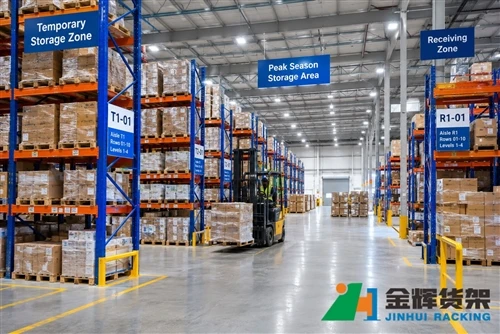
7. Temporary Storage Image: Organizing Peak-Season Inventory
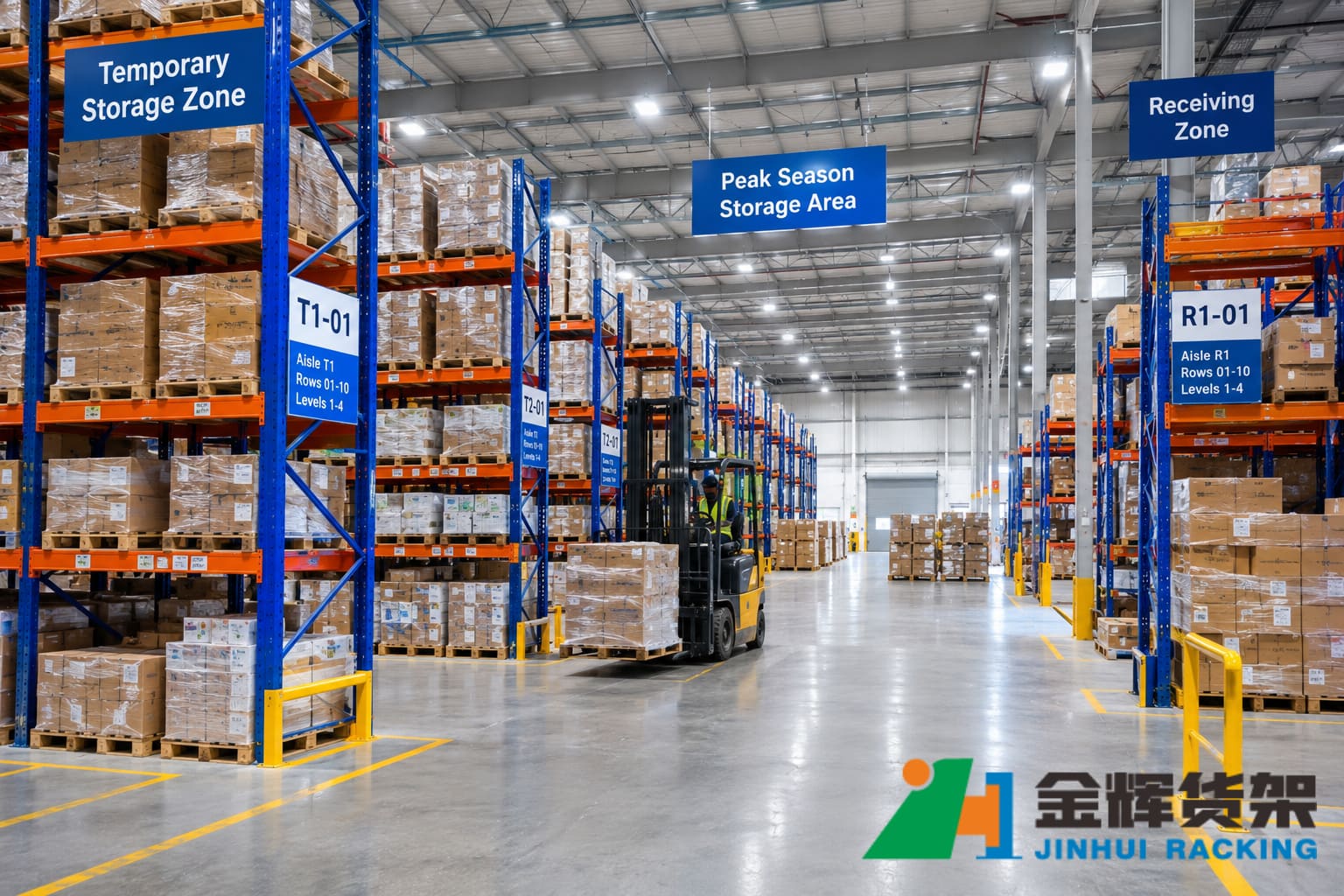
A well-organized temporary storage area should make inventory easy to identify, access, and move. Clearly defined zones, visible location labels, suitable pallet placement, and unobstructed travel routes help warehouse teams manage higher inventory volumes without losing control of daily operations.
8. Decide When Additional Storage Equipment Is Necessary
Reorganizing existing inventory may be sufficient for a short-term increase in demand. However, some warehouses will need additional storage equipment or a more comprehensive capacity plan.
Consider evaluating additional storage solutions when:
- Approved pallet positions are consistently close to full occupancy.
- Overflow inventory regularly occupies operational areas.
- Picking and replenishment become slower because stock is difficult to access.
- Forecast inventory growth is likely to continue beyond the peak period.
- Current storage arrangements no longer match product dimensions or handling needs.
Potential solutions depend on the application. Selective pallet racking can provide direct access to individual pallet positions, while other rack configurations may suit particular inventory volumes and access requirements. The appropriate choice should be based on SKU diversity, inventory turnover, required access, warehouse dimensions, and handling equipment.
Any new rack installation or modification should be reviewed by a qualified racking professional. Existing rack components should not be altered or reconfigured without confirming compatibility, load capacity, and the suitability of the proposed design.
9. Monitor Temporary Storage Throughout the Peak Period
Temporary storage needs can change quickly as goods arrive, orders are picked, and shipments leave the warehouse. A storage plan should be reviewed throughout the busy period rather than treated as a one-time arrangement.
Warehouse managers can monitor several practical indicators:
- Storage occupancy: How many approved storage positions remain available?
- Overflow inventory volume: Is temporary stock increasing or decreasing?
- Inventory accuracy: Do system records match the physical stock locations?
- Picking performance: Are workers spending more time searching for products?
- Receiving and shipping congestion: Are staging areas remaining functional?
- Safety observations: Are aisles, exits, rack access points, and emergency equipment unobstructed?
Short daily reviews can help supervisors identify storage problems early. If overflow areas become difficult to manage, the warehouse may need to adjust inbound schedules, prioritize dispatches, relocate suitable stock, or activate another approved storage area.
10. Prepare a Plan for Removing Temporary Storage
Temporary storage should have a clear exit plan. If excess inventory remains in overflow areas after the peak season, those areas may gradually become permanent, unmanaged storage locations.
Before the busy period ends, define how temporary stock will be handled. Options may include shipping completed orders, returning excess goods where appropriate, transferring stock to approved permanent positions, or reducing future replenishment quantities.
After the temporary arrangement is removed, review what worked well and what caused difficulties. Record the highest inventory volume, the storage areas used, any congestion issues, and the additional capacity that would have been useful.
This information can improve preparation for the next peak season and help determine whether the warehouse needs a long-term storage redesign.
Common Mistakes in Temporary Warehouse Storage
Several common mistakes can make temporary storage less effective:
- Using any available floor space: Open space may be unsuitable because of floor limitations, access requirements, or safety restrictions.
- Blocking receiving or shipping areas: Overflow inventory should not interfere with essential material-handling activities.
- Ignoring location records: Unrecorded inventory movements make products harder to find and stock counts less reliable.
- Overloading existing racks: Additional demand does not justify exceeding approved load limits.
- Mixing incompatible products: Some goods require separation, special handling, or environmental controls.
- Leaving temporary storage in place indefinitely: Short-term arrangements should be reviewed and removed or formally incorporated into an approved storage plan.
Frequently Asked Questions
What is temporary warehouse storage?
Temporary warehouse storage is a short-term arrangement used to accommodate inventory that exceeds the capacity of normal storage locations. It may involve approved overflow zones, available pallet rack positions, or designated floor storage areas.
How can a warehouse increase storage capacity during peak season?
A warehouse can review available rack positions, improve inventory placement, consolidate compatible stock, schedule deliveries more effectively, and establish approved overflow zones. If these measures are insufficient, additional storage equipment or a revised layout may be necessary.
Can pallets be stored on the floor temporarily?
Yes, where floor storage is suitable and approved for the intended loads, pallet types, stacking arrangements, and handling equipment. The area must also preserve required access routes, visibility, and other site-specific safety requirements.
How should overflow inventory be tracked?
Assign each temporary location a clear identifier and update the warehouse inventory system whenever goods are moved. Product identity, quantity, and physical location should remain consistent between system records and actual stock.
When should a warehouse consider installing more pallet racking?
Additional pallet racking may be worth evaluating when approved storage locations remain consistently full, overflow storage disrupts operations, or increased inventory demand is expected to continue. The decision should follow a review of the warehouse layout, loads, pallet specifications, and handling requirements.
Conclusion
Managing temporary warehouse storage during peak season requires more than finding space for additional pallets. Effective planning combines inventory forecasting, approved storage locations, clear location records, safe forklift movement, and regular monitoring of storage capacity.
By organizing overflow inventory before demand reaches its highest level, warehouse operators can maintain better control of stock and reduce unnecessary disruption to receiving, picking, and shipping. If seasonal growth becomes a recurring challenge, reviewing the existing pallet racking system and evaluating additional storage solutions can support a more sustainable long-term plan.
JINHUI Rack provides industrial pallet racking solutions for different warehouse storage requirements. Share your warehouse layout, pallet dimensions, maximum load, and storage needs to discuss a suitable solution for your project.
WhatsApp: +86 185 0252 7163
Email: info@jhrack.com