Food and beverage warehouses have storage requirements that are different from many general industrial warehouses. Products may have expiration dates, production batches, different turnover rates, and strict requirements for inventory rotation.
Because of these characteristics, pallet racking should not be planned only around the number of pallets that need to be stored. The storage layout should also support product rotation, batch management, picking frequency, replenishment, and the way goods move through the warehouse.
A well-organized pallet racking system can help separate different inventory groups while providing appropriate access to fast-moving and time-sensitive products. The right configuration depends on the actual product profile and warehouse workflow.
Why Food and Beverage Warehouses Need Specialized Storage Planning
Food and beverage warehouses may handle large quantities of palletized products, but the inventory is rarely completely uniform.
Some products may have short shelf lives, while others can remain in storage for much longer. Some SKUs may move every day, while others may only be shipped occasionally. Products may also arrive in different batch quantities and pallet configurations.
This creates several storage challenges:
- Expiration date management
- Batch and lot tracking
- FIFO inventory rotation
- Different pallet heights and weights
- High-volume product movement
- Mixed SKU storage
- Frequent replenishment
- Fast order picking
The pallet racking layout should support these operational requirements rather than treating every pallet as identical inventory.
Start With Product Characteristics
Before designing the storage layout, identify the characteristics of the products that will be stored.
Important information includes:
- Product type
- Pallet dimensions
- Loaded pallet height
- Maximum pallet weight
- Number of pallets per SKU
- Daily or weekly movement
- Expiration date requirements
- Batch management requirements
- Required inventory rotation method
For example, a beverage distributor may have several high-volume SKUs that require frequent replenishment, while other products may move much more slowly.
These products do not necessarily need to occupy the same type of storage position.
How Expiration Dates Affect Pallet Rack Organization
Expiration dates can have a major influence on how pallet locations should be organized.
When products have limited shelf lives, warehouse operators need to know not only where a pallet is stored but also which pallet should be shipped first.
A storage strategy that groups products only by SKU may not be sufficient if multiple production batches are stored at the same time.
Location planning can therefore consider:
- SKU
- Production date
- Expiration date
- Batch or lot number
- Arrival date
- Expected shipping date
The exact inventory-control method depends on the warehouse's WMS and operating procedures, but the physical rack layout should make the required product flow practical.
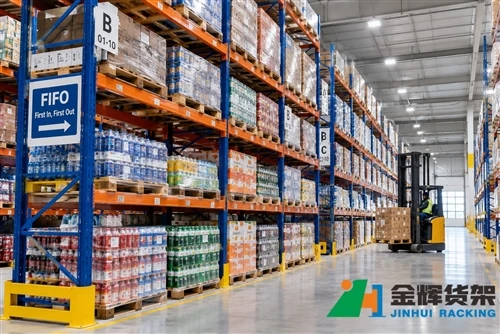
FIFO and Pallet Racking
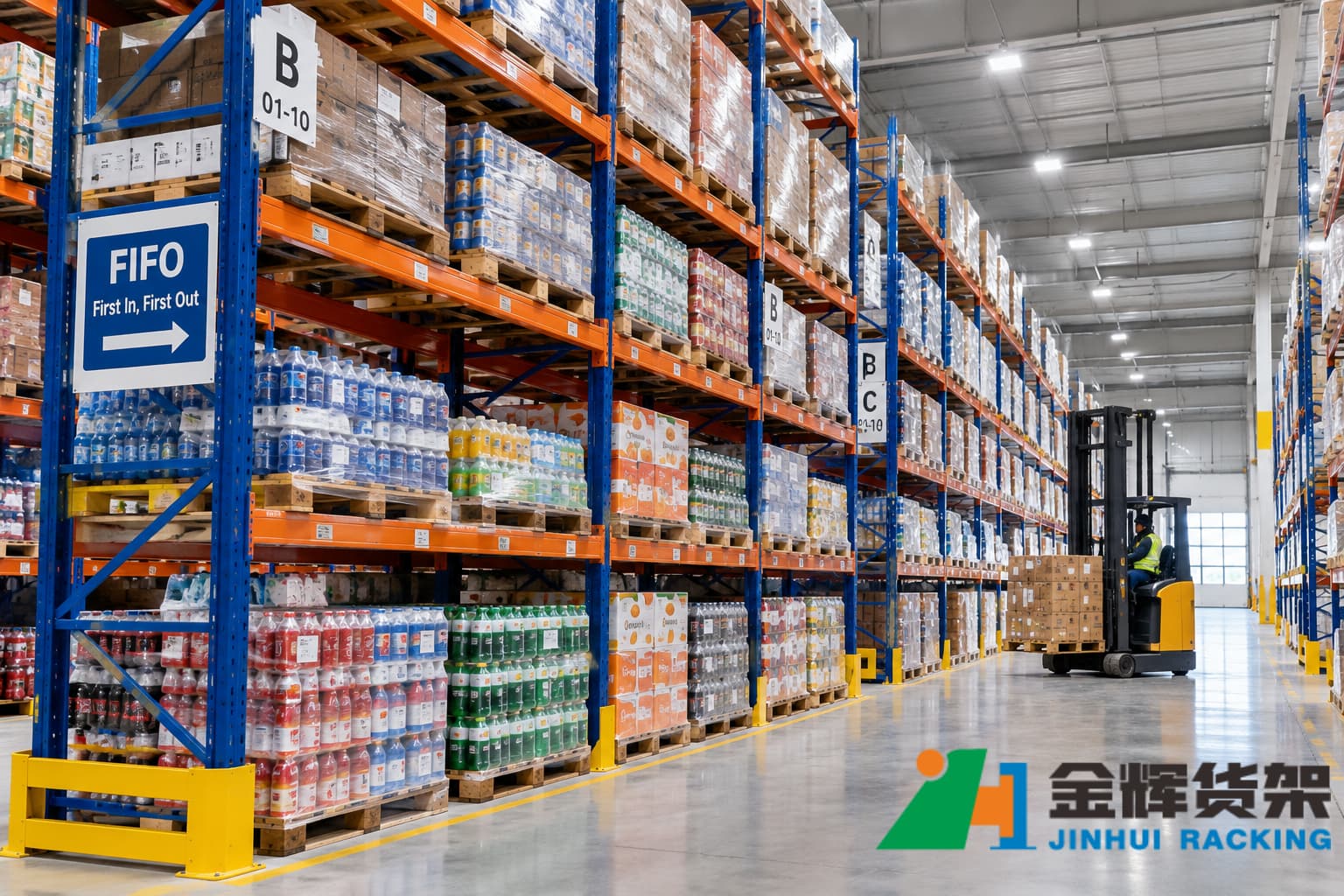
FIFO, or First-In, First-Out, means that older inventory is normally moved out before newer inventory.
For products with expiration dates or freshness requirements, FIFO can be an important part of inventory management.
The physical storage system can support FIFO by making the movement of pallets easier to control. Depending on throughput, pallet quantity, and available space, different rack configurations may be considered.
For example, pallet flow racking can provide a physical loading side and picking side, allowing pallets to move through storage lanes in a defined direction.
However, FIFO requirements should not automatically lead to one specific rack system. The warehouse should first determine its product volume, pallet characteristics, SKU profile, and required throughput.
Batch Storage for Food and Beverage Products
Batch management becomes important when the same SKU is received in multiple production batches.
For example, a warehouse may receive several pallets of the same beverage SKU on different dates. Although the product code is identical, the pallets may need to remain distinguishable because their production or expiration dates are different.
Rack locations can be organized to make these groups easier to identify and control.
Possible approaches include:
- Separating different batches into dedicated rack locations.
- Using clearly defined location zones for different receiving periods.
- Positioning older batches where they are easier to retrieve first.
- Using WMS location records together with physical rack labels.
- Keeping incompatible or restricted products in designated areas.
The best approach depends on the warehouse's inventory-control process and the number of batches handled simultaneously.
High-Volume Beverage Storage
Beverage warehouses often handle large numbers of similar pallets and high daily pallet movement.
This creates a different storage challenge from a warehouse with thousands of low-volume SKUs.
When a small number of products account for a large percentage of pallet movement, those products may benefit from storage positions that reduce unnecessary forklift travel and make replenishment more efficient.
Fast-moving products can be positioned closer to relevant picking or dispatch areas when the warehouse layout allows it.
At the same time, reserve inventory can be organized in higher or deeper storage positions depending on the selected rack configuration.
How SKU Turnover Should Influence Rack Location
Not every pallet position in a food or beverage warehouse needs to have the same operational priority.
A practical layout can divide inventory according to turnover rate.
| Inventory Profile | Storage Planning Consideration |
|---|---|
| Very fast-moving SKUs | Keep convenient access and efficient replenishment routes. |
| Medium-turnover SKUs | Use standard storage locations with balanced accessibility and density. |
| Slow-moving SKUs | Consider locations where storage density is more important than frequent access. |
| Expiration-sensitive products | Organize locations to support the required inventory rotation. |
| Large batch inventory | Group compatible pallets where deeper storage can improve space utilization. |
This type of zoning can reduce unnecessary movement and make the physical storage layout easier to manage.
Mixed Pallet Sizes in Food Warehouses
Food and beverage warehouses do not always use one standard pallet configuration.
Different product groups may have different pallet footprints, pallet heights, or load weights. Imported products may also arrive on pallet formats that differ from those used for domestic distribution.
Before designing the rack, collect the dimensions of the actual pallets that will be stored.
At minimum, record:
- Pallet length
- Pallet width
- Overall loaded height
- Maximum pallet weight
- Pallet construction
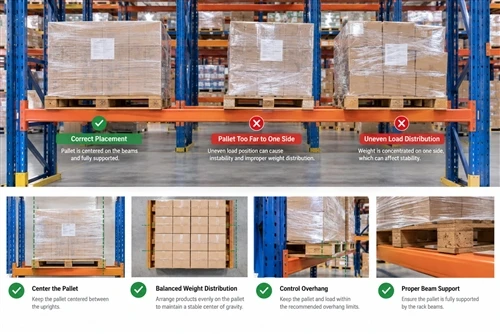
- Load overhang, if applicable
Using a single assumed pallet dimension for the entire warehouse can create clearance or storage-efficiency problems when the actual inventory is more varied.
How Pallet Racking Supports Replenishment
Food and beverage warehouses often need frequent replenishment because popular products can move quickly from storage to picking or shipping areas.
The rack layout should therefore consider the relationship between reserve storage and active picking locations.
A common operating concept is:
Receiving → Reserve Storage → Replenishment → Picking → Dispatch
The exact flow depends on the warehouse operation, but the physical rack arrangement should make these movements practical.
When fast-moving products are stored far away from their normal picking or dispatch areas, forklifts may travel longer distances during replenishment.
Organizing storage according to actual movement patterns can therefore improve warehouse efficiency without simply adding more rack positions.
Choosing Between Selective and High-Density Storage
Selective pallet racking provides direct access to individual pallet locations and can be useful when a warehouse handles many SKUs or requires frequent pallet selection.
High-density systems can be more appropriate when the warehouse stores larger quantities of similar products and wants to reduce the amount of floor space consumed by aisles.
The decision should consider:
- SKU diversity
- Number of pallets per SKU
- Inventory turnover
- FIFO requirements
- Available floor space
- Required pallet accessibility
- Forklift operation
- Future inventory changes
There is no single rack configuration that is ideal for every food or beverage warehouse.
When Pallet Flow Racking May Be Useful
Pallet flow racking can be considered when a warehouse needs directional pallet movement and FIFO inventory rotation.
The system uses inclined roller lanes to move pallets from the loading side toward the picking side. This can help create a defined product flow through the storage lane.
It can be particularly useful when:
- FIFO is operationally important.
- Pallet throughput is high.
- Products are stored in relatively consistent pallet configurations.
- Large quantities of individual SKUs are handled.
- Separate loading and picking sides are practical.
However, pallet flow rack design needs to consider pallet construction, load characteristics, lane depth, roller configuration, and the overall warehouse layout.
When Selective Pallet Racking May Be More Practical
Selective pallet racking can be a better fit when a food or beverage warehouse handles many different SKUs and needs direct access to individual pallets.
For example, a distributor may store hundreds or thousands of product variations but only a few pallets of each SKU.
In this situation, deep storage may reduce accessibility because several pallets of the same lane could occupy space that is needed for different products.
Selective racking allows each pallet location to remain directly accessible from the operating aisle.
JINHUI's selective pallet racking systems can be considered for warehouses where direct pallet access and flexible storage organization are important.
How to Organize Reserve and Picking Inventory
Separating reserve inventory from frequently accessed inventory can make warehouse operations easier to manage.
Reserve pallets can remain in designated rack locations while smaller quantities are replenished into active picking areas as required.
This approach can help reduce unnecessary forklift movements through areas where order picking or dispatch activity is concentrated.
The ideal arrangement depends on order volume, product characteristics, available floor space, and the warehouse management process.
Food and Beverage Warehouse Rack Layout Considerations
The rack layout should be planned together with the rest of the warehouse rather than designing storage rows independently.
Consider the relationship between:
- Receiving doors
- Shipping areas
- Staging areas
- Picking zones
- Reserve storage
- Forklift aisles
- Pedestrian routes
- Emergency access
- Building columns
- Fire protection equipment
The warehouse should have enough operating space for forklifts and workers to move between storage, picking, receiving, and dispatch areas.
Common Food and Beverage Pallet Storage Mistakes
Storing All SKUs in the Same Type of Location
Fast-moving products, slow-moving products, and expiration-sensitive products often have different storage requirements. Treating them identically can create unnecessary travel and inventory-control problems.
Ignoring Batch Differences
Two pallets with the same SKU number may belong to different production batches or have different expiration dates. Physical storage and inventory records should support the required batch-control process.
Using FIFO Without Considering Physical Flow
Labeling products as FIFO inventory does not automatically make the physical warehouse FIFO. The rack layout and operating process should make the required product sequence practical.
Using One Pallet Size for the Entire Design
Different products may use different pallet dimensions and load heights. These variations should be identified before the rack configuration is finalized.
Placing Fast-Moving Products Too Far From Their Operating Area
Long forklift travel distances can reduce productivity when the same high-volume products are replenished and shipped repeatedly.
Focusing Only on Storage Density
Maximum pallet density is not always the same as maximum warehouse efficiency. Accessibility, product rotation, replenishment, and forklift movement also affect overall performance.
How to Plan a Food and Beverage Pallet Racking Project
Before requesting a pallet rack quotation, prepare the information that describes both the products and the warehouse operation.
A useful project information list includes:
- Warehouse dimensions
- Clear warehouse height
- Warehouse floor plan
- Pallet dimensions
- Maximum pallet weight
- Loaded pallet height
- Number of SKUs
- Number of pallets per SKU
- Daily pallet movement
- FIFO or LIFO requirements
- Forklift type
- Required pallet positions
- Receiving and dispatch workflow
- Future storage requirements
Providing accurate information at the beginning helps the rack supplier develop a configuration that reflects the actual warehouse operation instead of relying on generic assumptions.
FAQ About Food and Beverage Pallet Racking
What pallet racking is best for food warehouses?
The appropriate system depends on SKU diversity, pallet volume, turnover, FIFO requirements, available space, and forklift operations. Selective, pallet flow, drive-in, push-back, and other systems can be suitable for different inventory profiles.
Why is FIFO important in food storage?
FIFO can help warehouses prioritize older inventory before newer inventory, which can be important for products with expiration dates or limited shelf life.
Is selective racking suitable for beverage warehouses?
Yes. Selective racking can be useful when beverage warehouses handle many SKUs and need direct access to individual pallet locations.
Is pallet flow racking suitable for food and beverage products?
It can be suitable when FIFO, high throughput, and directional pallet movement are important. The pallet and product characteristics should be reviewed before selecting the system.
How should different product batches be stored?
Batch storage should make production dates, expiration dates, and inventory sequence manageable. The exact arrangement depends on the warehouse's inventory-control procedures and WMS.
Should fast-moving food products be stored closer to shipping?
When the warehouse layout allows it, positioning frequently moved products closer to their normal picking or dispatch areas can reduce unnecessary forklift travel and replenishment movement.
Build a Pallet Storage System Around Product Flow
Food and beverage pallet storage is not simply a question of how many pallets can fit inside a warehouse. Expiration dates, batch quantities, SKU turnover, pallet dimensions, replenishment frequency, and inventory rotation can all influence the most practical rack configuration.
A successful warehouse storage plan connects the physical pallet rack layout with the way products actually move through the facility.
JINHUI provides customized warehouse pallet racking solutions for food and beverage storage, distribution centers, manufacturing facilities, and other industrial applications. The rack configuration can be planned according to warehouse dimensions, pallet information, storage requirements, and operating conditions.
Explore JINHUI Warehouse Pallet Rack Solutions and discuss your storage requirements with our team.
Contact JINHUI Rack:
WhatsApp: +86 185 0252 7163
Email: info@jhrack.com
Website: https://www.jinhui-rack.com/