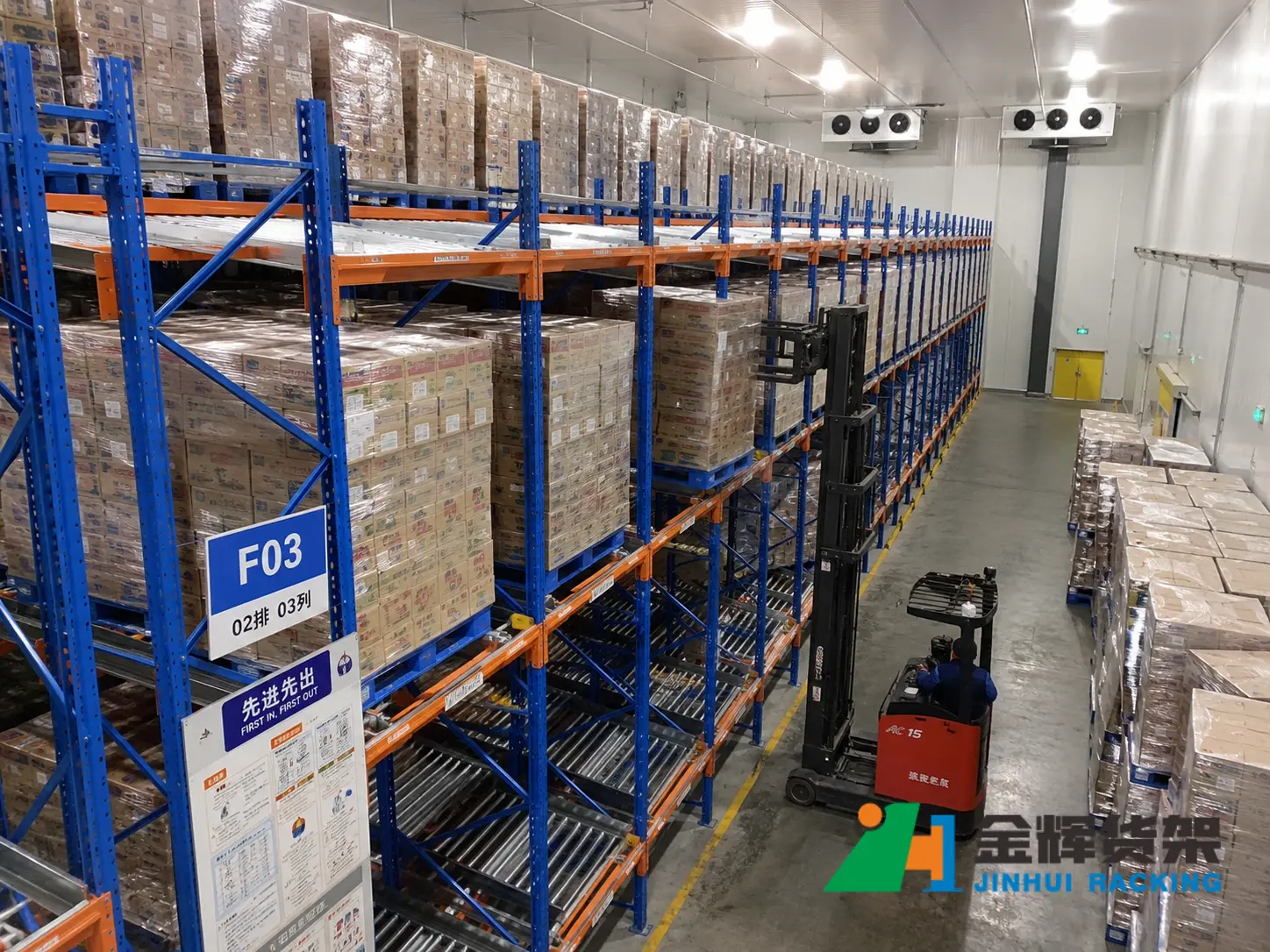
Pallet flow rack for cold storage is a practical solution for refrigerated and frozen warehouses that need higher storage density and reliable FIFO inventory rotation.
Compared with conventional selective pallet racking, pallet flow systems can reduce the number of forklift aisles by storing multiple pallets in deep gravity lanes. This allows cold-storage operators to make better use of expensive refrigerated space while maintaining a clear first-in, first-out stock flow.
However, cold-storage projects place additional demands on the rack system. Temperature, pallet condition, roller performance, braking devices, corrosion protection, lane depth, and forklift workflow should all be considered before the final layout is confirmed.
Why Pallet Flow Racking Works Well in Cold Storage
Cold warehouses usually have higher construction and operating costs than standard warehouses. Refrigeration equipment, insulation, energy consumption, and temperature control make every square meter of storage space more valuable.
Pallet flow racking helps improve space utilization by storing several pallets in depth while keeping loading and picking operations on opposite sides of the rack.
This configuration is particularly useful for products that require regular stock rotation, such as:
- Frozen food
- Fresh and chilled products
- Beverages
- Dairy products
- Pharmaceutical products
- Temperature-sensitive raw materials
Because pallets move automatically toward the picking side after the front pallet is removed, the system naturally supports FIFO inventory management.
Key Design Considerations for Cold Storage Pallet Flow Racks
1. Confirm the Actual Operating Temperature
The first step is to confirm the temperature range inside the warehouse.
Chilled storage, frozen storage, and very low-temperature warehouses may require different roller, bearing, lubricant, seal, and accessory configurations.
The moving components in the flow lane should therefore be selected according to the actual operating environment rather than using a standard configuration for every project.
2. Match the Roller Lane to the Pallet
The pallet bottom structure directly affects how smoothly the load moves through the gravity lane.
Before designing the rack, the supplier should confirm:
- Pallet length and width
- Maximum loaded weight
- Bottom runner structure
- Fork entry direction
- Pallet material
- Pallet condition
Wooden, plastic, and steel pallets can all be used in pallet flow systems, but their bottom structures may require different roller spacing and support arrangements.
Damaged pallets, warped runners, or irregular bottoms can also interrupt smooth pallet movement.
3. Plan Lane Depth Around Inventory Turnover
One of the main advantages of pallet flow racking is deep-lane storage, but a deeper lane is not always better.
Lane depth should be planned according to:
- Number of pallets per SKU
- Inventory turnover rate
- Required storage capacity
- Pallet weight
- Available warehouse depth
- Loading and picking frequency
If the lane is too deep for the actual inventory pattern, the warehouse may gain theoretical capacity without improving daily operating efficiency.
A good design should balance storage density with practical stock rotation.
4. Use Proper Braking and Speed-Control Components
Pallets move through flow racks under gravity, so their speed needs to remain controlled.
Depending on pallet weight and lane depth, the system may use:
- Damping rollers
- Brake rollers
- Pallet separators
- Guide rails
- End stops
Heavy pallets and deeper lanes generally require more careful speed control.
Too little braking can cause excessive impact at the picking end, while too much resistance may cause the pallet to stop inside the lane.
For more detail on this topic, see our article on pallet flow rack braking systems.
5. Consider Condensation and Corrosion
Cold-storage racks may be exposed to condensation, moisture, cleaning processes, and repeated temperature changes.
These conditions can increase the risk of corrosion over time.
Depending on the warehouse environment, suitable surface treatment may include:
- Powder coating
- Galvanized components
- Additional corrosion-resistant treatment
The final finish should be selected according to humidity, temperature, cleaning frequency, and exposure conditions.
6. Design the Rack for the Actual Pallet Load
The rack structure should be calculated according to the maximum loaded pallet weight, not only the average pallet weight.
The design should consider the complete load path, including:
- Number of pallets per lane
- Number of storage levels
- Beam loading
- Upright frame loading
- Roller lane capacity
- Overall rack height
Changing pallet weight or increasing the number of storage levels can affect the entire rack structure, so the complete system should be reviewed together.
7. Plan Loading and Picking Aisles Together
Pallet flow racking normally uses separate loading and picking sides.
This means the rack layout should be coordinated with forklift traffic before installation.
Important factors include:
- Forklift type
- Lifting height
- Turning radius
- Aisle width
- Receiving area
- Shipping area
- Cold-room doors
- Columns and building structures
A high-density rack layout only works well if pallets can be loaded and retrieved efficiently.
Pallet Flow Rack vs Selective Rack in Cold Storage
Both systems can be used in cold warehouses, but they suit different inventory strategies.
| Factor | Pallet Flow Rack | Selective Pallet Rack |
|---|---|---|
| Storage Density | High | Moderate |
| Inventory Rotation | FIFO | Flexible direct access |
| Aisle Requirement | Fewer aisles | More aisles |
| SKU Access | By lane | Direct access to every pallet |
| Best For | High-volume FIFO products | Warehouses with many SKUs |
If direct access to every pallet is the main priority, selective pallet racking may be the better option.
If the warehouse stores larger quantities of the same SKU and requires FIFO stock rotation, pallet flow racking can provide higher storage density.
Common Mistakes to Avoid
Several design problems are especially common in cold-storage pallet flow projects.
- Choosing the longest possible lane: Storage density should not be increased at the expense of practical inventory flow.
- Ignoring pallet condition: Damaged or irregular pallets can stop inside the roller lane.
- Using standard components without checking temperature: Moving parts should be suitable for the actual cold-storage environment.
- Overlooking corrosion protection: Moisture and condensation may require a more suitable surface treatment.
- Planning racks before forklift routes: Loading and picking access should be included in the initial warehouse layout.
What Should Buyers Prepare Before Requesting a Design?
Providing complete project information helps the rack manufacturer prepare a more accurate layout and quotation.
Before requesting a pallet flow rack design, prepare:
- Warehouse length, width, and clear height
- Cold-storage operating temperature
- Pallet dimensions
- Maximum pallet weight
- Pallet bottom photos
- Required pallet positions
- Number of SKUs
- Expected pallets per lane
- Forklift model and lifting height
- Warehouse layout drawing, if available
These details help determine the rack height, lane depth, roller arrangement, braking configuration, structural capacity, and forklift aisle layout.
Cold Storage Racking Solutions From Jinhui Rack
Jinhui Rack provides customized warehouse racking solutions for refrigerated, frozen, and general industrial storage projects.
For pallet flow applications, rack layout, lane depth, roller configuration, load capacity, and FIFO workflow can be designed according to actual pallet specifications and warehouse conditions.
For other storage requirements, Jinhui also supplies industrial pallet racking systems and selective pallet racking systems.
The right system depends on storage density, SKU quantity, inventory turnover, pallet specifications, and daily warehouse operation.
Final Thoughts
Pallet flow racking can be a strong choice for cold storage when high-density storage and FIFO inventory rotation are both important.
The key is to design the system around the real operating conditions of the warehouse. Temperature, pallet type, lane depth, braking components, corrosion protection, rack load capacity, and forklift access should all be reviewed before production.
A properly designed system can help make better use of refrigerated space while keeping pallet movement and stock rotation more organized.
Planning a cold-storage racking project?
Send Jinhui Rack your warehouse dimensions, operating temperature, pallet size, maximum load, required storage capacity, and pallet photos. Our team can help evaluate a suitable pallet flow rack configuration for your project.
Talk to Jinhui Rack
WhatsApp: +86 185 0252 7163
Email: info@jhrack.com