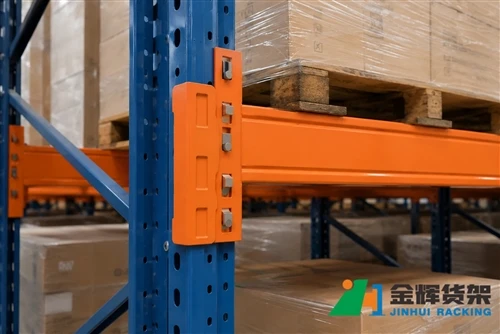
Pallet rack beam connectors are small but critical components of a warehouse racking system. They connect horizontal beams to upright frames and transfer the loads from stored pallets into the rack structure. Although the connector may appear to be a simple steel component, its design, compatibility, locking mechanism, and installation all contribute to the performance and safety of the complete pallet rack.
When selecting a pallet racking system, warehouse operators often pay close attention to beam length, rack height, pallet capacity, and upright dimensions. However, the beam-to-upright connection also deserves careful consideration because every loaded beam depends on this connection to remain securely attached to the rack frame.
A properly designed connection helps maintain the intended rack configuration during normal loading and unloading operations. It also helps prevent unintended beam movement or disengagement when the rack is exposed to routine warehouse activity.
Quick Answer
Pallet rack beam connectors secure horizontal beams to upright frames and form an important part of the rack's load path. The correct connector should be compatible with the upright profile and beam design, include the required locking mechanism, and be installed according to the rack manufacturer's specifications.
What Is a Pallet Rack Beam Connector?
A pallet rack beam connector is the component used to attach a horizontal pallet rack beam to an upright frame.
In a typical selective pallet racking system, the connector is positioned at the end of the beam and engages with the perforations or connection points on the upright column.
The basic structural relationship is:
Pallet → Beam → Beam Connector → Upright Frame → Base Plate → Warehouse Floor
This means the connector is an important link in the load-transfer path.
Depending on the rack design, beam connectors may use different shapes, hooks, tabs, locking pins, or other mechanical features. The exact design should be matched to the rack system rather than selected as a generic replacement component.
Why Beam Connectors Matter in Pallet Racking
The beam connector has several important functions within an industrial rack.
- Connects beams to upright frames
- Maintains the intended beam position
- Transfers beam loads into the upright structure
- Helps prevent unintended beam disengagement
- Supports the modular assembly of pallet rack bays
- Allows storage levels to be adjusted in compatible rack systems
Because the connector is part of the structural connection, damage, incorrect installation, or component incompatibility can affect the performance of the rack system.
For this reason, warehouse operators should not treat beam connectors as interchangeable hardware without verifying compatibility.
How a Pallet Rack Beam Connects to an Upright
A typical adjustable pallet rack uses upright frames with regularly spaced connection points.
The beam connector is attached to the beam end and engages with the upright at the selected height. Once the beam is positioned correctly, the locking mechanism is secured according to the rack manufacturer's design.
This creates a mechanical connection between the horizontal and vertical members.
The installation process generally involves:
- Positioning the upright frames correctly
- Aligning the beam connector with the upright connection points
- Engaging the connector with the upright
- Seating the beam fully
- Installing or confirming the required safety lock
- Checking the beam position before loading
The exact installation method varies by rack system, so the manufacturer's assembly instructions should always take priority.
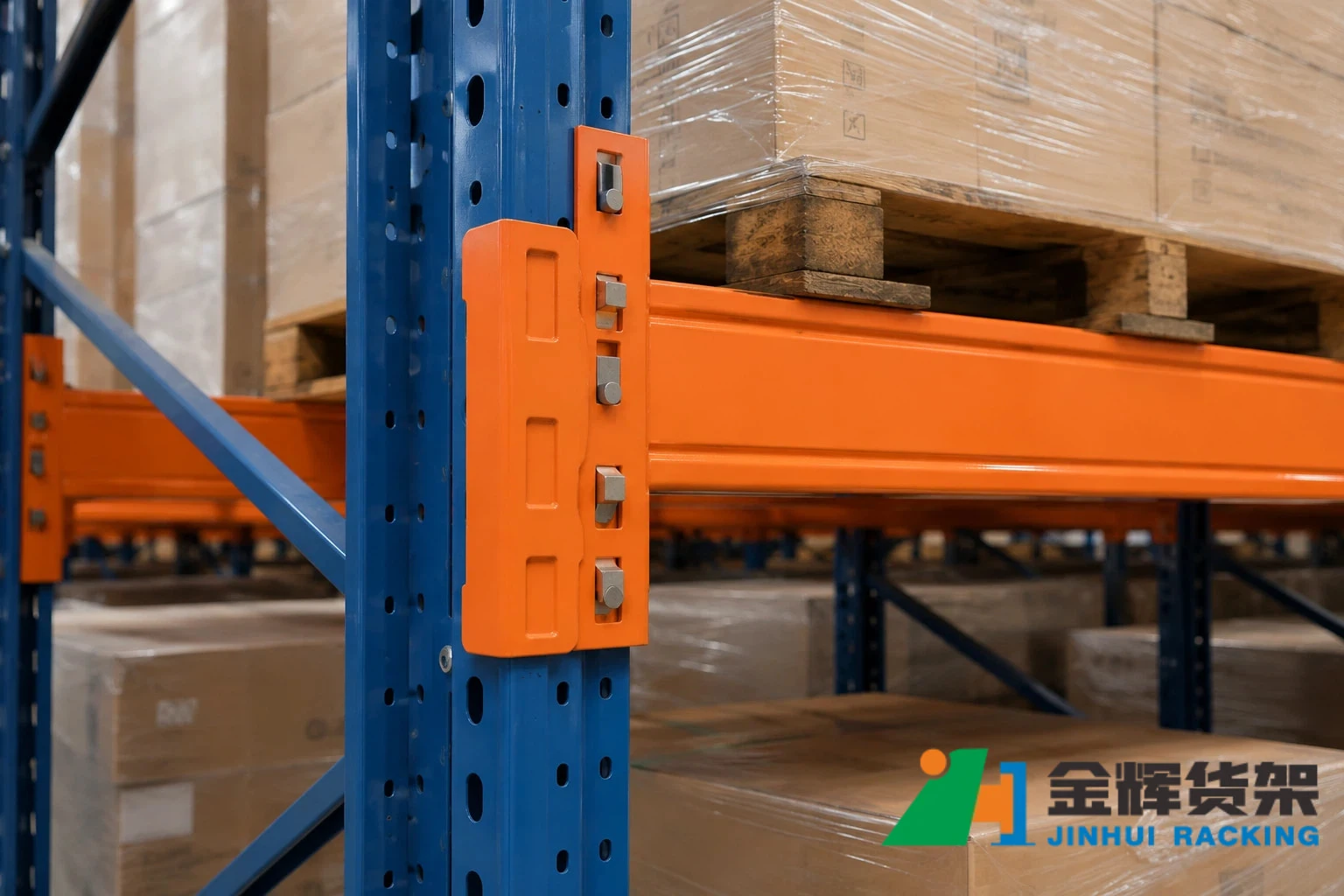
Beam connectors form the mechanical connection between horizontal pallet rack beams and upright frames.
Beam Connector Design and Load Transfer
Stored pallet loads are transferred through the rack structure rather than being carried by the beam alone.
When pallets are placed on a storage level, the load is transferred to the horizontal beams. The beams then transfer the load through their end connections into the upright frames.
This makes the beam connector an important part of the overall structural system.
The connection should therefore be designed to work with:
- Beam span
- Maximum pallet load
- Number of pallets per level
- Number of storage levels
- Upright frame dimensions
- Rack configuration
Changing the beam span or load configuration without reviewing the complete rack system can create an unsuitable combination of components.
Mechanical Locking Features
Many industrial pallet rack systems incorporate a mechanical safety locking feature at the beam-to-upright connection.
The purpose of the locking feature is to help prevent accidental beam disengagement during normal warehouse operation.
Forklift activity, pallet placement, vibration, and routine handling can expose rack components to repeated movement and impact. A properly engaged locking mechanism provides an additional level of security for the beam connection.
Warehouse operators should visually confirm that the required locking component is correctly installed whenever a beam is assembled, adjusted, or replaced.
Why Beam Connector Compatibility Matters
One of the most common mistakes in rack modification is assuming that any beam connector can fit any upright frame.
This is not necessarily true.
Rack systems can differ in:
- Upright profile
- Upright hole pattern
- Beam connector geometry
- Beam profile
- Connector thickness
- Locking mechanism
- Connection dimensions
Even if two components appear visually similar, their structural compatibility should be verified before use.
Warehouse operators replacing damaged components should therefore provide the rack manufacturer with the existing beam and upright specifications whenever possible.
Beam Connectors and Adjustable Pallet Racking
One of the major advantages of selective pallet racking is its adjustable storage configuration.
Beam levels can often be repositioned vertically to accommodate different pallet heights and inventory requirements.
This flexibility depends on the beam connection system being correctly installed at the selected upright position.
For example, a warehouse may adjust beam levels to create:
- Taller storage positions for high pallets
- Shorter positions for smaller loads
- Different storage levels for different SKU groups
- More efficient vertical space utilization
However, changing beam elevations should not be performed simply to create additional storage space. The resulting configuration should remain within the rack system's intended structural and operational limits.
Beam Connectors and Pallet Rack Load Capacity
Beam connectors are only one part of the rack's load-bearing system.
The complete rack capacity depends on multiple factors, including beam capacity, upright frame capacity, beam span, storage level arrangement, and load distribution.
For example, increasing the load stored on each pallet may require a different beam configuration. Adding another storage level may also increase the total load transferred through the upright frames.
Therefore, replacing a beam with a stronger-looking component does not automatically increase the safe capacity of the entire rack.
Warehouse operators should evaluate the complete system when changing beam sizes, pallet loads, or storage configurations.
For detailed capacity considerations, see how pallet rack load capacity is determined.
Beam Connectors and Rack Bay Width
The beam connector also works within the overall bay configuration.
The distance between upright frames determines the beam span, while the beam length and connector arrangement establish the horizontal structure of the storage bay.
When warehouse operators change bay width, they should also review:
- Beam length
- Beam capacity
- Pallet positions
- Pallet clearance
- Upright frame capacity
- Connector compatibility
This is particularly important when modifying an existing warehouse rack system.
Our guide on pallet rack bay width explains how bay dimensions influence pallet storage configuration.
Beam Connector Inspection in Warehouse Operations
Beam connectors should be included in regular pallet rack inspections.
Warehouse personnel should look for visible signs of:
- Connector deformation
- Damaged hooks or tabs
- Missing locking pins
- Loose connections
- Impact damage
- Corrosion
- Improperly seated beams
If a forklift impacts an upright frame or beam, the connector should also be inspected.
A rack may continue to appear visually usable even when a connection component has been damaged. Any significant rack damage should therefore be assessed according to the manufacturer's procedures or by a qualified rack professional.
Regular inspection helps identify damaged beam connections before they affect warehouse rack operation.
Common Beam Connector Problems
1. Missing Safety Lock
A missing or improperly engaged locking component can compromise the intended beam connection.
2. Damaged Connector
Forklift impacts or improper handling can deform connector components.
3. Incorrect Beam Installation
A beam that is not fully seated in the upright connection may not perform as intended.
4. Incompatible Replacement Components
Using a connector that does not match the rack system can create compatibility and structural concerns.
5. Unauthorized Rack Modification
Drilling, welding, cutting, or otherwise modifying rack components without engineering approval can affect the original design.
6. Ignoring Impact Damage
Forklift collisions should be treated seriously because damage to the upright, beam, connector, or base plate can affect the complete rack structure.
How to Choose the Right Pallet Rack Beam Connector
Step 1: Identify the Rack System
Confirm the manufacturer, rack series, upright profile, and beam configuration.
Step 2: Check the Upright Connection Pattern
Measure or verify the upright hole pattern and connection geometry.
Step 3: Confirm the Beam Profile
The connector must be designed for the corresponding beam profile and dimensions.
Step 4: Confirm the Locking Mechanism
Check which safety locking component is required for the rack system.
Step 5: Review Load Requirements
Confirm the intended pallet weight, beam span, and storage configuration.
Step 6: Check Component Compatibility
Do not assume that visually similar components are structurally interchangeable.
Step 7: Follow the Manufacturer's Installation Instructions
Install the connector and locking mechanism according to the approved rack assembly procedure.
Beam Connectors in Selective Pallet Racking
Selective pallet racking relies on modular beam-to-upright connections to create adjustable storage levels.
This configuration allows warehouse operators to directly access individual pallet positions while adjusting storage levels according to pallet height and inventory requirements.
Because selective pallet racking is commonly used across distribution centers, manufacturing warehouses, logistics facilities, and general industrial storage applications, reliable beam connections are an important part of the system design.
The complete rack should be configured according to pallet dimensions, load capacity, rack height, beam span, aisle requirements, and warehouse operating conditions.
Beam Connectors Should Be Considered as Part of the Complete Rack System
A common mistake is to evaluate rack components individually.
For example, a warehouse may ask for a specific beam length without providing pallet weight or rack height. Another customer may request replacement connectors without identifying the upright profile.
For reliable rack design, these details should be considered together.
| Rack Component | Main Consideration |
|---|---|
| Pallet Rack Beam | Span, load capacity, pallet positions |
| Beam Connector | Compatibility, connection geometry, locking |
| Upright Frame | Total rack height and accumulated load |
| Wire Decking | Pallet support and decking capacity |
| Base Plate | Floor connection and load transfer |
This system-based approach is more reliable than selecting individual components based only on dimensions.
Industrial Pallet Racking Solutions From Jinhui Rack
Jinhui Rack provides industrial pallet racking systems for warehouses with different pallet sizes, load requirements, storage heights, and operating conditions.
For selective storage applications, selective pallet racking provides direct access to individual pallet positions and flexible beam-level adjustment.
A complete system can be configured around the customer's required beam span, pallet positions, storage levels, rack height, and warehouse layout.
When replacement components are required, providing accurate information about the existing rack system helps ensure that beams, connectors, upright frames, and accessories are properly matched.
Final Thoughts
Pallet rack beam connectors play an important role in securing horizontal beams to upright frames and maintaining the intended structure of an industrial pallet racking system.
The connector should be compatible with the beam and upright design, properly seated, and secured with the required locking mechanism. It should also be inspected after installation and following significant forklift impacts or other rack damage.
Most importantly, beam connectors should not be considered separately from the rest of the rack. Beam length, beam capacity, upright frame capacity, pallet loads, storage levels, and warehouse operating conditions all work together to determine the performance of the complete system.
By selecting compatible components and following the rack manufacturer's installation and inspection requirements, warehouse operators can create a more reliable pallet storage system and reduce the risks associated with improper rack modifications.
Need help selecting pallet rack beams or connectors?
Send Jinhui Rack your pallet dimensions, maximum pallet weight, beam length, rack height, upright specifications, and required pallet positions. Our team can help determine a suitable pallet racking configuration and compatible components for your warehouse.
Talk to Jinhui Rack
Share your pallet size, load capacity, warehouse dimensions, and storage requirements with our team for a pallet racking solution designed around your actual operating conditions.
WhatsApp: +86 185 0252 7163
Email: info@jhrack.com