Pallet Rack Quotation Checklist: What Information Should You Give a Supplier?
When requesting a pallet rack quotation, providing complete warehouse and storage information helps the supplier develop a more accurate rack configuration and commercial proposal. The more clearly the storage requirements are defined, the easier it is to select the appropriate rack dimensions, components, load capacity, and layout.
For a professional pallet racking project, a supplier normally needs more than a simple request such as "heavy duty pallet racks for 1,000 kg pallets." Pallet dimensions, maximum load, storage levels, rack height, warehouse dimensions, forklift type, and required pallet positions can all affect the final design and quotation.
This pallet rack quotation checklist explains the key information warehouse managers, importers, distributors, and project buyers should prepare before contacting a pallet rack manufacturer.
Why Complete Information Matters When Requesting a Pallet Rack Quotation
A pallet rack quotation is based on the proposed rack configuration, not simply on the amount of steel used to manufacture the rack.
For example, changing the pallet width may affect beam length. Changing pallet height may affect storage-level spacing. Increasing rack height can affect upright frame requirements, while changing the number of pallets per bay can affect beam configuration.
Providing complete information at the quotation stage can help reduce:
- Repeated technical questions.
- Incorrect rack dimensions.
- Unnecessary quotation revisions.
- Misunderstandings about storage capacity.
- Delays during engineering and production.
A clear specification also allows different suppliers to quote against more consistent project requirements.
1. Pallet Dimensions
Pallet dimensions are among the first specifications a rack supplier should receive.
Provide the actual pallet:
- Length.
- Width.
- Overall loaded height.
- Maximum loaded weight.
If multiple pallet sizes will be stored, provide the dimensions of each pallet type and indicate which pallet size is the most common.
Do not provide only the pallet footprint if the loaded pallet height varies significantly. Product height can affect the vertical spacing between rack levels and the total rack height.
2. Maximum Pallet Weight
The supplier should know the maximum expected weight of a loaded pallet, not only the average pallet weight.
For example, if most pallets weigh 800 kg but some pallets can reach 1,200 kg, the rack design should account for the maximum expected loading condition.
Useful information includes:
- Average pallet weight.
- Maximum pallet weight.
- Number of heavy pallets.
- Whether pallet weights vary by SKU.
This information helps the supplier evaluate the appropriate beam and upright configuration for the project.
3. Number of Pallets Per Rack Bay
Tell the supplier how many pallets you want to store across each rack bay.
Common configurations may include:
- Two pallets per beam level.
- Three pallets per beam level.
- Customized pallet positions based on pallet dimensions.
The number of pallets per level affects the required beam length and the load distribution across the rack system.
Do not assume that a longer beam can automatically accommodate more pallets. The beam length, pallet dimensions, load requirements, and rack configuration need to be considered together.
4. Required Number of Storage Levels
Tell the supplier how many pallet storage levels you require, including the floor storage position if applicable.
For example, a project may require:
- Three storage levels.
- Four storage levels.
- Five storage levels.
- A customized number of levels based on warehouse height.
The required number of levels helps determine the overall rack configuration and vertical load distribution.
5. Required Rack Height
Provide the available warehouse clear height and, if known, the target rack height.
Important information includes:
- Warehouse clear height.
- Maximum practical rack height.
- Required storage level elevations.
- Obstructions above the rack.
- Ceiling and fire protection conditions.
The rack should not simply be made as high as the warehouse ceiling allows. The design must also consider forklift capability, pallet height, safety clearances, fire protection requirements, and the actual operating environment.
6. Required Rack Depth
Rack depth should be selected according to the pallet dimensions and the required pallet support arrangement.
When requesting a quotation, provide:
- Pallet depth.
- Expected pallet overhang or underhang requirements.
- Number of pallets stored in depth where applicable.
- Special pallet support requirements.
The rack depth should provide appropriate pallet support without unnecessarily consuming warehouse space.
7. Warehouse Dimensions

A supplier needs enough warehouse information to understand how the rack system will fit into the building.
Provide, where available:
- Warehouse length.
- Warehouse width.
- Clear height.
- Column positions.
- Door locations.
- Loading and unloading areas.
- Existing equipment.
- Walls and other permanent obstructions.
A warehouse drawing or CAD layout is especially useful for larger projects because it allows the supplier to evaluate rack rows, aisles, access routes, and available storage areas.
8. Building Column Locations
Building columns can significantly affect pallet rack layout.
If columns are located inside the proposed storage area, provide their:
- Position.
- Width.
- Depth.
- Distance from walls.
- Distance from doors and other fixed structures.
Accurate column information helps the supplier design rack rows around existing building structures rather than discovering conflicts after installation begins.
9. Forklift Type
Forklift information is essential because the rack layout and aisle arrangement need to match the equipment used for pallet handling.
Provide:
- Forklift type.
- Forklift model where available.
- Maximum lifting height.
- Load capacity.
- Required operating aisle width.
For example, a counterbalance forklift and a reach truck may require different aisle arrangements.
The rack supplier can use this information when planning the relationship between rack rows, working aisles, and pallet handling areas.
10. Required Aisle Width
If your warehouse already has a defined forklift aisle requirement, provide it to the supplier.
If you are not sure what aisle width is appropriate, provide the forklift information instead and ask the supplier to recommend a practical layout based on the equipment and operating conditions.
Aisle width should balance:
- Forklift maneuverability.
- Operator safety.
- Storage density.
- Pallet accessibility.
- Warehouse traffic flow.
11. Required Number of Pallet Positions
Tell the supplier how many pallet positions you need to achieve.
For example:
| Project Requirement | Example Information |
|---|---|
| Total pallet positions | 1,200 pallet positions |
| Pallets per bay | 3 pallets per level |
| Storage levels | 4 levels |
| Maximum pallet weight | 1,000 kg |
| Pallet size | 1,200 × 1,000 mm |
Providing the target number of pallet positions gives the supplier a clear starting point for rack quantity and layout planning.
12. Inventory and SKU Information
Storage requirements are not determined only by pallet weight.
The supplier should also understand how inventory is managed.
Useful information includes:
- Number of SKUs.
- Average pallets per SKU.
- Inventory turnover.
- Fast-moving and slow-moving products.
- FIFO or LIFO requirements.
- Requirement for direct pallet access.
A warehouse with hundreds of different SKUs may have very different rack requirements from a warehouse storing large quantities of only a few products.
13. Storage Method and Rack Type
If you already know which rack system you want, include it in the quotation request.
If you are not sure, explain the operational requirement instead.
| Storage Requirement | Potential Rack System |
|---|---|
| Direct access to individual pallets | Selective Pallet Racking |
| High-density storage with similar products | Drive-In Pallet Racking |
| Multiple pallets per lane with one-sided access | Push Back Racking |
| FIFO pallet rotation | Pallet Flow Racking |
For flexible individual pallet access, JINHUI provides Selective Pallet Racking Systems configured according to pallet dimensions, load requirements, storage levels, and warehouse conditions.
14. Floor Conditions
The warehouse floor is part of the rack installation environment and should not be overlooked during quotation planning.
Provide information about:
- Concrete floor condition.
- Floor thickness if known.
- Uneven floor areas.
- Existing floor damage.
- Known floor loading limitations.
For larger or specialized projects, the supplier may require additional information before finalizing the anchoring and installation approach.
15. Seismic and Local Site Requirements
If the warehouse is located in an area with specific seismic or structural requirements, tell the supplier before the rack design is finalized.
Other site-specific requirements may include:
- Local building regulations.
- Fire protection requirements.
- Seismic design conditions.
- Special operating environments.
- Temperature-controlled storage.
- Corrosive or humid environments.
These conditions can affect rack specifications and should be communicated at the beginning of the project.
16. Rack Protection Requirements
If forklifts operate close to rack uprights, consider whether rack protection components are required.
Potential protection requirements include:
- Upright protectors.
- End-of-aisle protection.
- Guard rails.
- Post protectors.
- Other impact protection systems.
Including protection requirements in the initial quotation can provide a more complete project cost instead of adding these components later.
17. Future Storage Requirements
Tell the supplier if you expect the warehouse to expand or if pallet loads may increase in the future.
Future planning information may include:
- Expected inventory growth.
- Future additional pallet positions.
- Potential changes in pallet dimensions.
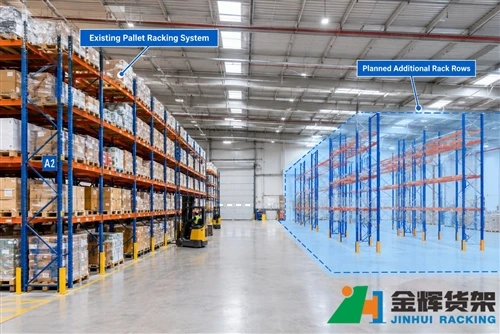
- Future rack expansion.
- Possible changes in forklift equipment.
JINHUI's Industrial Heavy Duty Pallet Racks can be configured with customized rack height, depth, beam length, and storage requirements for different warehouse applications.
What Should Be Included in a Pallet Rack Quotation Request?
A practical quotation request should give the supplier enough information to understand both the storage requirements and the warehouse environment.
| Information | What to Provide |
|---|---|
| Pallet size | Length × width × loaded height |
| Maximum pallet weight | Maximum loaded pallet weight |
| Pallet positions | Total required storage positions |
| Pallets per bay | Required pallet positions per level |
| Storage levels | Number of required levels |
| Rack height | Required or maximum available height |
| Rack depth | Required frame depth |
| Warehouse size | Length, width, and clear height |
| Forklift | Type, model, lifting height, and capacity |
| Aisle | Existing or required aisle width |
| Building columns | Locations and dimensions |
| Floor | Condition and known limitations |
| Future requirements | Expected expansion or load changes |
What If You Do Not Know All the Specifications?
You do not necessarily need to have every engineering detail prepared before contacting a rack supplier.
If some information is unavailable, provide the information you do know and explain the project objective.
For example, you can provide:
- Warehouse dimensions.
- Pallet dimensions.
- Maximum pallet weight.
- Required pallet quantity.
- Forklift type.
- Warehouse photos.
- Existing warehouse drawings.
A professional supplier can then identify the missing information and work with you to develop the appropriate rack configuration.
How to Make a Pallet Rack Quotation Easier to Compare
When requesting quotations from multiple suppliers, try to provide the same project information to each company.
This makes it easier to compare:
- Rack dimensions.
- Storage capacity.
- Material specifications.
- Load requirements.
- Protection components.
- Installation scope.
- Delivery terms.
Do not compare quotations based only on total price. A lower price may reflect a different rack configuration, material specification, storage capacity, or project scope.
Final Pallet Rack Quotation Checklist
Before sending your quotation request, check whether you have the following information available:
- ☐ Pallet length and width.
- ☐ Loaded pallet height.
- ☐ Maximum pallet weight.
- ☐ Required pallet positions.
- ☐ Pallets per bay.
- ☐ Number of storage levels.
- ☐ Required rack height.
- ☐ Required rack depth.
- ☐ Warehouse length and width.
- ☐ Warehouse clear height.
- ☐ Building column locations.
- ☐ Forklift type and lifting height.
- ☐ Required aisle width.
- ☐ Floor conditions.
- ☐ Fire protection requirements where applicable.
- ☐ Rack protection requirements.
- ☐ Future expansion requirements.
FAQ About Pallet Rack Quotations
What information does a pallet rack supplier need for a quotation?
The supplier normally needs pallet dimensions, maximum pallet weight, required pallet positions, storage levels, rack height and depth, warehouse dimensions, forklift information, aisle requirements, and other site conditions.
Do I need a warehouse drawing to get a pallet rack quotation?
A drawing is not always mandatory for an initial quotation, but it can significantly improve the accuracy of layout planning for larger projects.
Should I provide the maximum or average pallet weight?
Provide the maximum expected pallet weight. If pallet weights vary significantly, explain the weight range and identify the heaviest loading condition.
Can a supplier recommend the right pallet rack type?
Yes. If you are unsure whether selective, drive-in, push back, or another rack system is appropriate, provide your inventory characteristics, pallet information, accessibility requirements, and warehouse conditions.
Can pallet rack dimensions be customized?
Yes. Industrial pallet rack dimensions can be customized according to pallet size, storage requirements, warehouse dimensions, forklift operation, and the selected rack configuration.
Why does forklift information matter when requesting a quotation?
Forklift type and lifting capability affect aisle planning, storage height, pallet handling, and the practical operation of the rack system.
Final Thoughts
A good pallet rack quotation starts with accurate project information.
Before contacting a supplier, prepare your pallet dimensions, maximum load, required pallet positions, storage levels, warehouse dimensions, forklift information, and future storage requirements. These details give the supplier a much clearer understanding of what the warehouse actually needs.
The goal should not be to find the cheapest rack quotation. The goal is to obtain a rack system that matches the actual pallet loads, warehouse layout, operating equipment, storage density, and long-term requirements.
JINHUI provides customized warehouse pallet racking solutions for different pallet sizes, load requirements, storage configurations, and warehouse conditions.
Ready to request a pallet rack quotation?
Send your pallet dimensions, maximum pallet weight, required pallet positions, warehouse dimensions, rack height, and forklift information to JINHUI. Our team can help evaluate the requirements and develop a suitable pallet racking configuration.
WhatsApp: +86 185 0252 7163
Email: info@jhrack.com
Website: https://www.jinhui-rack.com/