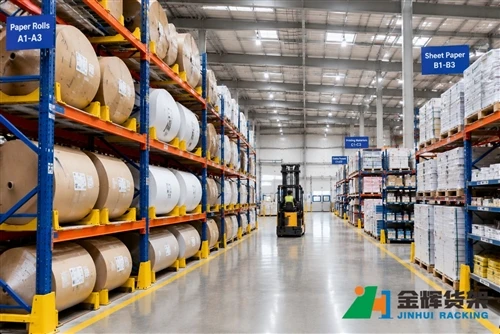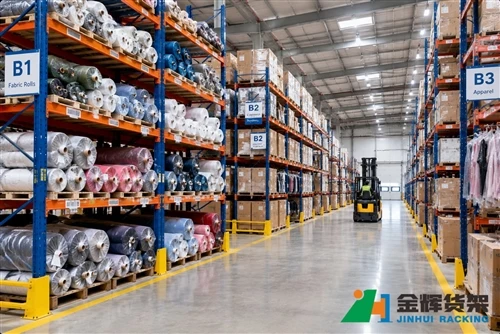
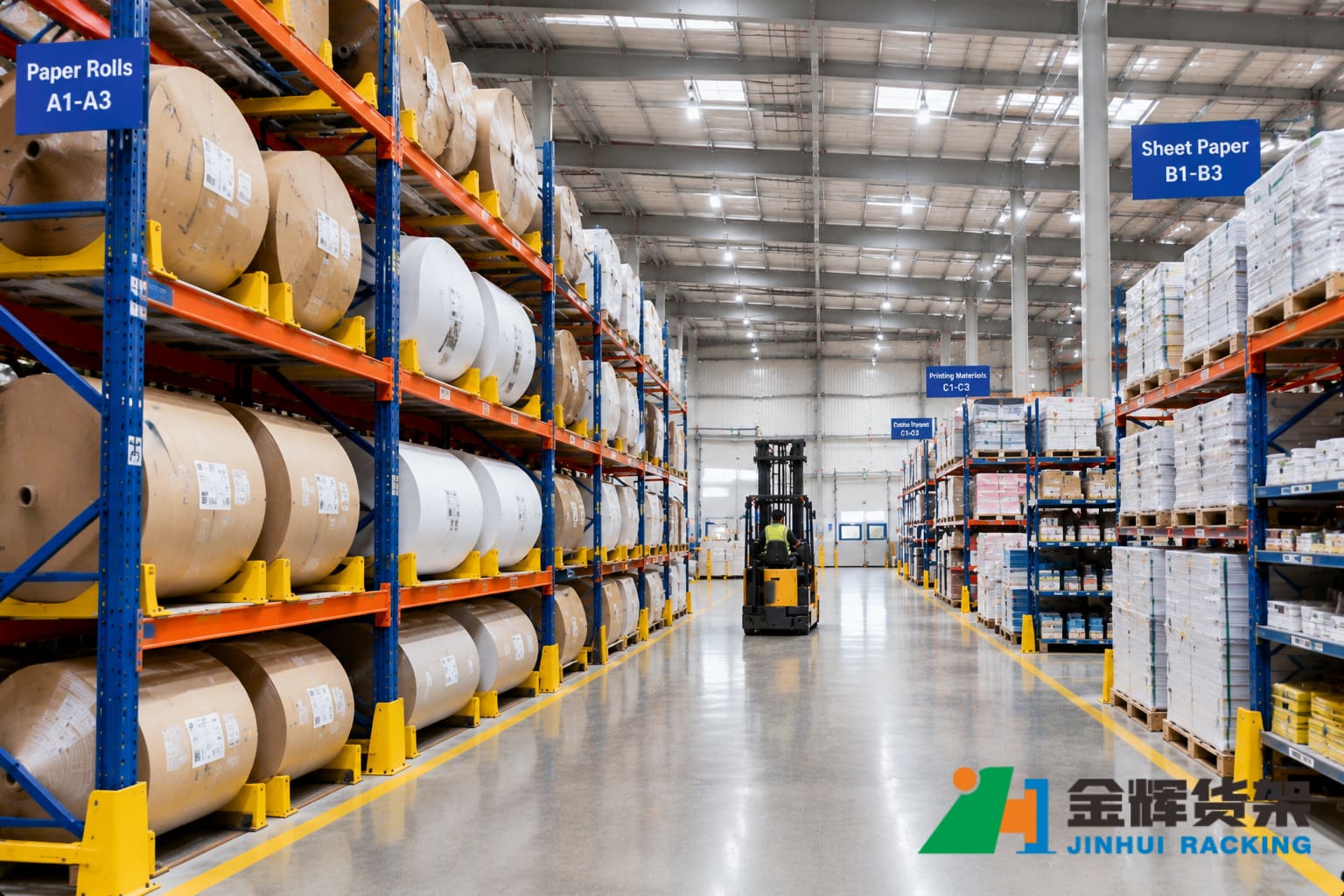
Paper distribution centers and printing material warehouses often handle products with very different dimensions, weights, and storage requirements. Large paper rolls, palletized sheet paper, printing boards, packaging paper, and smaller printing supplies may all move through the same facility. Although these products belong to the same general industry, they cannot always be stored using the same arrangement.
Paper rolls require stable support and suitable protection against movement, while sheet paper is often stored in palletized stacks or flat packages. Printing materials may also vary in weight, format, grade, and order frequency. A practical warehouse racking plan should therefore consider product shape, load characteristics, packaging, handling equipment, and inventory turnover.
1. Understand the Storage Requirements of Paper Products
Paper warehouses handle both cylindrical and flat products. Their different shapes and packaging methods influence how they should be supported, stored, and retrieved.
Before selecting a storage system, classify inventory according to product dimensions, weight, packaging, storage orientation, and handling frequency.
- Large paper rolls: Heavy cylindrical products that require suitable cradles, supports, or purpose-designed storage arrangements to prevent rolling and movement.
- Printing paper rolls: Different paper grades, widths, diameters, and core sizes may require separate identification and storage positions.
- Sheet paper: Flat paper stacks are commonly packaged on pallets or in protective wrapping. Storage positions must accommodate the complete pallet load.
- Printing boards and cardboard sheets: These products may have large dimensions and require adequate support to prevent bending or edge damage.
- Packaging paper: Paper used for wrapping, cartons, and industrial packaging may have different roll sizes and stock turnover rates.
- Printing supplies: Smaller consumables and accessories may be better suited to shelving or bin-based storage.
This classification helps determine which products can share a storage zone and which require a dedicated storage method.
2. Divide the Paper Warehouse into Functional Storage Zones
A paper warehouse can become difficult to manage when large rolls, palletized sheets, and small printing supplies are placed together without a clear location strategy. Dividing the facility into functional zones helps organize inventory and reduce unnecessary movement.
| Warehouse Zone | Typical Products | Main Planning Consideration |
|---|---|---|
| Receiving and inspection | Incoming paper rolls, sheet paper, and printing materials. | Allow space for checking quantities, packaging condition, and product specifications. |
| Paper roll storage | Large paper reels and printing paper rolls. | Provide suitable supports and prevent unintended rolling or movement. |
| Palletized sheet storage | Stacks of printing paper, coated paper, and paperboard. | Match rack dimensions to pallet size, load weight, and package stability. |
| Oversized paper storage | Large-format sheets, boards, and non-standard packages. | Allow sufficient support and clearance for the complete product dimensions. |
| Printing supplies | Smaller consumables, accessories, and packaged materials. | Use clear SKU identification and convenient picking locations. |
| Order consolidation and dispatch | Prepared paper orders and completed shipments. | Provide suitable staging areas without obstructing storage and handling routes. |
The size of each zone should reflect actual inventory quantities and order patterns. A facility handling mostly large paper reels will need a different layout from a distributor focused on palletized printing paper.
3. Plan Suitable Storage for Large Paper Rolls
Large paper rolls are among the most challenging products to organize in a paper warehouse. Their cylindrical shape makes them different from conventional palletized cartons. If they are not properly supported, rolls may move, shift, or become damaged during storage and handling.
The appropriate storage method depends on roll diameter, width, weight, core construction, packaging, and the equipment used to handle the rolls.
Check Roll Dimensions and Weight
Before designing a roll storage area, record the main dimensions of the products, including:
- Roll diameter and overall width.
- Core diameter and core construction.
- Individual roll weight.
- Packaging and protective wrapping.
- Required storage orientation.
- Handling equipment and attachment specifications.
Different paper grades and production specifications may produce rolls with significantly different dimensions. Storage positions should be planned around the actual product range rather than one average roll size.
Use Appropriate Roll Supports
Paper rolls need a storage arrangement that controls their position and provides suitable support. Dedicated cradles, saddles, or other purpose-designed supports may be used depending on the roll characteristics and handling method.
The support arrangement should prevent unintended movement and distribute the load appropriately. It should also allow operators to retrieve individual rolls without disturbing adjacent inventory.
Do not assume that ordinary pallet rack beams alone provide sufficient support for loose cylindrical rolls. Any rack-mounted roll storage arrangement should be designed or verified for the intended roll dimensions, weight, loading direction, and handling process.
Consider Cantilever Racking for Suitable Paper Products
Cantilever racking systems are commonly used for long and bulky materials that need open-front access. Depending on the product configuration and engineered design, cantilever systems may be considered for certain paper products, especially long-format materials or compatible packaged loads.
However, cantilever arms should not automatically be treated as suitable supports for every cylindrical paper roll. The actual support geometry, load stability, arm capacity, and roll-handling method must be evaluated before selecting the system.
4. Organize Palletized Sheet Paper with Selective Pallet Racking
Sheet paper is often supplied in flat stacks protected by wrapping, corner protection, or other packaging. When these products are palletized in compatible configurations, selective pallet racking can provide direct access to individual loads.
This is useful for warehouses handling multiple paper grades, sheet sizes, thicknesses, and customer specifications. Each pallet position can be assigned to a particular product or SKU group.
Measure the Complete Pallet Load
Rack planning should use the dimensions and weight of the complete palletized load rather than the paper stack alone. Record pallet length, width, overall height, total weight, and the way the load is supported.
Paper stacks can be heavy, and their load distribution may vary according to the sheet format and packaging. The pallet must provide suitable support, and the rack configuration must be specified for the actual load.
Maintain Stable Sheet Paper Loads
Paper stacks should remain stable during storage and retrieval. Packaging should protect the edges and surfaces from damage, while the pallet arrangement should prevent the load from shifting during forklift movement.
Where different sheet formats are stored in the same rack area, clearly distinguish their storage positions. Similar-looking paper packages may have different grades, weights, or dimensions.
Use Selective Access for Mixed Paper Inventory
JINHUI RACK selective pallet racking systems may be suitable for compatible palletized paper products where direct access to different SKUs is important.
Selective access can help distributors retrieve specific paper grades or sheet sizes without moving other pallets. This can be useful when the warehouse handles many product specifications and relatively small quantities of each item.
5. Store Oversized Paper Sheets and Printing Boards
Large-format paper sheets, paperboard, and printing boards may require more space than standard palletized products. Their dimensions and stiffness influence how they should be supported during storage.
Important planning considerations include:
- Sheet dimensions: Measure the complete length and width of the package.
- Stack height: Check the permitted stacking arrangement and packaging limits.
- Support distribution: Provide appropriate support to reduce bending or deformation.
- Edge protection: Prevent damage to exposed corners and sheet edges.
- Handling access: Confirm that forklifts or other equipment can retrieve the packages without contacting nearby inventory.
- Product separation: Keep different paper grades and sheet formats clearly identified.
For non-standard packages, the storage system may need customized dimensions or additional support components. The final arrangement should be checked against the actual product loads and handling requirements.
6. Protect Paper Products from Moisture, Dust, and Physical Damage
Paper products can be affected by moisture, dust, compression, and rough handling. Damaged packaging may expose paper to environmental conditions that affect its quality and suitability for printing or further processing.
Storage planning should therefore consider both the racking arrangement and the warehouse environment.
- Control moisture exposure: Keep paper products protected from roof leaks, water ingress, and unsuitable storage conditions.
- Maintain packaging: Preserve protective wrapping where it is required to protect the paper surface and edges.
- Avoid excessive compression: Follow packaging and stacking instructions for the stored product.
- Prevent impact damage: Keep loads within their designated storage positions and avoid contact with rack structures.
- Keep storage areas clean: Manage dust and debris that may affect exposed paper products.
- Separate damaged inventory: Inspect damaged packages and prevent unverified products from returning to available stock.
- Follow product requirements: Apply the manufacturer's recommended storage and handling conditions.
Paper storage requirements may vary by grade, coating, packaging, and intended use. Follow supplier guidance rather than assuming that all paper products can be stored under identical environmental conditions.
7. Match Handling Equipment to Paper Roll and Sheet Storage
Paper warehouses may use conventional forklifts, roll clamps, specialized roll-handling attachments, or other material-handling equipment. The equipment must be compatible with the product and storage arrangement.
Large paper rolls may need a different handling method from palletized sheet paper. Using an unsuitable attachment can damage the roll surface, deform the core, or affect load stability.
Before finalizing the layout, review the following factors:
- Equipment type: Identify the forklifts and specialized attachments used for each product category.
- Load capacity: Confirm that equipment capacity is suitable for the complete load at the required lifting height.
- Roll dimensions: Check whether the equipment can handle the largest roll diameter and width.
- Turning clearance: Allow enough room for equipment to maneuver with the intended load.
- Storage access: Ensure that rolls and pallets can be placed and retrieved without disturbing neighboring products.
- Operator procedures: Establish suitable handling instructions for different paper products.
Rack layout, handling equipment, and product packaging should be planned together. A storage arrangement that appears suitable on a drawing may not work efficiently if the equipment cannot approach or retrieve the load safely.
8. Organize Paper Grades, Sizes, and Inventory Locations
Paper warehouses may store many products that look similar but have different specifications. Paper grade, grammage, coating, roll width, diameter, sheet dimensions, and customer requirements can all affect product identification.
A clear location management process helps reduce the risk of picking the wrong material.
Establish Consistent SKU Identification
Each product should have a clear identification record. Depending on the operation, this may include paper grade, product dimensions, weight, batch or production reference, and supplier information.
Keep the physical product label consistent with the warehouse inventory record. Where barcode scanning is used, ensure that labels remain visible and readable during storage and picking.
Assign Locations by Product Characteristics
Separate paper rolls, sheet paper, oversized boards, and printing supplies into suitable storage areas. Within each zone, assign locations based on product dimensions, handling needs, and inventory movement.
Frequently dispatched products may be assigned to convenient locations where this supports the overall workflow. Slower-moving stock can occupy other suitable positions, provided that its storage conditions and access requirements remain appropriate.
Track Roll and Sheet Movements
Paper products may be received in large quantities and dispatched in smaller orders. Record each movement from receiving and put-away through picking and dispatch.
Where a warehouse management system is used, connect each rack location with the correct SKU and stock information. This helps staff identify the right product and quantity before moving the load.
9. Plan Forklift Aisles and Material Flow
Large paper rolls and wide sheet-paper pallets can occupy considerable space during handling. The warehouse layout should allow equipment to move and turn with the complete load while maintaining clear access to storage positions.
Consider the following points when planning the warehouse:
- Forklift aisle dimensions: Determine aisle requirements using the actual equipment, attachments, and load dimensions.
- Receiving space: Provide sufficient room to inspect and identify incoming paper products.
- Roll handling routes: Avoid unnecessary movement through areas where fragile or smaller products are being picked.
- Dispatch staging: Provide designated areas for preparing outbound rolls and sheet-paper orders.
- Pedestrian routes: Keep pedestrian access clearly defined and separate where required.
- Emergency access: Keep required exits, access routes, and safety equipment unobstructed.
Aisle dimensions should be determined according to the actual handling equipment, building layout, product loads, and applicable safety requirements. They should not be reduced simply to create additional rack positions.
10. Common Paper Warehouse Storage Mistakes
| Common Mistake | Potential Impact | Better Practice |
|---|---|---|
| Storing loose paper rolls without suitable support | Rolls may move or become unstable. | Use suitable cradles, supports, or purpose-designed storage arrangements. |
| Using ordinary pallet rack beams as roll cradles without assessment | The load may not be adequately supported or restrained. | Verify the support geometry and complete rack configuration for the intended rolls. |
| Ignoring palletized sheet dimensions | Loads may not fit the planned rack positions. | Measure complete pallet loads before setting rack dimensions. |
| Mixing paper grades without clear identification | Picking errors and inventory discrepancies may increase. | Use distinct SKUs, labels, and location records. |
| Ignoring moisture protection | Paper packaging and product quality may be affected. | Maintain suitable building conditions and protect products according to supplier guidance. |
| Using unsuitable handling attachments | Roll surfaces, cores, or packaging may be damaged. | Match handling equipment to the roll or pallet configuration. |
| Planning aisles without considering load dimensions | Equipment may have difficulty maneuvering or retrieving products. | Check the complete load and equipment turning requirements. |
11. What to Prepare Before Selecting a Paper Warehouse Racking System
Before requesting a storage proposal, prepare information about the paper products, handling equipment, building, and warehouse workflow. These details help determine whether the facility needs roll storage, pallet racking, cantilever systems, or a combination of configurations.
- Paper roll specifications: Provide roll diameter, width, weight, core size, and required storage orientation.
- Sheet paper specifications: Record sheet dimensions, pallet dimensions, stack height, and total load weight.
- Packaging information: Identify protective wrapping, pallet condition, stacking limits, and special handling instructions.
- Inventory profile: Estimate the number of paper grades, roll sizes, sheet formats, and printing material SKUs.
- Storage quantities: Identify current stock levels, reserve inventory, and expected seasonal changes.
- Handling equipment: Specify forklift types, roll clamps, attachments, rated capacities, and lifting heights.
- Building information: Provide usable floor dimensions, clear height, columns, doors, and other obstructions.
- Workflow requirements: Describe receiving, storage, replenishment, picking, and dispatch procedures.
Use these details to compare storage capacity, product accessibility, load support, and handling efficiency. The final design should be checked against the actual product characteristics and the intended operating conditions.
For suitable palletized paper products, review JINHUI RACK selective pallet racking systems. For long or bulky materials that are compatible with the system design, explore cantilever racking systems.
Frequently Asked Questions
What type of racking is suitable for paper roll storage?
The appropriate storage method depends on roll diameter, width, weight, core construction, and handling equipment. Dedicated cradles or purpose-designed supports may be required to prevent rolling and provide stable support. The final arrangement should be verified for the intended loads.
Can paper rolls be stored on ordinary pallet racking?
Not automatically. Cylindrical rolls need suitable support and restraint. Standard pallet rack beams alone should not be assumed to provide an appropriate cradle. A rack-mounted roll storage arrangement must be evaluated according to the roll dimensions, load, support geometry, and handling method.
Can sheet paper be stored on selective pallet racking?
Compatible palletized sheet paper may be stored on selective pallet racking when the pallet dimensions, load weight, packaging, and rack configuration are suitable. The complete load must remain stable and properly supported.
How can a paper warehouse prevent product damage?
Use suitable packaging and support arrangements, protect paper from moisture and excessive dust, follow stacking instructions, and use compatible handling equipment. Rolls and palletized sheets should be moved according to their specific handling requirements.
Should paper rolls and sheet paper share the same storage area?
They may be located within the same warehouse, but their storage arrangements should reflect their different physical characteristics. Dedicated roll storage and palletized sheet storage zones can help prevent unsuitable handling and improve product identification.
Conclusion
Warehouse racking for paper rolls and printing materials requires careful consideration of product shape, load weight, packaging, storage orientation, and handling equipment. Large cylindrical rolls need suitable support and restraint, while palletized sheet paper and printing boards require stable load arrangements and accessible storage positions.
By separating product categories, assigning clear storage locations, protecting paper from environmental and physical damage, and matching the racking configuration to actual loads, paper distributors and printing material warehouses can create a more organized storage operation.
The most suitable solution should be based on the complete inventory profile and warehouse workflow rather than storage density alone. Proper planning helps improve product protection, inventory accuracy, and daily material handling.
Contact JINHUI RACK
Planning a paper roll warehouse or reorganizing storage for sheet paper and printing materials? Contact JINHUI RACK to discuss your product dimensions, load requirements, handling equipment, and warehouse layout.
Email: info@jhrack.com
WhatsApp: +86 185 0252 7163
Product page: Selective Pallet Racking Systems