Warehouse Racking for Electronics Distribution Centers: Organizing Components, Finished Devices, and Secure Inventory
Electronics distribution centers handle a wide range of products, from small electronic components and accessories to boxed computers, communication equipment, household devices, and finished electronic products. These items often differ significantly in size, weight, packaging strength, storage conditions, inventory value, and order frequency.
Some products are stored in small cartons or component boxes, while others arrive on pallets or in large protective cases. High-value products may also require controlled access, careful handling, and accurate inventory records. Without a suitable storage arrangement, electronics warehouses can experience inefficient picking, packaging damage, misplaced stock, and unnecessary handling.
A well-planned warehouse racking system helps distribution centers organize different product categories, use vertical storage space, and maintain accessible inventory locations. The most suitable configuration depends on product dimensions, pallet specifications, inventory turnover, handling equipment, and warehouse operating procedures.

1. Why Electronics Distribution Centers Need a Structured Storage System
Electronics warehouses have different storage requirements from facilities that handle a limited range of uniform palletized products. A single distribution center may store thousands of SKUs, including small accessories, circuit boards, cables, monitors, printers, computers, and packaged electronic devices.
Several operating characteristics influence warehouse storage planning:
- Wide product size variations: Small component cartons and large equipment packages require different storage dimensions and picking methods.
- High SKU variety: Similar-looking products may have different models, specifications, or part numbers, making accurate location management important.
- Different inventory turnover rates: Frequently ordered accessories may need convenient picking locations, while slower-moving products can be stored in reserve areas.
- Fragile packaging: Some electronic products require stable support and careful pallet handling to reduce the risk of packaging damage.
- High inventory value: Selected product categories may need restricted access and additional inventory control procedures.
- Changing product ranges: New models, product launches, and changing demand can affect storage allocation over time.
These factors mean that warehouse storage should be planned around actual inventory characteristics and daily operating processes rather than simply maximizing the number of pallet positions.
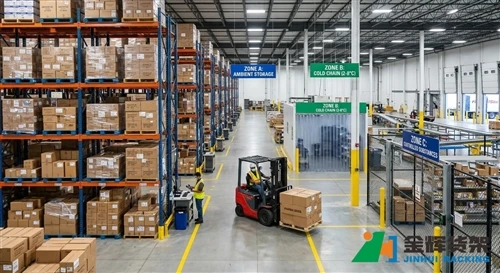
2. Divide the Electronics Warehouse into Functional Storage Zones
A practical electronics distribution center should separate different activities and product categories where the building layout and operating requirements allow. Clear zoning helps employees identify inventory locations and reduces unnecessary movement between receiving, storage, picking, and dispatch operations.
| Warehouse Zone | Main Function | Storage Consideration |
|---|---|---|
| Receiving and inspection | Check incoming products, quantities, and packaging condition | Provide temporary staging space outside main forklift aisles. |
| Small-component storage | Store accessories, electronic parts, and small cartons | Use shelving or compartmentalized storage suited to carton dimensions and picking frequency. |
| Reserve pallet storage | Hold bulk inventory and replenishment stock | Use pallet racking designed for the actual pallet size and load characteristics. |
| Finished-product storage | Store boxed computers, monitors, printers, and other devices | Provide stable pallet support and suitable handling clearances. |
| High-value inventory area | Manage products requiring additional access control | Combine suitable physical storage arrangements with warehouse security procedures. |
| Order picking and packing | Prepare products for customer orders | Keep frequently picked items accessible and provide sufficient working space. |
| Returns and inspection | Handle returned, damaged, or unverified products | Keep unverified stock separate from available inventory. |
The exact number and size of storage zones should be based on inventory volume, order profiles, warehouse dimensions, and the required movement of goods. Avoid placing temporary staging pallets in designated forklift aisles or emergency access routes.
3. Select Suitable Racking Systems for Different Electronics Products
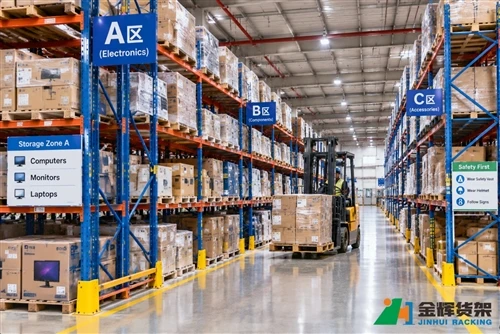
Not every electronics product should be stored in the same type of rack. A combination of pallet racking and smaller-item storage can often provide a more practical solution for distribution centers handling mixed inventory.
Selective Pallet Racking for Boxed Electronics
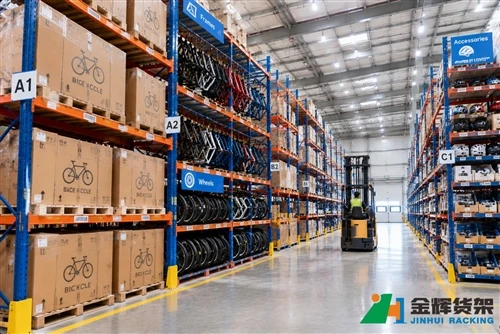
Selective pallet racking provides direct access to individual pallet positions. It is useful for warehouses with many product models, different SKUs, and frequent stock rotation.
Typical applications include:
- Palletized computers and monitors.
- Boxed printers and office equipment.
- Packaged household electronic devices.
- Bulk cartons of electronic accessories.
- Reserve inventory awaiting order picking or replenishment.
Because each pallet position can be accessed independently, selective racking supports flexible inventory organization. Beam levels can be configured according to pallet dimensions and the required storage height, subject to the approved rack design and load capacities.
For electronics distribution centers with a wide product range, this accessibility can be more valuable than achieving the highest possible storage density.
Shelving for Small Electronic Components
Small electronic parts, connectors, adapters, cables, and accessories are often easier to manage in shelving systems than in pallet positions.
Shelving can provide accessible locations for cartons, bins, and compartmentalized containers. It is particularly useful when employees pick individual items or small quantities instead of complete pallets.
When planning shelving areas, consider:
- Container and carton dimensions.
- Product weight and shelf load capacity.
- Picking frequency and employee access.
- Location labels and SKU identification.
- Space for replenishment and inventory counting.
Frequently picked components should be placed in convenient locations based on the picking method and ergonomic requirements. Heavier cartons should be positioned according to safe manual-handling practices and the shelving system's rated capacity.
High-Density Pallet Racking for Suitable Reserve Inventory
Some electronics distributors hold larger quantities of the same product or maintain reserve stock that does not require immediate individual pallet access. In these situations, high-density storage systems may help improve space utilization.
Drive-in racking or radio shuttle racking can be considered when inventory characteristics, pallet consistency, stock rotation requirements, and handling processes are suitable.
These systems are not automatically appropriate for every electronics warehouse. Their suitability depends on SKU distribution, the number of pallets per SKU, required selectivity, and the operating method. A warehouse with many different models and frequent access requirements may benefit more from selective pallet racking.
4. Organize Inventory by Product Category, SKU, and Picking Frequency
Electronics distribution centers often store products with similar packaging but different specifications. A consistent inventory organization method helps reduce confusion and makes stock locations easier to manage.
One practical approach is to classify products using several factors:
- Product category: Separate computers, displays, printers, accessories, cables, components, and other product groups.
- SKU or model: Assign identifiable storage locations to different models and specifications.
- Picking frequency: Position frequently ordered products in convenient picking areas where practical.
- Storage format: Distinguish between individual cartons, bins, palletized goods, and oversized packages.
- Inventory status: Separate available stock from returned, damaged, inspected, or otherwise restricted inventory.
For example, a distribution center may store bulk monitor cartons in pallet racking while keeping commonly ordered cables and adapters in nearby shelving areas. This arrangement allows reserve inventory and small-item picking to operate without forcing every product into the same storage format.
Location allocation should also account for replenishment movements. Frequently picked products may require more convenient access, but their positions should not obstruct forklift travel or create conflicts between picking and pallet handling.
5. Protect Fragile Products Through Appropriate Storage and Handling
Many electronic devices are sensitive to impact, vibration, compression, and improper handling. Although warehouse racking provides structural storage support, product protection also depends on packaging design, pallet condition, load stability, and handling procedures.
Consider the following measures when planning storage:
- Use pallets that are suitable for the dimensions, weight, and base structure of the packaged products.
- Check that cartons are stable and properly positioned before placing pallets into rack locations.
- Avoid storing loads that exceed the rated capacity of the rack beams, frames, or other structural components.
- Ensure that stored cartons do not protrude into forklift aisles or interfere with adjacent loads.
- Use suitable handling equipment and trained operators when lifting or moving palletized electronic products.
- Inspect packaging and pallet conditions during receiving and before storage.
Products that require specific environmental conditions should be managed according to the manufacturer's storage instructions. For example, temperature, humidity, condensation, and electrostatic discharge requirements may be relevant to particular electronic components.
Standard steel pallet racking should not be treated as an electrostatic discharge protection system. Where ESD-sensitive products are handled, appropriate ESD-controlled packaging, work surfaces, containers, procedures, and equipment should be specified separately.
6. Plan Forklift Aisles and Material Flow
Warehouse racking layout directly affects how products move through an electronics distribution center. Narrow or obstructed travel routes can slow down receiving, replenishment, order picking, and dispatch activities.
Before installing a racking system, planners should evaluate the handling equipment and the movement of goods throughout the building.
Important layout considerations include:
- Forklift dimensions: Consider the turning radius, lifting height, load dimensions, and operating characteristics of the selected equipment.
- Aisle width: Determine the required working aisle according to the forklift specifications, pallet dimensions, and operating conditions.
- Pedestrian movement: Establish suitable pedestrian routes and separation measures where people and material-handling equipment operate in the same facility.
- Receiving and dispatch flow: Provide sufficient staging space so incoming and outgoing goods do not block storage access.
- Replenishment routes: Plan how reserve pallets move to picking locations without creating unnecessary traffic conflicts.
- Emergency access: Keep exits, fire protection equipment, and required access routes unobstructed.
For warehouses using several storage methods, it is useful to evaluate the relationship between pallet racking, shelving, packing stations, and dispatch areas as one operating layout.
7. Improve Inventory Accuracy with Clear Rack Location Management
Electronics warehouses may handle products with similar packaging, multiple model numbers, and frequent inventory movements. A clear location management system helps employees find the correct product and reduces the risk of picking errors.
A warehouse location code can identify the aisle, rack section, level, and individual storage position. For example, a code such as A02-R04-L03-P02 may represent aisle 2, rack section 4, level 3, and position 2.
Good location management practices include:
- Use consistent location codes across pallet racking and shelving areas.
- Place labels where employees can read them from normal working positions.
- Keep SKU and model information aligned with the warehouse management system.
- Record inventory movements when products are received, relocated, picked, or returned.
- Use barcode scanning or other verification methods where supported by the warehouse system.
- Review location accuracy regularly, especially after layout changes or seasonal stock adjustments.
High-value products may also require additional inventory controls, such as access permissions, movement records, and periodic reconciliation. These procedures should be coordinated with the warehouse's security and inventory management policies.
8. Plan for Product Changes and Future Storage Requirements
Electronics product ranges can change quickly. New models may replace older products, packaging dimensions may be revised, and demand for certain product categories may increase or decline.
A storage layout that works well today may become less suitable when the inventory profile changes. Warehouse operators should therefore review storage allocation periodically.
When planning future capacity, consider:
- Expected changes in the number of SKUs.
- Growth in pallet quantities for existing product categories.
- New product dimensions and packaging formats.
- Changes in order volume and picking frequency.
- Available warehouse height and floor space.
- Compatibility with existing handling equipment.
- Possible changes to picking, packing, and replenishment processes.
Adjustable pallet racking can provide flexibility when pallet dimensions and load requirements vary within the system's approved design limits. However, changes to beam levels, rack components, or structural configurations should be reviewed by qualified personnel before implementation.
9. What to Evaluate Before Choosing an Electronics Warehouse Racking System
Before selecting a storage configuration, warehouse operators should collect accurate information about their products, building, and daily operations. This information helps determine whether selective pallet racking, shelving, high-density storage, or a combination of systems is appropriate.
A practical project assessment should include:
- Product information: Product categories, carton dimensions, pallet dimensions, weights, and packaging characteristics.
- Inventory profile: Total SKU count, average stock levels, peak inventory, and product turnover.
- Order requirements: Order frequency, picking quantities, dispatch schedules, and replenishment needs.
- Storage requirements: Required pallet positions, shelving capacity, picking locations, and any special storage conditions.
- Building information: Warehouse length, width, clear height, columns, doors, floor conditions, and building services.
- Handling equipment: Forklift types, lifting heights, turning requirements, and other equipment used in the facility.
- Safety considerations: Rack load ratings, aisle requirements, pedestrian routes, and applicable local regulations.
- Future development: Expected inventory growth, new product categories, and possible changes to warehouse operations.
Comparing proposed layouts using storage capacity, accessibility, picking efficiency, replenishment workload, and safe operating space provides a more useful basis for decision-making than comparing pallet positions alone.
Frequently Asked Questions
What type of racking is best for an electronics distribution center?
The most suitable system depends on product dimensions, SKU variety, pallet quantities, picking frequency, and handling equipment. Selective pallet racking is often suitable for accessible palletized inventory, while shelving can be useful for small components and accessories. Some facilities combine several storage types.
Can electronics products be stored on standard pallet racking?
Many boxed electronic products can be stored on pallet racking when the pallets, loads, and rack configuration are compatible. The rack must be designed for the actual load dimensions and weights, and the stored products must be stable and properly supported.
How should small electronic components be stored?
Small components are often easier to organize in shelving, bins, or compartmentalized containers. Storage locations should be labeled clearly and arranged according to product identification, picking frequency, and handling requirements.
How can a warehouse reduce damage to electronic products?
Use suitable packaging and pallets, maintain stable loads, follow appropriate forklift handling procedures, and avoid exceeding rack load ratings. Products with special environmental or ESD requirements should also be managed using the appropriate controls specified for those products.
Should high-value electronics be stored separately?
Where inventory value or business procedures require additional control, a dedicated area with restricted access and clear inventory records may be appropriate. The storage arrangement should be coordinated with the facility's security procedures and operational requirements.
Can pallet racking and shelving be used in the same electronics warehouse?
Yes. Pallet racking can hold bulk inventory and reserve stock, while shelving can support small-item storage and individual order picking. The layout should provide clear movement routes between reserve storage, picking, packing, and dispatch areas.
Conclusion
Efficient electronics distribution storage requires more than providing enough pallet positions. Different products need suitable storage formats, clear inventory locations, careful handling, and an organized material flow.
By combining appropriate pallet racking and shelving, separating functional storage zones, planning forklift aisles, and maintaining accurate inventory records, electronics distributors can create a warehouse layout that supports both storage capacity and daily order fulfillment.
The final racking configuration should always be based on actual product dimensions, load weights, pallet specifications, building conditions, handling equipment, and operating requirements.
Contact JINHUI RACK
Planning a new electronics distribution center or upgrading your existing warehouse storage system? JINHUI RACK can help evaluate your storage requirements and discuss suitable racking configurations for your facility.
To support an initial project assessment, you can prepare the following information:
- Warehouse dimensions and available storage height.
- Product and pallet dimensions.
- Maximum pallet load weight.
- Estimated SKU count and required storage capacity.
- Forklift type and operating aisle requirements.
- Warehouse layout drawings, if available.
Email: info@jhrack.com
WhatsApp: +86 185 0252 7163
Visit our website: JINHUI RACK
Explore our Selective Pallet Racking Systems for warehouse storage applications.
Contact our team to discuss a racking solution based on your actual warehouse requirements.