Efficient Storage Planning for Cosmetics and Personal Care Products
Cosmetics and personal care distribution centers handle a wide variety of products, from skincare bottles and makeup cartons to shampoos, haircare products, beauty tools, and promotional gift sets. These items often come in different package sizes, shapes, weights, and order quantities. A warehouse may need to store full pallets of popular products while also providing quick access to individual cartons and smaller quantities for order fulfillment.
Choosing an appropriate warehouse racking system helps distributors organize inventory, use available storage space effectively, and coordinate replenishment with picking operations. The right layout should reflect the product range, packaging characteristics, inventory turnover, and material handling equipment used in the facility.
1. Understanding the Storage Requirements of Cosmetics Warehouses
Unlike warehouses that mainly handle a few standardized product types, cosmetics distribution centers may manage hundreds or thousands of SKUs. Products can vary considerably in packaging dimensions and handling requirements.
Different Product Categories
A typical cosmetics and personal care warehouse may contain several inventory groups:
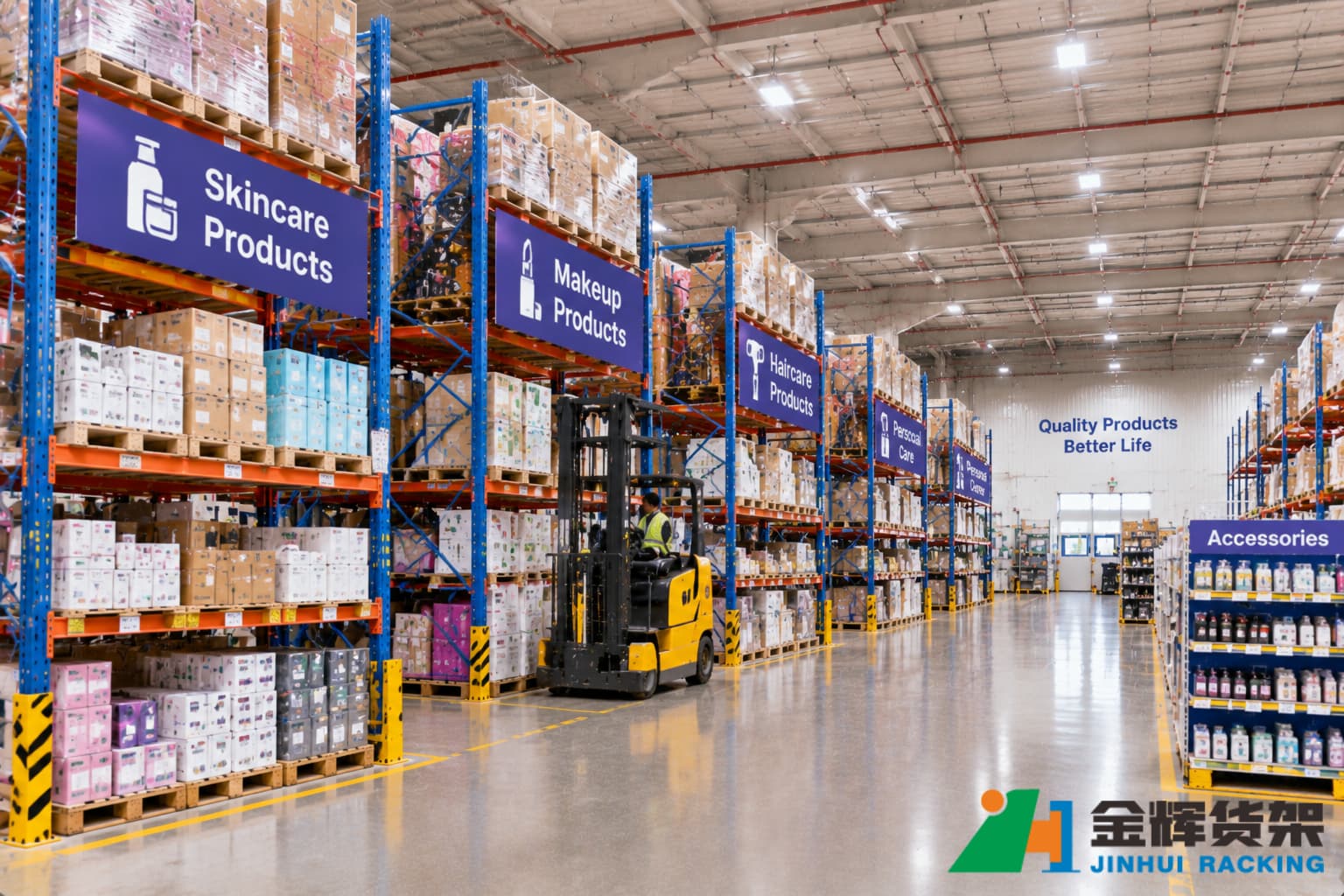
- Skincare products: Creams, lotions, serums, facial cleansers, masks, and skincare sets.
- Makeup products: Foundation, lipstick, mascara, eyeshadow palettes, powders, and cosmetic gift boxes.
- Haircare products: Shampoo, conditioner, hair treatments, styling products, and hair accessories.
- Body care products: Body wash, hand cream, deodorants, soaps, and body lotions.
- Beauty tools and accessories: Brushes, mirrors, applicators, grooming tools, and packaged accessories.
- Promotional and seasonal products: Gift sets, limited-edition collections, and bundled product packages.
These categories may require different storage arrangements. Large cartons of shampoo can be stored on pallet racking, while small makeup packages and individual beauty accessories may be better suited to shelving or dedicated picking locations.
High SKU Variety and Different Order Quantities
Many cosmetics distributors receive orders containing multiple product types in relatively small quantities. One order might include several skincare cartons, individual makeup products, and a few personal care accessories.
This creates a need to balance bulk storage with accessible picking locations. A warehouse designed only for pallet storage may make small-item picking inefficient, while relying entirely on shelving may not provide enough capacity for reserve inventory.
Packaging and Product Handling Considerations
Cosmetics products can be packed in glass bottles, plastic containers, tubes, jars, and decorative retail boxes. Some products are relatively lightweight but have fragile outer packaging. Others, such as large liquid containers, can create substantial loads when stored in bulk.
Warehouse operators should consider carton strength, pallet stability, package dimensions, product weight, and stacking limitations when assigning storage locations. Fragile items should be handled according to their packaging and handling instructions rather than treated as ordinary heavy cartons.
2. Choosing Suitable Warehouse Racking Systems
There is no single racking configuration that suits every cosmetics distribution center. A practical design often combines pallet racking and smaller-item storage to support different inventory and picking requirements.
Selective Pallet Racking for Bulk Inventory
Selective pallet racking is suitable for warehouses that need direct access to individual pallet locations. It can store reserve stock, full pallets of fast-moving products, and larger quantities of standardized cartons.
For cosmetics distributors, this system can support:
- Bulk storage of skincare and personal care cartons.
- Reserve inventory for popular makeup and haircare products.
- Separate pallet locations for different SKUs or batches.
- Replenishment stock for forward picking areas.
- Flexible access when product demand changes.
Each rack level and bay must be designed according to the actual pallet dimensions, unit loads, beam capacities, upright capacities, and operating conditions. Warehouse operators should also confirm that the pallet and load are suitable for the rack configuration.
Learn more about selective pallet racking systems for accessible pallet storage.
Shelving for Small Products and Carton Picking
Many cosmetics products are picked in quantities smaller than a full carton or pallet. Shelving can provide convenient access to individual cartons, small packages, and frequently ordered products.
It is particularly useful for:
- Small skincare and makeup packages.
- Beauty tools and personal care accessories.
- Individual cartons prepared for mixed-SKU orders.
- Frequently picked products near packing stations.
- Small promotional items and product bundles.
Shelving dimensions and load ratings should match the actual products stored. Operators should avoid overloading shelves or stacking packages beyond their packaging limitations.
Combining Pallet Racking and Shelving
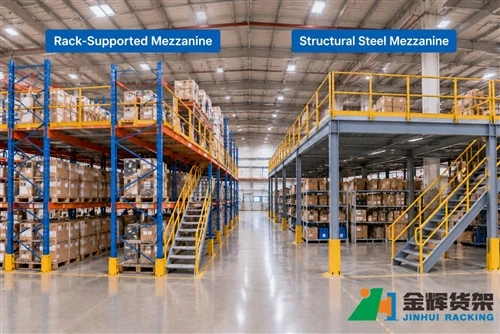
A combined storage arrangement can separate reserve inventory from active picking stock. Pallet racking stores larger quantities, while shelving provides accessible locations for smaller picking units.
For example, a warehouse may store full pallets of a particular skincare product in an upper or reserve area and replenish a nearby shelving section when stock levels fall. This arrangement reduces the need to retrieve a full pallet every time a small order is received.
The replenishment process should define when stock is moved, how quantities are recorded, and how the correct SKU and batch are verified.
3. Organizing Inventory into Practical Storage Zones
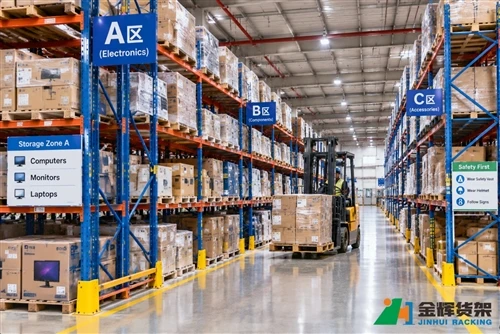
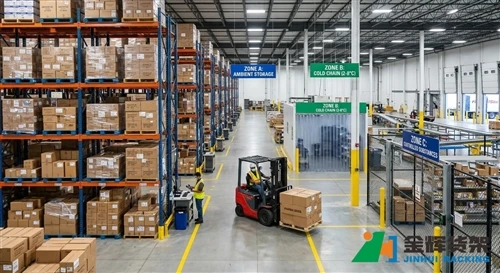
Clear storage zones help warehouse teams locate products, replenish stock, and prepare orders with fewer unnecessary movements. Cosmetics warehouses can organize their space according to product category, picking frequency, packaging characteristics, and order-processing requirements.
Bulk Storage Zone
The bulk storage zone holds reserve inventory, full pallets, and products that are not picked frequently in small quantities. Selective pallet racking can provide direct access to different SKUs and support replenishment activities.
Products should be assigned locations according to their dimensions, weight, pallet configuration, and turnover. Heavier loads should be placed at suitable lower levels when required by the rack design and operating procedures.
Fast-Moving Picking Zone
Popular products such as frequently ordered cleansers, shampoos, lotions, and makeup items may benefit from accessible picking locations. Positioning these products closer to order consolidation or packing areas can reduce travel distances.
However, product placement should be based on actual order history rather than assumptions. A product that sells well in one season may have a different demand pattern at other times of the year.
Small-Item Picking Zone
Small-item storage is important for makeup products, beauty accessories, and individual retail packages. Shelving, labeled bins, and compartmentalized storage can help separate similar-looking products and reduce picking errors.
Each location should have a clear identification method. When products have similar packaging or multiple color and size variations, barcode verification can provide an additional check during picking.
Receiving and Inspection Zone
Newly received goods should not be placed directly into storage without the required receiving checks. A designated receiving area gives employees space to verify product quantities, inspect packaging, identify damaged cartons, and confirm SKU information.
Products requiring further inspection or clarification should be kept separate from available inventory until their status has been confirmed.
Order Consolidation and Packing Zone
Orders containing multiple cosmetics and personal care SKUs may need to be consolidated before packing. A dedicated area can help employees verify quantities, group products by order, and prepare shipments.
This zone should have enough working space for the expected order volume without obstructing forklift aisles or access to storage locations.
4. Managing Fragile Packaging and Different Load Characteristics
Cosmetics warehouses may handle products with very different packaging requirements. A pallet of shampoo cartons does not necessarily need the same handling approach as a pallet containing glass skincare bottles or decorative gift boxes.
Protecting Glass Bottles and Delicate Packages
Glass bottles and fragile containers should be packed and palletized according to the manufacturer's handling requirements. Suitable cartons, internal dividers, protective materials, and stable pallet arrangements can reduce the risk of damage during storage and movement.
Warehouse teams should check that loads are stable before placing them on racks. Damaged pallets, leaning cartons, and visibly unstable loads should be addressed before storage.
Checking Carton and Pallet Loads
The weight of a complete pallet can be considerably different from the weight of an individual carton. Rack selection should therefore be based on the actual unit load, including the pallet and its contents.
Before installation, the warehouse operator should confirm:
- Maximum pallet load and overall load dimensions.
- Carton stacking limitations and pallet condition.
- Beam capacity and upright frame capacity.
- Load distribution across the supporting beams.
- Forklift compatibility and required operating clearances.
Racking components should be selected and configured according to an engineered design. Product packaging limitations and rack load limits must both be respected.
Separating Special-Handling Products
Some cosmetics and personal care products may have specific storage, handling, or regulatory requirements. For example, certain aerosol products, flammable formulations, or other regulated goods may require dedicated storage arrangements under applicable local rules.
These requirements should be assessed separately from ordinary rack selection. Standard pallet racking does not automatically provide fire protection, temperature control, ventilation, or hazardous-material compliance.
5. Improving Picking and Replenishment Efficiency
Efficient storage is not only about fitting more pallets into a warehouse. The layout must also support the movement of inventory from receiving to storage, replenishment, picking, packing, and dispatch.
Use Order Data to Assign Picking Locations
Review historical order lines and picking frequency to identify products that should be placed in more accessible locations. Frequently ordered items may be assigned to convenient picking areas, while slower-moving stock can remain in reserve storage.
Product popularity should be reviewed periodically because promotions, new product launches, and seasonal demand can change picking patterns.
Establish a Replenishment Process
When a picking location reaches its minimum stock level, reserve inventory should be replenished according to a defined procedure. This helps prevent picking interruptions and reduces the chance of inaccurate inventory records.
Replenishment rules should specify:
- Minimum and maximum stock quantities for picking locations.
- Which reserve locations supply each picking area.
- How replenishment tasks are prioritized.
- How SKU, batch, and quantity information is verified.
- How inventory movements are recorded in the WMS or stock system.
Keep Forklift and Pedestrian Routes Clear
Cosmetics distribution centers may use forklifts for pallet movement and manual picking equipment for smaller orders. Their routes should be planned to minimize unnecessary interaction and congestion.
Rack aisles, pedestrian paths, packing areas, and emergency access routes should be clearly identified. Aisle widths must be suitable for the actual handling equipment and operating conditions.
6. Inventory Identification and Warehouse Management
With many similar products and packaging variations, accurate identification is essential. A clear location system helps employees distinguish between different brands, product types, sizes, colors, and batches.
Standardize Rack Location Labels
Each rack location should have a unique address. A practical system may identify the aisle, rack bay, level, and position. The same location code should appear in the warehouse management system and on physical rack labels.
Product labels should remain visible and readable during normal operations. Where possible, barcode scanning can help employees verify the product and location during receiving, put-away, picking, and replenishment.
Track Batch and Expiration Information Where Required
Some cosmetics and personal care products have batch identification, shelf-life, or expiration-related requirements. Inventory procedures should capture the information required by the manufacturer, customer, and applicable regulations.
Where stock rotation is necessary, the warehouse can use an appropriate picking rule, such as first-expired, first-out (FEFO), based on recorded product dates. This is an inventory management procedure and should be supported by accurate labeling and system records.
Review Inventory Accuracy Regularly
Cycle counting can help identify discrepancies between recorded quantities and physical stock. High-value items, fast-moving products, and products with similar packaging may deserve more frequent verification.
When discrepancies occur, investigate receiving records, picking transactions, replenishment movements, returns, and location changes rather than simply adjusting the recorded quantity.
7. Common Warehouse Racking Mistakes to Avoid
Several avoidable planning and operating problems can reduce storage efficiency in cosmetics distribution centers.
- Using only pallet storage: Full-pallet locations may not provide convenient access to small quantities and individual cartons.
- Mixing similar products without clear identification: Similar packaging can increase the risk of picking the wrong size, shade, or product variant.
- Ignoring packaging limitations: Cartons and pallets should not be stacked beyond their safe handling and load limits.
- Placing fast-moving products in inconvenient locations: Poor slotting can increase picking travel and handling time.
- Failing to plan replenishment: Picking locations may run out of stock even when reserve inventory is available.
- Overlooking special storage requirements: Products subject to specific handling or regulatory rules need separate assessment.
- Expanding racks without checking capacity: Changes to rack height, beam levels, or load conditions should be reviewed by a qualified rack designer or engineer.
8. Planning a Cosmetics Warehouse Racking Project
Before selecting a racking system, warehouse operators should collect information about the facility, inventory, and daily operating process. A well-planned project begins with actual storage and handling requirements rather than choosing a rack type based only on its appearance or initial price.
Information to Prepare
- Warehouse length, width, clear height, and usable floor area.
- Column positions, doors, loading docks, and building obstructions.
- SKU quantities and product packaging dimensions.
- Maximum pallet weight and pallet sizes.
- Expected inventory volume and future growth.
- Order profiles and the proportion of full-pallet versus carton picking.
- Forklift types, turning requirements, and aisle clearances.
- Any special product handling or regulatory requirements.
With this information, the storage layout can be evaluated in relation to capacity, accessibility, picking efficiency, and safe operation. The final design should also account for floor conditions, rack anchoring requirements, local regulations, and the manufacturer's specifications.
Conclusion
Cosmetics and personal care distribution centers need storage arrangements that can handle a wide variety of SKUs, packaging types, and order quantities. Combining selective pallet racking with suitable shelving can help separate reserve inventory from active picking stock while maintaining access to different product categories.
Effective warehouse planning also depends on clear storage zones, reliable product identification, appropriate load management, and well-defined replenishment procedures. By considering inventory characteristics and daily workflows together, distributors can build a storage system that supports efficient operations as their product ranges and order volumes change.
JINHUI RACK can help evaluate warehouse storage requirements and develop racking solutions based on facility dimensions, pallet specifications, inventory characteristics, and handling equipment.
Contact JINHUI RACK
Planning a new cosmetics distribution center or improving your existing warehouse storage? Contact JINHUI RACK to discuss your inventory profile, warehouse layout, and racking requirements.
Email: info@jhrack.com
WhatsApp: +86 185 0252 7163
Contact Us: https://www.jinhui-rack.com/contact-us