Planning Efficient Storage for Musical Instruments and Music Equipment
Musical instrument distribution centers handle products with very different shapes, sizes, weights, and handling requirements. A warehouse may store guitars, violins, keyboards, drum sets, amplifiers, speakers, microphones, instrument cases, and thousands of smaller accessories in the same facility.
Unlike warehouses that mainly handle uniform cartons or standard palletized goods, music equipment warehouses must accommodate both delicate products and bulky packages. Some instruments are supplied in individual protective cases, while others arrive in cartons, bundles, or multi-piece sets. Small accessories may also require frequent individual-item picking.
A suitable warehouse storage arrangement helps distributors organize these product categories, protect packaged inventory during handling, and improve access to different SKUs. The right solution depends on product dimensions, packaging, load weight, inventory quantities, picking methods, and warehouse equipment.

1. Understand the Storage Challenges of Musical Instruments
Musical instruments are not a uniform product category. Their storage requirements vary according to instrument type, packaging design, product value, and handling frequency.
Common warehouse inventory may include:
- String instruments: Guitars, violins, cellos, ukuleles, and related products.
- Keyboard instruments: Electronic keyboards, digital pianos, and packaged piano accessories.
- Percussion instruments: Drums, cymbals, percussion sets, and related equipment.
- Audio equipment: Amplifiers, speakers, mixers, microphones, and recording accessories.
- Instrument cases: Protective cases, gig bags, and hard-shell storage products.
- Small accessories: Strings, picks, cables, tuners, stands, pedals, and replacement parts.
These products create several practical storage challenges:
- Irregular dimensions: Long guitar cartons, compact accessory boxes, and large keyboard packages require different storage positions.
- Fragile packaging: Some instruments need stable support and careful handling to reduce the risk of impact or compression damage.
- Mixed inventory formats: Products may arrive individually packaged, in cartons, or on pallets.
- High SKU variety: Similar-looking instruments may have different models, finishes, specifications, and accessories.
- Different order quantities: Some orders involve individual instruments, while others require complete cartons or bulk quantities.
- Special storage considerations: Certain instruments may have manufacturer-specified temperature or humidity requirements.
A warehouse layout should therefore be designed around the actual products and operating processes rather than assuming that every item can be stored in the same type of rack.
2. Divide the Warehouse into Practical Storage Zones
Separating inventory into functional zones helps employees locate products and manage different handling activities. The exact arrangement depends on warehouse size, inventory volume, and order fulfillment methods.
| Storage Zone | Typical Products | Storage Considerations |
|---|---|---|
| Receiving and inspection | Incoming cartons, pallets, and instrument cases | Provide temporary staging space for checking quantities and packaging condition. |
| String instrument storage | Guitars, violins, ukuleles, and related products | Use suitable shelves or pallet positions according to package dimensions and support requirements. |
| Keyboard and piano equipment | Digital keyboards, electronic pianos, and accessories | Provide appropriate support for larger and heavier packages. |
| Drum and percussion storage | Drum sets, cymbals, and percussion accessories | Organize products by package size and set configuration. |
| Audio equipment storage | Amplifiers, speakers, mixers, and microphones | Use suitable pallet racking or shelving according to load dimensions and weight. |
| Small accessory storage | Strings, picks, cables, tuners, and pedals | Use shelving, bins, and clearly labeled picking locations. |
| Order picking and packing | Individual instruments and mixed orders | Provide accessible picking positions and adequate packing space. |
| Returns and inspection | Returned, damaged, or unverified products | Keep products awaiting inspection separate from available inventory. |
Not every warehouse needs all these zones as separate physical areas. Smaller facilities can combine suitable categories while maintaining clear inventory identification and safe movement routes.
3. Select Suitable Racking Systems for Different Instruments
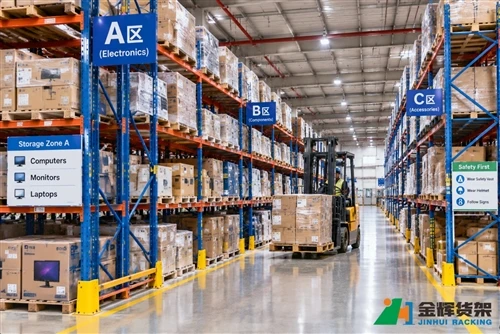
A musical instrument warehouse often benefits from combining pallet racking and shelving. Different storage systems can support different product formats and picking requirements.
Selective Pallet Racking for Cartonized Instruments
Selective pallet racking provides direct access to individual pallet positions. It is useful for distributors handling many instrument models and requiring flexible access to different SKUs.
Typical applications include:
- Palletized cartons of guitars and keyboards.
- Boxed amplifiers and audio equipment.
- Bulk cartons of instrument accessories.
- Packaged drum sets and percussion products.
- Reserve inventory awaiting replenishment or customer orders.
Beam levels can be arranged according to pallet dimensions, load weight, and available warehouse height, subject to the approved rack design. Each pallet position can be assigned to a specific product or SKU group to simplify stock identification.
For warehouses with a wide variety of instrument models, selective pallet racking provides convenient access without requiring employees to move other pallets before retrieving the required product.
Shelving for Small Musical Instrument Accessories
Many musical instrument accessories are sold individually or in small quantities. Products such as guitar picks, strings, tuners, cables, adapters, pedals, and replacement parts are often easier to manage using shelving systems.
Shelving can accommodate cartons, bins, and compartmentalized containers, making it suitable for individual-item picking.
When planning accessory storage, consider:
- Product and container dimensions.
- Maximum load per shelf level.
- Picking frequency and employee access.
- SKU identification and location labels.
- Space for replenishment and stock counting.
Frequently ordered accessories can be placed in convenient picking locations. Smaller items should be separated by product code or model to reduce picking mistakes.
Cantilever Racking for Suitable Long Packages
Some instrument-related products and equipment packages have elongated dimensions. Depending on their length, weight, packaging, and support requirements, cantilever racking may be considered for suitable long loads.
Cantilever systems use vertical columns and projecting arms to support products without conventional front upright obstructions at each storage level.
Before choosing this system, evaluate:
- Package length and cross-sectional dimensions.
- Individual product and bundled load weights.
- Required support points and load distribution.
- Loading and unloading equipment.
- Arm capacity, column capacity, and overall structural design.
Cantilever racking is not automatically suitable for every guitar carton or instrument case. Long products should only be stored using a configuration that provides adequate support and complies with the rack's approved loading design.
4. Organize Fragile Instruments and Protective Cases
Many musical instruments require careful handling because impacts, vibration, compression, and unsuitable support can damage the product or its packaging.
Although warehouse racking provides storage support, product protection also depends on packaging quality, pallet condition, load stability, and handling procedures.
Consider the following measures:
- Use suitable cartons, protective cases, and packaging materials for each product type.
- Check that pallets provide stable support for the complete packaged load.
- Avoid placing heavy products on top of packages that are not designed to support additional loads.
- Keep cartons within the intended storage footprint and prevent them from protruding into aisles.
- Use suitable handling equipment when moving large or heavy packages.
- Inspect packaging and pallets during receiving and before storage.
For instruments with specific environmental requirements, follow the manufacturer's storage instructions. Temperature and humidity conditions can be important for certain wooden instruments and other sensitive products.
Ordinary warehouse pallet racking does not provide temperature or humidity control. If a product requires a controlled environment, the warehouse must provide suitable environmental management separately.
5. Manage Mixed SKUs and Multi-Piece Instrument Sets
Musical instrument distributors may store products that contain several components or accessories. A drum set, for example, may include multiple drums, stands, pedals, and other components. A keyboard package may include a power supply, stand, or additional accessories.
These products create inventory management challenges when components are stored separately or arrive in multiple cartons.
Useful warehouse practices include:
- Assign clear SKU or product-set identification to related components.
- Use location labels to distinguish different models and package configurations.
- Record the storage location of components that are kept separately.
- Use picking verification procedures before releasing complete sets.
- Keep similar-looking products separated by model, size, or specification.
- Record inventory movements when products are relocated or returned.
Where a product is supplied as a complete set, the warehouse management process should make it clear whether all required components are available before an order is packed.
6. Plan Storage for Audio Equipment and Heavy Packages
Audio equipment can vary significantly in weight and dimensions. Small microphones and compact mixers may fit on shelving, while large speakers, amplifiers, and packaged sound systems may require pallet storage.
When planning storage for these products, consider:
- Package dimensions: Measure the complete package rather than relying only on the product dimensions.
- Load weight: Confirm the maximum pallet or storage-unit weight.
- Load stability: Check that the packaging and pallet provide stable support.
- Handling equipment: Confirm that forklifts or other equipment can safely transport the loads.
- Storage height: Consider package height, clearance, and available building height.
- Picking method: Determine whether products are retrieved individually, by carton, or as complete pallets.
Rack beams and frames must be selected according to the actual load requirements. Large or heavy audio equipment should not be stored on a rack position without checking the pallet base, support arrangement, and rated capacity.
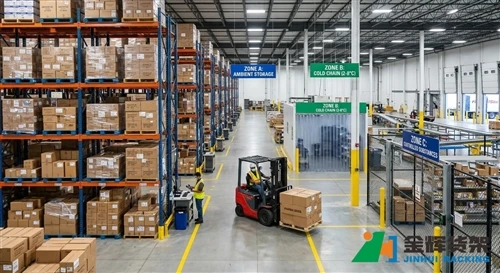
7. Design Forklift Aisles and Material Flow
A well-planned warehouse layout should support the movement of products from receiving to storage, picking, packing, and dispatch. Poorly designed aisles can create congestion and increase unnecessary handling.
Important layout considerations include:
- Forklift specifications: Consider turning radius, lifting height, load dimensions, and operating requirements.
- Aisle width: Determine suitable working aisle dimensions based on the selected handling equipment and pallet configuration.
- Pedestrian routes: Establish appropriate routes and separation measures where employees and forklifts operate in the same area.
- Receiving space: Provide sufficient room for unloading and inspecting incoming instruments.
- Picking and packing areas: Keep order preparation activities from interfering with forklift travel.
- Dispatch flow: Organize completed orders so they can be checked and loaded without blocking storage access.
- Emergency access: Keep exits, fire protection equipment, and required access routes unobstructed.
For warehouses that combine pallet racking and shelving, it is important to coordinate the different aisle types and ensure that employees can move between storage, picking, and packing areas safely.
8. Improve Inventory Accuracy with Clear Location Labels
Musical instrument warehouses may contain similar products with different models, finishes, sizes, and specifications. A consistent location coding system helps employees find the correct product and reduces picking errors.
A location code can identify the aisle, rack section, level, and position. For example, A02-R04-L03-P02 may represent aisle 2, rack section 4, level 3, and position 2.
Effective location management practices include:
- Use consistent location codes across pallet racking and shelving areas.
- Place labels where employees can read them from normal working positions.
- Maintain accurate SKU and product descriptions.
- Record inventory movements when products are received, relocated, picked, or returned.
- Use barcode scanning or other verification procedures where available.
- Review stock accuracy regularly, especially after warehouse layout changes.
For products supplied as multi-piece sets, inventory records should also identify whether all required components are available for order fulfillment.
9. What to Evaluate Before Choosing a Musical Instrument Warehouse Racking System
Before selecting a storage configuration, distributors should collect accurate information about their products, building, and operating processes.
A project assessment should include:
- Product categories: Identify the types of instruments, audio equipment, cases, and accessories to be stored.
- Product dimensions: Record carton dimensions, pallet dimensions, package lengths, and other relevant measurements.
- Load weights: Confirm individual pallet weights and the maximum loads expected in each storage area.
- Inventory quantities: Estimate the number of SKUs, average stock levels, and peak inventory.
- Order profiles: Understand whether orders involve individual products, cartons, mixed orders, or complete pallets.
- Building conditions: Measure warehouse length, width, clear height, columns, doors, and floor conditions.
- Handling equipment: Identify forklift types, lifting heights, and operating aisle requirements.
- Environmental requirements: Identify any product-specific temperature or humidity requirements.
- Future development: Consider new product categories, inventory growth, and changes in order volume.
Comparing storage capacity, product accessibility, picking efficiency, replenishment workload, and safe operating space provides a more useful basis for selecting a system than comparing pallet positions alone.
Frequently Asked Questions
What type of racking is suitable for a musical instrument warehouse?
The most suitable system depends on product dimensions, load weights, pallet quantities, and picking requirements. Selective pallet racking can support palletized instruments and audio equipment, while shelving is useful for small accessories. Cantilever racking may be considered for suitable long products.
How should guitars and other string instruments be stored in a warehouse?
Guitars and other string instruments should be stored in suitable protective packaging or cases, with stable support and appropriate handling procedures. The storage arrangement should be selected according to the packaged dimensions and the manufacturer's environmental recommendations.
Can musical instruments be stored on standard pallet racking?
Many cartonized instruments can be stored on pallet racking when the pallet, load, and rack configuration are compatible. The rack must be designed for the actual load dimensions and weights, and the packages must be stable and properly supported.
How should small musical instrument accessories be organized?
Small accessories can be stored in shelving, bins, or compartmentalized containers. Clear SKU labels and consistent location codes help employees identify different models and prepare orders accurately.
Does warehouse racking protect wooden instruments from humidity changes?
No. Standard warehouse racking provides structural storage support but does not regulate humidity or temperature. Instruments with special environmental requirements need suitable warehouse environmental controls based on manufacturer recommendations.
Can pallet racking and shelving be used in the same warehouse?
Yes. Pallet racking can store bulk cartons and reserve inventory, while shelving can support small-item storage and individual order picking. The layout should provide clear movement routes between the different storage and operating areas.
Conclusion
Musical instrument distribution centers need storage arrangements that accommodate fragile products, bulky packages, small accessories, and different inventory formats. A single storage method may not be suitable for every product category.
By combining selective pallet racking, shelving, and suitable cantilever storage where required, distributors can organize different product groups and improve access to inventory. Clear location labels, careful handling procedures, and well-planned forklift aisles further support efficient warehouse operations.
The final storage configuration should always be based on actual product dimensions, load weights, pallet specifications, building conditions, handling equipment, and operating requirements.
Contact JINHUI RACK
Planning a new musical instrument distribution center or upgrading your existing warehouse storage system? JINHUI RACK can help evaluate your storage requirements and discuss suitable racking configurations for your facility.
To support an initial project assessment, you can prepare the following information:
- Warehouse dimensions and available storage height.
- Instrument, carton, and pallet dimensions.
- Maximum pallet or unit load weight.
- Estimated SKU count and required storage capacity.
- Forklift type and operating aisle requirements.
- Warehouse layout drawings, if available.
Email: info@jhrack.com
WhatsApp: +86 185 0252 7163
Visit our website: JINHUI RACK
Explore our Selective Pallet Racking Systems and Cantilever Racking for different warehouse storage applications.
Contact our team to discuss a racking solution based on your actual warehouse requirements.