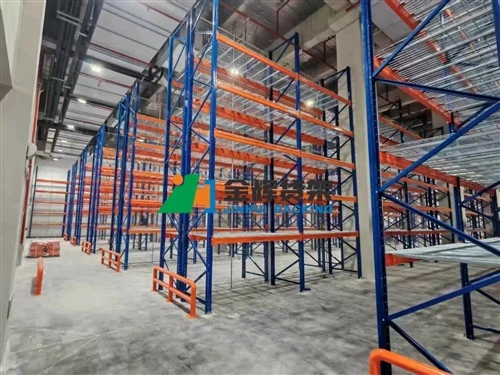
Why Proper Installation Matters
Heavy duty selective pallet racking is designed to provide decades of reliable warehouse storage, but its long-term performance depends just as much on correct installation as on engineering and manufacturing quality. Even premium rack components can experience structural problems if they are assembled incorrectly, installed on unsuitable floors, or anchored improperly.
A professionally installed pallet racking system improves warehouse safety, maximizes storage capacity, extends equipment life, and reduces maintenance costs. Proper installation also ensures compliance with local warehouse safety regulations and engineering standards.
This guide explains the complete installation process for heavy duty pallet racking, from warehouse planning and floor preparation to final safety inspections.

Planning Before Installation
Successful pallet rack installation begins long before the first upright frame is assembled. Proper planning minimizes installation time, reduces project costs, and helps avoid expensive modifications later.
Warehouse planners should evaluate:
- Warehouse dimensions
- Building column locations
- Fire protection systems
- Forklift operating aisles
- Receiving and shipping areas
- Future warehouse expansion
- Inventory turnover requirements
- Required storage capacity
Creating an optimized warehouse layout before installation ensures efficient material flow while making the best use of available floor space.
Our Heavy Duty Selective Pallet Racking System is customized according to each customer's warehouse dimensions, pallet sizes, forklift specifications, and inventory requirements, ensuring every installation delivers maximum storage efficiency.
Checking Warehouse Floor Conditions
The warehouse floor forms the foundation of the entire pallet racking system. Even the strongest rack cannot perform safely if it is installed on an unsuitable concrete slab.
Before installation, engineers should inspect:
- Concrete thickness
- Floor flatness
- Surface levelness
- Concrete strength
- Existing cracks
- Floor settlement
- Drainage conditions
Uneven floors may require leveling plates or shims to ensure upright frames remain perfectly vertical after installation.
Organizing Rack Components Before Assembly
Large warehouse projects often involve thousands of individual rack components. Organizing materials before installation significantly improves efficiency and reduces assembly errors.
Components should be sorted according to:
- Upright frames
- Load beams
- Bracing members
- Anchor bolts
- Base plates
- Safety locks
- Rack protection accessories
- Installation hardware
Proper staging also minimizes unnecessary forklift movement during installation.
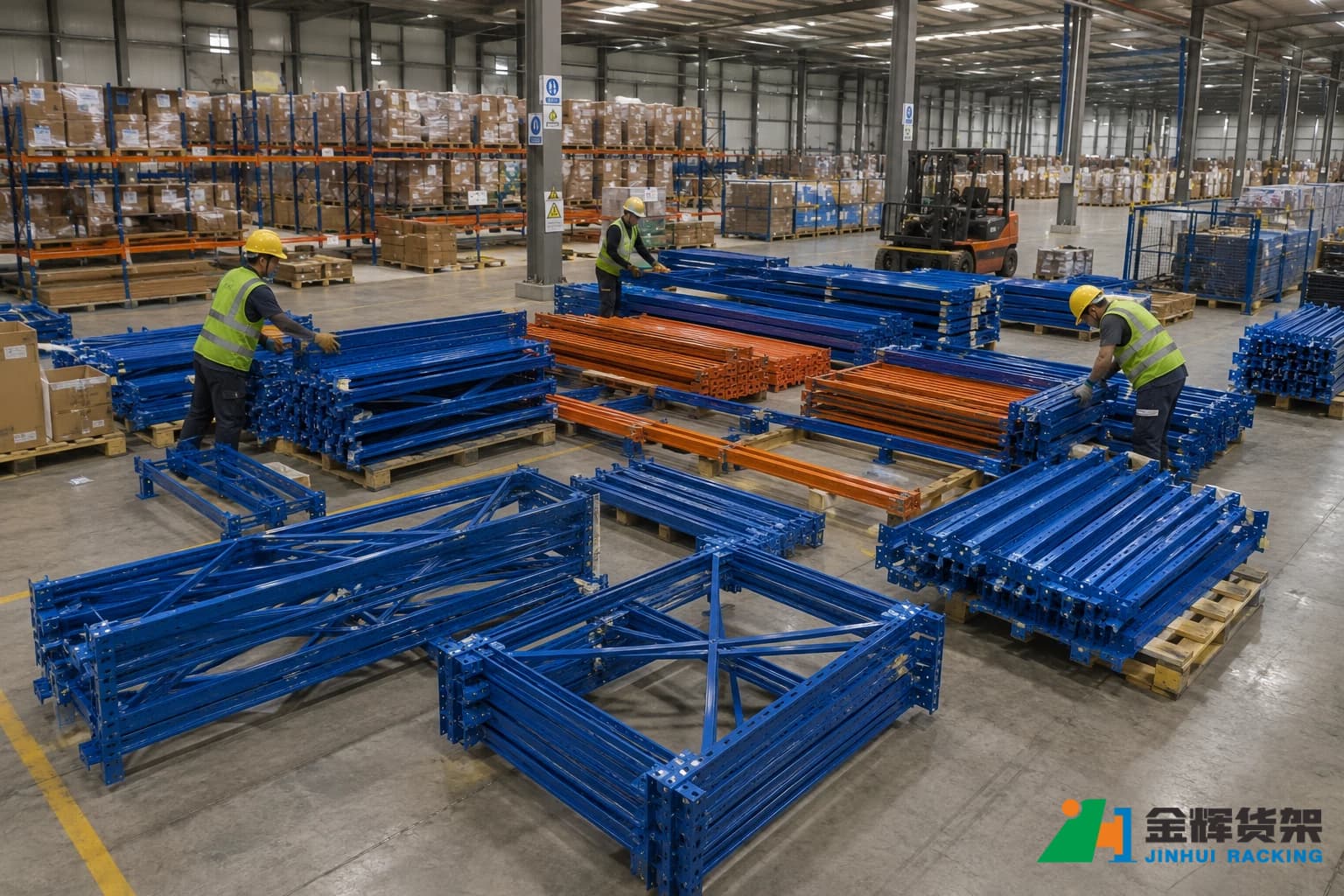
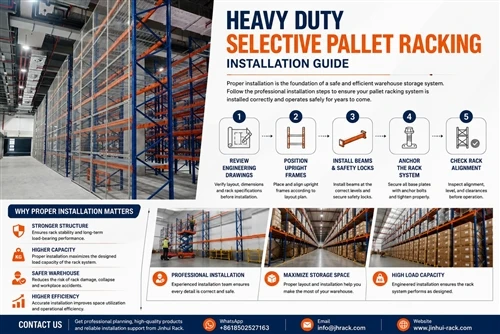
Step 1: Positioning Upright Frames
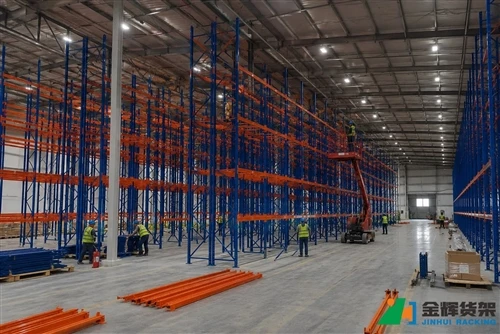
Installation begins by positioning upright frames according to the approved warehouse layout drawing. Each frame must be accurately aligned to ensure correct bay spacing and aisle dimensions.
During positioning, installers should verify:
- Bay width
- Aisle width
- Frame orientation
- Building column clearance
- Emergency exit access
- Forklift turning radius
Correct positioning during this stage prevents alignment problems later in the installation process.
Step 2: Installing Load Beams
After upright frames are temporarily positioned, horizontal load beams are connected to create stable rack bays.
Installation technicians should ensure:
- Correct beam elevation
- Fully engaged beam connectors
- Safety locking pins installed
- Uniform beam spacing
- No visible beam deformation
Each completed bay becomes progressively more stable as additional beam levels are installed.
Step 3: Checking Vertical Alignment
Before permanently anchoring the racking system, installers must verify that every upright frame remains perfectly plumb.
Typical alignment checks include:
- Vertical plumbness
- Frame spacing
- Diagonal measurements
- Beam levelness
- Overall bay alignment
Minor adjustments at this stage help prevent installation errors that could affect the structural performance of the completed warehouse storage system.
Typical Heavy Duty Pallet Rack Installation Sequence
| Installation Stage | Primary Task | Key Inspection Point |
|---|---|---|
| Planning | Warehouse layout confirmation | Storage efficiency & aisle design |
| Floor Inspection | Concrete evaluation | Strength & levelness |
| Frame Positioning | Locate upright frames | Correct bay spacing |
| Beam Installation | Install load beams | Beam locks fully engaged |
| Alignment | Verify plumbness | Frame verticality |
Step 4: Anchoring the Rack to the Warehouse Floor
Once the rack frames have been assembled and aligned, the next critical step is securing the system to the warehouse floor. Proper anchoring prevents movement caused by forklift operations, uneven loading, or accidental impacts. It also ensures the racking system performs according to its engineered load capacity.
Anchor installation should always follow the manufacturer's engineering drawings and applicable local safety standards.
Installation technicians should verify:
- Correct anchor bolt type and size.
- Proper anchor hole depth.
- Specified tightening torque.
- Base plate fully contacting the concrete floor.
- No concrete cracking around anchor locations.
- Correct installation of shims where necessary.
Anchors should never be omitted or substituted without engineering approval.
Installing Rack Protection Accessories
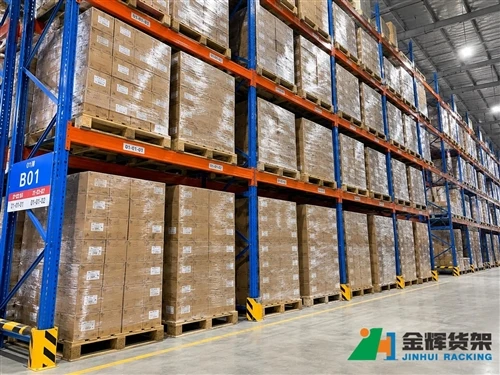
After the main rack structure has been secured, protective accessories should be installed to reduce the likelihood of future damage. These accessories absorb forklift impacts before structural components are affected, helping extend the service life of the storage system.
Common protective equipment includes:
- Upright column protectors.
- End-of-row barriers.
- Guide rails.
- Rack guards.
- Safety bollards.
- Wire mesh backing.
- Pallet support bars.
- Safety signage and rack identification labels.
Although these accessories represent a relatively small portion of the total project cost, they can significantly reduce long-term maintenance expenses.
Final Safety Inspection Before Operation
Before pallets are loaded onto the racking system, a comprehensive final inspection should be completed. This inspection confirms that installation has been performed according to engineering specifications and that all structural components are functioning correctly.
The final inspection should include:
- Verification of upright plumbness.
- Beam level inspection.
- Confirmation that safety locks are installed.
- Anchor bolt inspection.
- Rack spacing verification.
- Load capacity label installation.
- Inspection of protective accessories.
- Removal of installation debris.
Only after passing the final inspection should warehouse personnel begin loading inventory.
Common Installation Mistakes to Avoid
Many rack failures originate from installation errors rather than manufacturing defects. Avoiding these common mistakes helps ensure long-term structural safety.
- Installing racks on uneven floors without leveling.
- Incorrect beam elevations.
- Missing beam safety locks.
- Insufficient anchor bolts.
- Poor aisle spacing.
- Ignoring building column clearance.
- Mixing incompatible rack components.
- Loading pallets before installation is completed.
Every installation should be completed by trained personnel following the manufacturer's installation manual.
Best Practices for Heavy Duty Pallet Rack Installation
Professional installation combines engineering precision with practical warehouse experience. Following industry best practices improves project quality while minimizing future maintenance requirements.
- Prepare a detailed warehouse layout before installation.
- Inspect the concrete floor thoroughly.
- Use only original manufacturer components.
- Install rack protection during the initial project.
- Check alignment after every installation stage.
- Anchor every upright according to engineering specifications.
- Clearly display rack load capacity labels.
- Complete a documented final inspection before operation.
These practices help maximize warehouse safety while ensuring the storage system delivers its full designed performance.
Heavy Duty Pallet Rack Installation Checklist
| Inspection Item | Status Before Operation | Purpose |
|---|---|---|
| Concrete Floor Inspection | Completed | Ensure stable foundation. |
| Rack Alignment | Verified | Maintain structural accuracy. |
| Anchor Installation | Verified | Prevent rack movement. |
| Safety Locks Installed | Confirmed | Secure beam connections. |
| Load Capacity Labels | Installed | Guide safe warehouse operation. |
Frequently Asked Questions
Can heavy duty pallet racking be installed on any warehouse floor?
No. The concrete floor must meet the required strength, thickness, and levelness specifications. Weak or uneven floors may require repairs or engineering modifications before installation.
Should pallet racks always be anchored?
Yes. Heavy duty selective pallet racking should generally be anchored according to the manufacturer's engineering design to ensure maximum stability and safety.
How long does pallet rack installation take?
The installation time depends on warehouse size, rack configuration, and project complexity. Small projects may take only a few days, while large distribution centers can require several weeks.
Can existing pallet racking be relocated?
Yes, but the system should be completely disassembled, inspected, and reinstalled following the same engineering and safety procedures as a new installation.
Who should perform rack installation?
Installation should always be carried out by experienced technicians familiar with warehouse racking systems and the manufacturer's installation requirements.
Conclusion
Correct installation is the foundation of a safe and efficient warehouse storage system. Careful planning, accurate assembly, proper anchoring, and thorough final inspections ensure that heavy duty selective pallet racking performs according to its engineered design throughout its service life.
By following professional installation procedures and industry best practices, warehouse operators can maximize storage capacity, improve workplace safety, reduce maintenance costs, and protect their long-term investment.
Install Your Heavy Duty Pallet Racking with Confidence
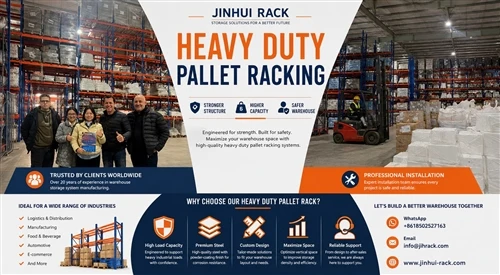
Jinhui Rack has more than 20 years of experience designing, manufacturing, and supporting heavy duty warehouse storage systems worldwide. We provide complete project support-from warehouse layout design and engineering calculations to installation guidance and after-sales technical service.
Explore our Heavy Duty Selective Pallet Racking System to discover customized storage solutions engineered for maximum safety, efficiency, and long-term performance.
WhatsApp
+8618502527163
Email
info@jhrack.com