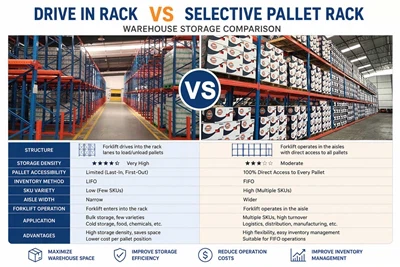
High-density warehouse storage systems are designed to maximize pallet storage capacity while reducing aisle space. Among the most popular solutions, drive-in racks and push back racks are widely used in logistics centers, cold storage warehouses, food manufacturing plants, and industrial facilities.
Although both systems improve warehouse space utilization, they differ significantly in inventory rotation, forklift operation, storage accessibility, and operational efficiency.
This guide compares drive-in racking and push back racking to help you choose the right solution for your warehouse.
What Is a Drive-In Rack?
Drive-in racking is a high-density pallet storage system where forklifts drive directly into storage lanes to load and retrieve pallets.
The system uses rails installed on both sides of the lane to support pallets.
Learn more about Drive-In Rack Systems
Advantages of Drive-In Racking
- Very high storage density
- Reduced aisle requirements
- Ideal for bulk pallet storage
- Cost-effective for large warehouses
- Suitable for cold storage applications
Limitations of Drive-In Racking
- LIFO inventory system
- Lower selectivity
- Higher forklift operating difficulty
- Potential rack damage from forklift contact

What Is a Push Back Rack?
Push back racking is a dynamic storage system that stores pallets on inclined rails using nested carts or rollers.
When a new pallet is loaded, it pushes the previous pallet backward. When unloading, pallets automatically slide forward by gravity.
Explore Push Back Rack Systems
Advantages of Push Back Racking
- Higher selectivity than drive-in racks
- Faster pallet handling
- Reduced forklift travel distance
- Improved warehouse efficiency
- Less risk of rack damage
Limitations of Push Back Racking
- Higher system cost
- Slightly lower storage density
- Requires more engineering precision

Drive-In Rack vs Push Back Rack: Key Differences
| Feature | Drive-In Rack | Push Back Rack |
|---|---|---|
| Storage Density | Very High | High |
| Inventory Method | LIFO | LIFO |
| Forklift Entry | Forklift enters lanes | No lane entry required |
| Pallet Accessibility | Lower | Higher |
| Rack Damage Risk | Higher | Lower |
| Storage Cost | Lower | Higher |
| Warehouse Efficiency | Moderate | High |
Which System Is Better for Cold Storage?
Drive-in racking is commonly used in cold storage warehouses because it maximizes storage density and reduces refrigerated space costs.
However, push back racking may provide better operational efficiency for warehouses with higher pallet turnover.
Which Industries Commonly Use These Systems?
Drive-In Rack Applications
- Cold storage warehouses
- Food & beverage industry
- Bulk inventory storage
- Manufacturing warehouses
Push Back Rack Applications
- Logistics centers
- E-commerce warehouses
- Industrial distribution centers
- Fast-moving inventory storage
How to Choose the Right High-Density Storage System
Choosing between drive-in racks and push back racks depends on:
- Inventory turnover rate
- Warehouse size
- Pallet quantity
- Forklift operation requirements
- Budget considerations
- Storage density goals
Warehouses prioritizing maximum storage density often choose drive-in systems, while operations requiring faster pallet handling and higher efficiency may prefer push back systems.
Conclusion
Both drive-in racks and push back racks are excellent high-density warehouse storage solutions. The right choice depends on your inventory flow, operational efficiency requirements, and warehouse layout.
Understanding the differences between these systems can help businesses maximize warehouse space utilization and improve storage efficiency.
Need a Customized High-Density Storage Solution?
JINHUI provides customized warehouse racking systems for industrial warehouses, logistics centers, and cold storage facilities worldwide.
WhatsApp: +86 18502527163
E-mail: info@jhrack.com